
Translated material
We’ll take hands, friends ...
In the opposition
 We’ll take hands, friends ...
April 6, 2010 Harry Kasparov
The attacks in the Moscow metro on March 29 reminded many othersEvents - explosions of houses in the fall of 1999 in Moscow, with which, in fact, the Putin era began. The impunity of that cruelty provoked the waves of the new. The coming to the power of the security forces of Putin, even in terms of security, not to mention other aspects of life in the country, did not change the situation for the better. Such a bitter result is more than a significant basis for its resignation. In this light, the initiative of the opposition with the collection of signatures under the letter "Putin must leave!" It looks more than convincing. So believes the head of the United Civil Front, member of the Political Council "Solidarity"
Harry Kasparov .
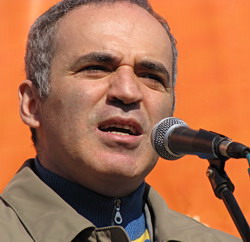 - Harry Kimovich, individual pro -government figures accuse the opposition of what happened, they say, it is by her criticism of the Ministry of Internal Affairs that swinging the political situation. What can you say about this?
- This is a severe form of paranoia. PR on the blood. Calculating distortion of facts. Obviously, the responsibility for terrorist attacks is completely on power. The main version of involvement in the explosions of Caucasian suicide bombers directly indicates that war in the North Caucasus led to the tragedy, as well as the inability of the authorities to organize peaceful life in this region. Such a metaphor is still appropriate here: when the hands of the authorities are busy stolen, it is no longer ahead of the criminals. All the power of the law enforcement system, in addition to roofing various businesses, is aimed at counteracting the peaceful, non -violent shares of protest of citizens to the detriment of their direct duties. The recently created center "E" instead of countering terrorists is engaged in hunting for political activists. Thus, all the conditions for the expanse of terrorists have been created. For example, the head of the Moscow police, Vladimir Kolokoltsev, on the eve of the attacks, was primarily preoccupied with toughening the punishment for participating in peaceful protests, such as the exit of every 31st on the triumphal square in defense of the Constitution. The chief policeman is not up to terrorists, when you have to think only about suppressing the peaceful, non -violent protest of the non -systemic opposition.
However, the Duma opposition, which has become part of the political system, which is built on the principle of irremovability of power, should still take on a share of responsibility for the revelry of terror in the country. In particular, the Communist Party, which is mainly engaged in the fight against dissent and cleaning its own ranks, has long degenerated as an opposition. A huge number of people who signed a letter against Putin indicate that in the context of turning elections to a farce, this is the only way to express their desire for change. At the same time, the Communist Party, breaking the united front of the opposition, helps the authorities to restrain the wave of protest.
- Do you mean the ban for members of the Communist Party of the Communist Party to participate in joint actions with "solidarity"?
- The Communist Party refuses to enter joint stocks with other political organizations. At the time when the protest against the authoritarian regime is growing, there is a transformation of socio-economic slogans into political. And in this case, ideological differences fade into the background. Those who are ready to go to protest promotions to defend their own rights no longer pay attention to political flags, be it the Communist Party or "solidarity". This is a normal situation. However, the Communist Party for conjunctural reasons, in order to gain more votes in the elections, makes attempts to privatize this protest. Today, the Communist Party is the most organized opposition political force in the country (although its influence is an order of magnitude less than what Zyuganov is talking about), but, having received a mandate for legal activity, it always balances on the verge of participation in the protest and maintaining good relations with the Kremlin. The authorities are profitable to preserve the ideological falsehoods that denote the unchanging values of Russian political life: supposedly liberal Chubais, supposedly communist Zyuganov, supposedly nationalist Zhirinovsky. It is thanks to such an illusion, successfully created and supported by the authorities, that people have a permissible idea of the essence of ideological differences.
- Do you raise the question of liability for the situation in the country of the entire Communist Party or only its leadership?
- The Communist Party has long turned into the private property of Gennady Zyuganov. The party, from which people of really left -wing views are expelled, acquired a clearly nationalist bias. This is the result of the activity of a particular person who uses a promoted brand for his own purposes. Zyuganov is a master of backstage agreements. For him, contact with a radical opposition is always a matter of personal benefit. For example, in connection with Zyuganov’s pathetic statements in Gazeta.Ru that he does not want to have any business with “solidarity”, they make appropriately the memory of what happened in the relationship of the Communist Party and the non -systemic opposition in 2006 and early 2007.
I will briefly remind you of the then political landscape. Putin, facing the choice - either the third term and a direct violation of the constitution, or the transfer of power to the appointed successor, apparently, hesitated. After the conference "Other Russia", there was a feeling that the opposition would be able to unite in the presidential election in 2008. It was decided to create a united front and nominate a single candidate. In my opinion, any candidate that included the signature collection procedure was doomed in advance. This was one of my key disagreements with Mikhail Kasyanov. It was necessary to look for such a candidate that could be supported by the Communist Party, because her candidate was exempted from collecting signatures. An alliance with the Communist Party, if he did not give the opposition a real chance of victory, then at least quit a serious challenge to the authorities. Therefore, I made every effort to establish contacts with the Communist Party. Through the mediation of the deputy of the State Duma, Boris Kashin, who was at round tables and conferences "another Russia", as well as Ivan Melnikov, with whom communication began in December 2005 in connection with the potential nomination of Elena Lukyanova to State Duma deputies in the single -member district in Moscow, my meeting was held with Gennady Zyuganov. Our conversation after the exchange of numerous courtesies was long and substantial. We discussed the situation and found out that on many issues you can agree. The question arose about the candidacy in the presidential election. Zyuganov immediately stated that Kasyanov was unacceptable for them, and then I asked him: "Who do you offer?" Apparently, he did not expect that I would give him the initiative, but, having thought a little, answered: "Primakov." He had to object, they say, this is not serious, because, without a doubt, Primakov is part of power, and he will not challenge Putin. I suggested that Zyuganov call any other candidate, he once again thought and said: "Gerashchenko." I had no objections, after the story with Yukos Gerashchenko, obviously, was ready to go into battle. I took over the function of contacts with him and the formation of the position of the United Civil Front and the Coalition "Another Russia" in support of his candidacy. In the next few weeks, our relations with the Communist Party began to develop actively. A turning point was a meeting with Melnikov and Kashin on November 18 (for myself I recorded this date). Melnikov looked pale and bewildered when I asked him: "Where is Gennady Andreevich?" “He flies with Putin today in Hanoi,” there was an answer. After that, another meeting of Putin with Zyuganov took place as part of communication with the leaders of the fractions, and then another personal rendezvous, that is, only three meetings for 10 days. The flight on the presidential aircraft was key. All our relations are closed. The Communist Party actually abandoned all contacts and agreements. Incoming the opposition resource in order to then hand it over in time in exchange for political and material benefits - the standard algorithm of the leaders of the official opposition in Putin's Russia. The number of the party controlled by Zyuganov allowed him to conclude more large -scale transactions than Rogozin, Belykh, Yavlinsky.
In December 2007, after the parliamentary elections and on the eve of the nomination of presidential candidates, the “other Russia” again offered the Communist Party a plan of joint actions. We were ready to support any prominent policy put forward at the party’s congress, except, of course, Zyuganov, who proved absolutely unremarking all his career to seriously claim victory. The actual refusal of the struggle for the Kremlin in 1996, a silent consent to the supporting role in 2000, a demonstrative refusal to nominate in 2004, when Putin needed deafening interest - all this left no doubt that Zyuganov would obediently fulfill the functions of the statist. Candidates from the Communist Party, capable of obtaining wide support of opposition forces and thereby create a serious headache for the organizers of the successor operation, could be Zhores Alferov, Ivan Melnikov or, say, Elena Lukyanova.
Unfortunately, from prominent members of the Communist Party faction in the Duma, only Nikolai Kharitonov decided to discuss this proposal at a personal meeting. However, his support did not bring any results - the Zyuganovsky environment, despite the Kremlin’s obvious violation of agreements on the number of seats in the State Duma (according to Churov, the Communist Party received only 57 seats, although Zyuganov, without hiding, spoke before the guaranteed 90 mandates), was still not going to go into conflict with the current government.
- And what, in your opinion, explains the fact that anti -Putin’s letter signed mainly policies of liberal views?
- The formation of a consistent anti -Putin opposition on the left flank, where this process is inhibited by the Communist Party, is very difficult. Meanwhile, on the right flank, where there is no such stopper, "solidarity" is the brightest structure. No organization can act as a counterweight. "Solidarity" today is much stronger than the "Yabloko" and the "right business" combined. This ideological structure was not created by either the Kremlin or the loved ones with the oligarchs. The lack of similarity of "solidarity" on the left flank does not allow creating a full alternative political space. The new party "Rot Front" created by the left is still clearly weaker than the Communist Party, and all attempts by the left front to go around "this carcass" are so unsuccessful.
The Communist Party lives mainly under the press of the past, its members, for the most part, of advanced age, there is no tribute to young forces. Nevertheless, I would like to hope that in the Communist Party there are relatively young politicians who will decide that the future of left ideas cannot be associated with those for whom these ideas serve as the subject of bargaining with the authorities. For Zyuganov, the Communist Party has long become just a bread place. The most important decision that any new government should make is immediately dissolving existing parties, creating all the conditions for registering new ones with minimal restrictions, the very next day. Then the "creativity of the masses", the normal development of the country, including political activity on the left flank, will begin.
- Do you believe that the political activity of the masses will lead to positive changes?
- Different political forces may have different ideas about the nature of positive changes. Here you need to focus on the word change. Positive or negative - will depend on us. We must initiate changes that will lead to the appearance of healthy political competition. It is very important that we can adjust the common agenda already in a normal political field. In my opinion, if it is possible to create conditions that exclude the monopoly on power, then the situation in Russia will be straightened. The monopoly on power excludes the discussion of our future.
- What pluralism of opinions will we accept within the framework of one organization?
-“Solidarity” is represented by a set of people of rather different liberal views, including libertarian and moderate social democratic. This is normal for an organization working in the conditions of a rigidly authoritarian regime, which made it impossible to create independent ideologized political parties. Hot discussions, in particular about income tax, often unfold on political resources. It was a very sharp, substantial dispute, during which everyone performed with his motivated position.
But it seems to me illogical that members of "solidarity" are people subject to extreme nationalist moods. In my opinion, the discussions between the "memorial" and the DPNI are meaningless. Either you are a supporter of one position, or another. There are no intermediate positions here.
At the same time, I have no problems of interaction at joint events with different political organizations, with the same DPNI, if we can agree on the minimum joint requirements. In the National Assembly, we work together with Stalinist Yuri Mukhin. In the future, the parliament will have to interact with different political parties, but we will all get there on different lists.
The DPNI faction in the framework of "Solidarity" seems unnatural to me. Liberals, by definition, reject nationalism. In this sense, the situation with the sub -Rabinec was indicative. He was attacked not only from the "Nashists", but also in the framework of the "solidarity" itself. I have a lot of discrepancies with Porobinek, but I believe that in the mentality he was liberal and "solidarity" had to protect him.
-What example of democracy, in your opinion, was shown by the re-hearing meeting of the Moscow branch of "Solidarity"?
- "Solidarity" is an independent structure, not controlled by the Kremlin, but it was still created by political activists, well -known at the federal level, as it were from above. In "solidarity" representatives of the two concepts of the organization are fighting among themselves. Some advocate building from below, when financing of activities is carried out at the expense of voluntary donations and contributions of its members, others believe that the organization should be financed by sponsors. In this case, there is no equality among the members of the organization. There are activists who make a political career, and there is a "extras" that helps a group of leaders to fight for power. At the MGO conference, the first concept won, which seems to me more viable. A political organization should unite like -minded people whose views are close to each other when people consciously made a choice in favor of active political activity. The amount of their actions makes the organization strong both in the political and ideological sense. New people who have never done this before. Six thousand signatures against Putin only in Moscow, and at a meeting of the Moscow "solidarity" only about 400 people voted.
- What, in your opinion, ensured such a popularity of the idea of the letter "Putin should leave"?
- First of all, acute dissatisfaction with Putin's activities. An important role was also played by the text itself, on which our author’s group worked for almost two weeks. My main function was to collect comments and coordinate the text with all prominent signants - from Vladimir Bukovsky to Yuri Mukhin. It was a work requiring a thorough selection of words and placement of semantic accents. The difficult problem was the formulation of the main thesis of the letter. Initially, two options were considered: "Putin resigned!" And "Down with Putin!" The first version of the shallows, because a clear appeal sounded to Medvedev, and the second - because he gave it to Bolshevism. Two days before the launch of the project, I had the phrase “Putin, to the exit!”, Which arranged everyone. In addition, the scrupulous moment concerned the characteristics of the 90s era. Expressing the negative attitude towards her, it was necessary not to cross the line so as not to cause rejection of people such as, for example, Boris Nemtsov.
Our cooperation turned out to be very successful because there was a text that allowed to overcome the atomization of society. There are very different people on the anti -Putin list: Elena Bonner, Viktor Shenderovich, Alexey Kondaurov, Andrei Piontkovsky, Zakhar Prilepin, Anatoly Baranov, Heydar Dzhemal, Boris Nemtsov ... But famous names are a drop in the sea, the bulk of the signed are depolitized people. Work with these people will allow you to reach a qualitatively different level of policy.
-In your opinion, does the Kremlin use explosions thundered in the subway as an excuse to tighten the opposition's repression?
- The success of the letter clearly alarmed the Kremlin. The approach to the figure of 50 thousand, that is, de facto creating a prototype of the political party with the Putin program, to the exit!, Is an important psychological barrier for him. People who are accustomed to explain everything from the point of view of the possibility of sale and sale: they bought traffic here, here they painted dead souls-this causes a shock. For those who are used to living in a virtual space, the appearance of real people with surnames, email addresses, phones looks unnatural. Such an uninvited invasion is explained only by a conspiracy, a bribery. Nevertheless, the appearance of a political agenda from below is a fact. Реальные люди хотят участвовать в политике, кто-то предлагает клеить листовки, кто-то — начать собирать деньги.
Нынешний рост протестной активности характеризуется отсутствием как жесткой идеологической основы, так и ярко выраженной лидерской компоненты. Что создает большие проблемы для режима, привыкшего гасить недовольство, комбинируя идеологическое стравливание своих оппонентов с точечными репрессиями либо покупками оппозиционных вожаков. Сегодня такие действия властей оказываются неэффективными, так как оппозиция начинает стихийно самоорганизовываться в регионах. Поэтому налаженное на федеральном уровне взаимодействие различных идеологических сил может в довольно короткий срок трансформировать растущий социальный протест в конкретную политическую силу и заставить власть пойти на серьезные уступки.
Интервью брала Ольга Гуленок
Photo by hedgehog