
Translated material
Saints of the Soviet era
In society
 Saints of the Soviet era
June 5, 2013 Boris Kolymagin
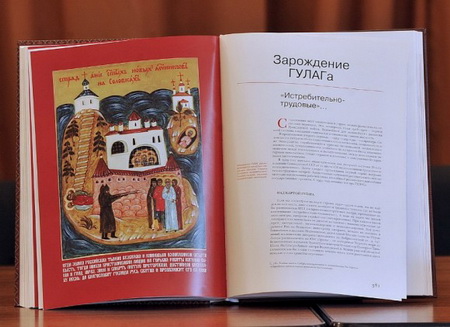
On June 1, Patriarch Kirill performed a service at the training ground in Butov - the place of mass executions of victims of political repression. So the church, and for more than a year, honors the memory of those who died at the hands of Soviet power. Waves of red terror destroyed entire layers of Russian society, “other Russia”: clergy, military, politicians, representatives of the intelligentsia, civil servants and peasants. Of course, these memories are painted in confessional tones, but the problem is by no means connected with this.
Confessional memory has the right to exist, to its progress and adjustments. So, at the last meeting of the Holy Synod, it was decided instead of the “Council of Confessors and New Martyrs of Russian” to call the holiday “Cathedral of the New Martyrs and Confessors of the Russian Church”.
But minor changes are one thing, the other is fundamental.
Recently, inside the dominant denomination, there has been a turn towards smoothing sharp moments. Memories are introduced into a purely liturgical context - smoothly, quietly, solemnly, waved a censer, said the right words, parted. The format of new religiosity, in which ideology plays a significant role, sets new prospects. It is no accident that at the beginning of the year 36 new martyrs did not fall into the fresh church calendar. How? Why? For what? It is still impossible to understand. One can only guess - no official explanations followed.
They say that new facts were revealed, some martyrs could not stand torture, and stipulated their neighbors. But how true is it? There are simply no access to the investigative cases of the 30s now for the vast majority of researchers, and we are offered to believe the rumors. And then: can the interrogation protocols be considered a reliable document? After all, they, as many authors note, contains pleasing to investigators “recognition”, which in fact were not. Often, an exhausted person put a signature without reading the material. Sometimes a signature on a white sheet was knocked out from the defendant, and then they entered anything.
Another fault of saints not included in the new saints is the departure from Metropolitan Sergius (Stragorodsky), non -canonical, so to speak. This is a fairly confusing ecclesiological issue, and the boundaries of the church at that time clearly did not coincide with the canonical territory of the locumer of the patriarchal throne.
Be that as it may, the new religiosity is in a hurry to cross out from the list of saints doubtful, from its point of view, names. So recently seen the light of the album, “The victims of the faith of Christ” (PSTGU, 2013) stopped on the years of great terror: so reliable. The compilers prudently decided to take a pause and thoroughly prepare for the publication of the second volume dedicated to the subsequent period of persecution of the church.
“Canonization,” the historian Georgy Fedotov wrote at one time, “does not mean determining the heavenly glory of the ascetic, but turns to the earthly church ... Church canonization, an act addressed to the earthly church, is led by religious-pedagogical, sometimes national-political motives.” It is important that the institution of holiness itself serves as a cement of the moral building of society, an ideal that simultaneously forms its spiritual culture and is formed by it.
With this extremely narrow point of view, it is obvious that this institution cannot be replaced by anything else. Of course, today its meaning has fallen greatly in comparison with the pre -revolutionary time, but even now it has a certain social impact. And it is important that the church responsible for its formation gives moral assessments to its past too. Then, perhaps, some early judgments about the victims of totalitarianism will seem inappropriate.
Take a case with the most famous new martyr buried at the Butovo training ground, Metropolitan Seraphim (Chichagov). It is known that when Sergius (Stragorodsky) learned about the intentions of the punitive bodies to arrest the hierarch, he immediately removed him from the Leningrad department. And that, of course, he accelerated the arrest. After all, it is one thing to put a bishop to prison, another is a person who leads the second most important department. Well, why not to publicly condemn such a “Sergian” act? And at the same time, not publicly reflect on the dangers of the church-Soviet and-wider-a church-state symphony, about the dangers of growing the state into the Church?
In contact with the life of the confessors, we meet with the very true that remains of the Soviet era. And I really do not want our memory to eventually be brought to the set of liturgical formulas and phrases. But the movement in this direction goes rapidly.
In this sense, the modern veneration of the laureate of the Stalinist prize of the Architect Luke (Voyno-Yasenetsky) (his memory is celebrated on June 11). Of the newly glorified saints, he probably is most popular. In honor of him, temples are opened in Moscow, Krasnoyarsk, Murmansk and other cities. Memorial boards appear on houses associated with his feat. In many places, sculptures are installed. There were even museums telling about his life.
Saint Luke is a kind of bridge connecting science and religion. He testifies to his life that there is no contradiction between them, that science can go hand in hand with faith.
But when promoting his name, for some reason, for some reason, it is not put on his confession, on long years of prison and exile, but in miracle. Like, prayed, dear person, Luke and the disease will pass.
It is known that Luke did not perform obvious miracles during his lifetime. More precisely, his medical art in itself was a miracle. But this does not bother architects of new religiosity within Orthodoxy. And the “tour” of relics begins, and the PR campaign, hype, collecting people around superstition begins. And not only in Russia. In Greece, say, forty Temples of St. Luke. And many expect a miracle from him.
Confessional memory easily turns into a fairy tale, into a myth. But in relation to the new martyrs this cannot be allowed, because oblivion will bring new troubles. And it’s good that after the service at the Butovo training ground, the Metropolitan Juvenal, who served the Patriarch, opened the exhibition “Cross of praise”, dedicated to the 75th anniversary of the martyrdom of the victims of the Bolshoi Terror (1937-38). Something is still being done, not only Kadilo and Kropilo.
Saints of the Soviet era help us to go back - without anger, without false pathos, without nihilism. Recall the Russian Holocaust that ceased the existence of Russian civilization. See the terrible anthropological pit in the place of man. And at the same time, they talk about the way out, show that at times there are much more difficult than the current ones, you can remain internally free, dignity and act - smartly and responsibly.
Photo from the site Pravmir.ru