
Translated material
Very different unions
Around Russia
 Very different unions
December 3, 2020 Alexander Golts
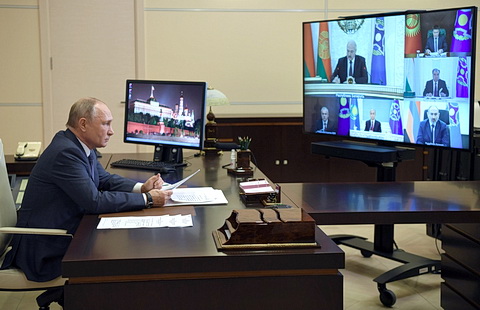
It so happened that in Brussels and Moscow, meetings of the leaders of two military alliances were simultaneously held. In the Belgian capital, NATO ministers gathered in the foreign affairs ministers, and in the Russian video conference, a meeting of the collective security council of the organization on collective security was held. I have no doubt that domestic propagandists will take advantage of these meetings in order to illustrate the purely peace of the CSTO and, on the contrary, the total aggressiveness of the North Atlantic Alliance.
In fact, the NATO documents accepted by the leaders of the CSTO are not mentioned at all. Only Alexander Lukashenko in his speech spoke of a threat to the West. And even then he connected her with the strange desire of the Belarusian people to free herself from him, until all his beloved father. It is clear that this could not happen without foreign intervention. As for the performances of the rest of the heads of states, they brilliantly proved: the CSTO countries, in principle, have no common security threats that could be opposed to jointly. The Armenian Prime Minister Nikola Pashinyan, of course, said that "Azerbaijan, supported by Turkey and mercenaries from the countries of the Middle East, unleashed the war against the Armenian people." At the same time, he pointed out the problems that the solutions demanded that the combat operations were stopped and the Russian peacekeeping operation began: on the exchange of prisoners of war, hostages, other people held, as well as the bodies of the dead, and clarifying the fate of the missing, as well as creating conditions for the return of refugees to their homes, on the restoration of normal life in Nagoric Karabakh.
The permanent head of Tajikistan Emomali Rahmon expectedly reminded the alarming development of the situation in Afghanistan. Amazingly, the leaders of the Kyrgyzstan, who had just survived the next political shocks, and seemed to have concentrated on domestic political problems. The acting Kyrgyz President Talent Mamyatov said that he was taken “the course to fulfill those requirements of the people and the elimination of the mistakes that were made during the election to the country's parliament on September 4, 2020,” and promised to hold honest elections in parliament and the president. The head of Kazakhstan Kasym-Zhomart Tokaev, actually appointed his predecessor, reported on unprecedented political reforms and promised to hold transparent and fair elections.
If the leaders of the countries included in the CSTO - the defensive, I recall, the union, were united, it was in verbose praise to the "dear Vladimir Vladimirovich". It is simply that the theory is confirmed that the only meaning in creating this organization was to enhance the inferiority complex of the Russian president, which was extremely annoyed by the absence of allies. The main Russian chief painfully searched and could not find at least some common denominator for the aspirations of his allies. He expressed the support of Armenia (which was powerless to help during the fighting). He expressed the hope that “the Belarusian people will have enough political maturity in order to calmly, without any sharp movements, build a domestic political dialogue with all political forces.” A few minutes before that, Lukashenko hinted that he could look for other sponsors, offering to meet in a wider circle: not only members of the CSTO, but also "the countries that feel and feel the danger that is approaching today, including us." Putin wished the leaders from Central Asian states stability. The documents adopted following the results were quite matching the sounding speeches: for all the good, against everything bad. Lukashenkovsky anti -West invectives were not supported.
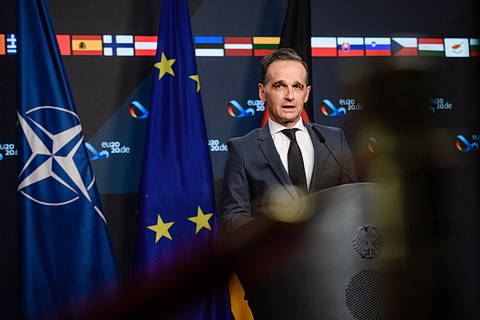
But the two -day meeting of foreign NATO ministers, whose focus was the Black Sea region, left no doubt about what the alliance is considered the main threat to themselves. The Secretary General of the Bloc Ien Stoltenberg: “Russia continues to violate the sovereignty and territorial integrity of Georgia and Ukraine. She continues to increase military power in the Crimea. And more and more actively places the armed forces in the Black Sea region. ” This is what NATO is going to counteract, both by increasing military efforts, and developing relations with the victims of Russian aggressiveness.
Moreover, the presentation of the NATO 2030 report ordered by the Group of Independent Experts, which was supposed to outline the main trends in the development of the alliance, was timed to the meeting of the heads of the diplomatic departments of the Alliance. Its authors without the slightest doubt indicate Russia as the main threat: “The Russian government strives for hegemony over former Soviet possessions and undermines their sovereignty and territorial integrity, trying to block the way to the countries that want to move towards NATO. While Russian aggression in Ukraine and Georgia continues, the aggressive behavior of Russia has intensified in the north and in the North Atlantic, the Air Force and Navy extensions in the key areas of Barents, the Baltic and Black Seas, as well as in the Mediterranean Sea. Russia expands the hybrid war and is jealous of the energy and critical important infrastructure (potential opponents. - A.G. ). In parallel, she tries to create a satellite states or clients near the territory of NATO, using the so-called frozen conflicts. ”
The report calls for a revision of the NATO strategic concept that has proclaimed partnership with Moscow in 2010. The authors quite frankly state that now the West has returned to geopolitical rivalry with Russia, which took place until 1989, that is, if you call a spade a spade, to the Cold War. Moreover, a policy in relation to our country should be based on military deterrence and peaceful coexistence. The revival of the term "peaceful coexistence" accurately indicates that the era of a strict military confrontation has returned.
At first glance, Russia, whose leader ends endlessly about the latest weapons, about the high combat effectiveness of the armed forces, is ready for such a confrontation. However, it turns out that it turns out: the countries listed by the allies are completely not ready to support it in the confrontation of the West. They consider their allied duty exclusively as the need to publicly bow to the Moscow khan once a year. And then everyone for himself ...
Photo: 1. 02.12.2020. Russia. Moscow region. Russian President Vladimir Putin in Novo-Ogravo during the session of the Collective Security Council of the Collective Security Organization (CSTO) in the format of video conferences. Alexey Nikolsky/Press Service of the President of the Russian Federation/TASS
2. 01.12.2020 . The German Foreign Minister Haiko Maas made a statement to online re-claims with ministers from NATO countries. Clemens Bilan/Pool/ERA/TASS