
Translated material
Multi -flower flights
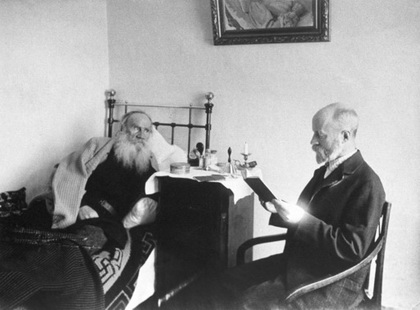
Russian writer Lev Nikolaevich Tolstoy (left) and a personal doctor of the Tolstoy family Dushan Petrovich Makovitsky. Yasnaya Polyana. 1907-1909
One hundred years ago, on the night of October 27 to October 28, 1910, Count Lev Nikolaevich Tolstoy left Yasnaya Polyana. Ten days after his disappearance, November 7, he died at the Astapovo railway station.
The story of Tolstoy's last trip has overgrown with many myths. Some saw in her a flight towards death, others - an attempt to merge with the people, the third - the desire to cut the Gordians of the node of family relations. Of course, all these versions could not be born at all: the writer has the right to secrets, into which strangers are indecent to meditate. But Tolstoy, to his misfortune, was too promoted. And the press, even then building many publications “on the stars”, controlled every step of the great man.
Around Tolstoy as a media person there was a lot of Harmsovsky jokes in the spirit, like this: “Leo Tolstoy loved children very much. It happens that he will catch a little boy, put him on his knees, and strokes the head all evening, and does not let go anywhere. ” The “Reference” and moralization of the writer was parodied. In the era of postmodern, when the cultural vertical itself was under suspicion, you can hear all kinds of, sometimes completely wild things about Tolstoy. However, this did not start today. Back in the Soviet school, they taught that the "mirror of the Russian revolution" did not pay something there, the coward was, in a word.
The image of Tolstoy is connected not only with literature, but also with Russia, with its identification code. Therefore, each more or less serious work about him causes public outcry. Of the latter, this is the light of Pavel of the Basinsky “Leo Tolstoy: flight from paradise”, just dedicated to significant care. Its author became the laureate of the prestigious “Book of the Year” award, entered the short list of “Big Book”.
This is a solid documentary prose, a little archaic due to the abundance of quotes. It is no accident that Basinsky “modernizes” her from the arsenal of relevant journalism with words, like “exclusive” and “project”.
This book can be evaluated as a large inventory list of relations between Lev Nikolayevich and Sofia Andreevna, who was sixteen years younger than her husband. It has many juicy details, plastics of life, scandalous details. But in general, it is far from yellowness, remembering the value of the value scale.
The family of Tolstoy, the author notes, was not the result of a random connection of two loving hearts or a “marriage contract”. She was a "project of happiness." And the first fifteen years, happiness really was. With bills, with incisions, but nonetheless. At this time, Tolstoy writes “War and Peace” and “Anna Karenin”, that is, his best works of art.
Touching on the anatomy of love, Basinsky notes that the fat people read each other's diaries. The initiative was shown by L.N., in this way the young Sophia with his love adventures. In the diary of S.A. Of course, you will not meet such things: the composer Taneyev composer in 1895 was purely platonic in nature. But in it there are, for example, such passages: “The physical side of love plays a large role. This is terrible - I have no, on the contrary. "
Physiology of marriage in the reasoning of L.N. often put in first place; The man has lust, it grows, and after intercourse, everything is repeated again. This is the algorithm of family life. Children are a by -product of the process.
After the worldview crisis of the end of the seventies, Tolstoy virtually runs from the family. The wife did not want to share the new views of her husband, the abyss grew between them. Soon the estate is flooded by the “dark”, followers of the teachings of the count. The fuss begins around Tolstoy’s will, which continues to the Astapov tragedy: the Tolstoyites did not let even S.A.
The Basinsky’s book tells about many colorful personalities surrounding L.N.: Here is the younger sister of the wife of Tanya, the secretary of the writer Chertkov, and the peasant Mikhail Novikov, who worked on a modest piece of land and wrote prose and articles (executed in 1937).
The Basinsky topic of Tolstoy’s excommunication and the possibility of his reconciliation with the church did not bypass. He describes in detail the last stay of the count in Optina, a series of accidents that did not allow him to talk with the elders; His meeting in Chamordino with a sister-monkhin.
Tolstoy was looking for meaning, and in his search he went too far from the church fence. So in the definition of the 1901 Synod there was nothing wrong. But why did it be necessary to take such a definition at all, not supported even by Pobedonostsev?
The position of the owl wings of the chief prosecutor of the Holy Synod overwhelmed over Russia is well known: “Tolstoyes” to pursue, but not to touch Tolstoy. Modern St. Petersburg historian S.L. Firsov says that Pobedonostsev was against the publication of a synodal act and remained with his opinion and after his release.
The synodal document, in my opinion, was a mistake. He negatively affected the relationship of the church and culture, contributed to the departure from the church fence of many thinking people. The church excommunicates only its own, in the appendix to Tolstoy the concept of “its own” is not suitable. Yes, formally he was listed as a member of the dominant denomination, as the majority of loyal citizens of the empire were listed. But if you adhere to such a formal principle, the synod should have excommunicated millions. He was not afraid to make an archaic, fundamentalist gesture in relation to the great writer, and did nothing with those who really prepared a bloody mess of revolution. In subsequent years, the church did not anathematize either Stalin or Khrushchev, the organizers of terrible anti -church campaigns. And even prayed for them. And the count who departed from the Orthodox doctrine was chosen publicly, forbade praying for him during public services. There is some kind of untruth in this. After all, Tolstoy was driven not only by his own pride, but also by the desire to show church diseases, to which he reacted painfully.
Basinsky suggests that the excommunication to some extent was provoked by the head of the novel "Resurrection", where the description of the liturgy was turned into a caricature. But why did these pages printed in the foggy Albion (in Russia did not miss the like) caused such a strange reaction in the synodals? The man simply expressed his private opinion, so it seems to me. No one was obliged to agree with him, even if this is the opinion of a brilliant writer. After all, when he acts as an universal teacher, as the modern missionary Alexander Korovsky noted, it immediately turns out that here he is not bad and not good, he is simply no.
Apparently, the St. Petersburg Metropolitan Anthony (Vadkovsky) signed the definition made a concession to the fundamentalists who demanded the head of the great writer. And the head from the novel played a role here.
Tolstoy himself reacted to the synodal definition calmly. Basinsky quotes his words: “The fact that I renounced the church, calling myself Orthodox, is completely fair. But I renounced from her not because I rebelled at the Lord, but on the contrary, only because I wanted to serve Him with all my might. ”
Basinsky’s book looks solid, it has more than six hundred pages. But it is easy to read, because it has a clear structure, a dramatic plot - flight and death around which everything else is built.
The whole civilized world talks about Tolstoy today. If you look at his image, you begin to understand that many problems that tormented him have the most direct attitude towards us.