
Translated material
Stalin @ Hitler
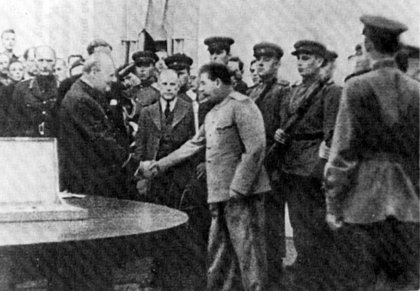
The resolution of the OSCE parliamentary Assembly, equalizing Stalinism and Nazism as two forms of totalitarianism, sharing Europe, caused a lot of noise and scandal, both chambers of the Russian Federal Assembly spoke with a sharp protest.
However, for citizens and organizations of Russia, the decisions of national legislation should be no less respected than the verdict of the International Military Tribunal, which recognized the leading staff of the NSDAP, Gestapo, SS and SD , condemned the ideology of Nazism and the regime based on it as criminal.
We are talking about the decision of the Constitutional Court of the Russian Federation and the laws of the Russian Federation (adopted by the Supreme Council of the RSFSR in the first version even under the USSR, i.e., when its legitimacy was undeniable - even for those who reject the legitimacy of the authorities created after decree No. 1400).
As the pre -revolutionary jury (lawyers) said, we will give the floor to the law.
1. (CPSU case) The case on verifying the constitutionality of the decrees of the President of the Russian Federation of August 23, 1991 N 79 "On the suspension of the activities of the Communist Party of the RSFSR", dated August 25, 1991 N 90 "On the property of the CPSU and the Communist Party of the RSFSR" and on November 6, 1991 N 169 "On the activities of the CPSU and the Communist Party of the RSFSR", as well as about the audit of verification The constitutionality of the CPSU and the Communist Party of the RSFSR was considered on May 26, July 6-15, July 20-August 4, September 14-October 23, October 28-November 30, 1992. Resolution N 9-P of November 30, 1992: “... 3. For a long time, the country has dominated the regime of the unlimited, based on violence of the power of the narrow group of communist functionaries, united in the Politburo of the Central Committee of the CPSU, led by the Secretary General of the CPSU Central Committee.
The materials available in the case indicate that the management bodies and senior officials of the CPSU acted in the vast majority of cases secretly from ordinary members of the CPSU, and often from responsible party functionaries.
At the lower levels of management, up to the region, real power belonged to the first secretaries of the relevant party committees. Only at the level of primary organizations, the CPSU had the features of a public association, although the production principle of the formation of these organizations made members of the CPSU dependent on their leadership, closely related to the administration.
The materials of the case, including the testimony of witnesses, confirms that the leading structures of the CPSU were initiators, and the structures on the ground are often the guides of the policy of repressions against millions of Soviet people, including in relation to deported peoples. This went on for decades ... "
2. The Law of the RSFSR of April 26, 1991 "N 1107-I " on the rehabilitation of the repressed peoples "(as amended on July 1, 1993)
The renewal of Soviet society in the process of its democratization and the formation of a rule of law in the country requires the purification of all spheres of public life from deformation and distortion of universal values. It created favorable opportunities for the rehabilitation of the peoples repressed during the years of Soviet power, which were subjected to genocide and slanderous attacks.
The policy of arbitrariness and lawlessness, practiced at the state level in relation to these peoples, was illegal, insulted the dignity of not only repressed, but also all other peoples of the country. Its tragic consequences still affect the state of interethnic relations and create dangerous foci of interethnic conflicts.
Based on international acts, the declaration of the Supreme Soviet of the USSR of November 14, 1989 "On recognition by illegal and criminal repressive acts against peoples exposed to violent resettlement, and ensuring their rights", the decision of the congresses of people's deputies of the RSFSR, as well as the current legislation of the RSFSR and the USSR, fixing the equal rights of the Soviet peoples, and, striving to seek The restoration of historical justice, the Supreme Council of the RSFSR proclaims the abolition of all illegal acts adopted in relation to repressed peoples and adopts this law on their rehabilitation. Article 1. To rehabilitate all the repressed peoples of the RSFSR, recognizing repressive acts against these peoples illegal and criminal. Article 2. The peoples (nations, nationality or ethnic groups and other historically formed cultural and ethnic communities, for example, Cossacks) are recognized as repressed, in respect of which, according to the signs of national or other affiliation, was carried out at the state level of the policy of slander and genocide , accompanied by their violent resettlement, the abolition of national-state formations, and crossing, crossing national-territorial boundaries, establishing a regime of terror and violence in places of special settlement. ”
3. The Law of October 18, 1991 "On the rehabilitation of victims of political repressions" (as amended on June 26, December 22, 1992, September 3, 1993, November 4, 1995). During the years of Soviet power, millions of people became victims of the arbitrariness of the totalitarian state, were subjected to repression for political and religious beliefs, according to social, national and other signs . Convicing many years of terror and mass persecution of their people as incompatible with the idea of law and justice, the Supreme Council of the Russian Federation expresses deep sympathy for the victims of unreasonable repressions, their relatives and friends, declares a steady desire to achieve real guarantees for ensuring the legality and human rights. The purpose of this Law is to rehabilitate all victims of political repressions, subjected to such on the territory of the Russian Federation from October 25 (November 7), 1917, their restoration in civil rights, eliminating other consequences of arbitrariness and ensuring the currently feasible compensation for material and moral damage.
I. General provisions. The Law of the Russian Federation of September 3, 1993 N 5698-I amended Article 1 of this Law.
Article 1 . Political repressions are recognized by various coercion measures used by the state for political reasons, in the form of imprisonment or freedom, premises for compulsory treatment in psychiatric medical institutions, expulsion from the country and deprivation of citizenship, eviction of population groups, referral to exile, expulsion and special settlement, attracting to coercive work in conditions of restriction of freedom, and Also, the other deprivation or restriction of the rights and freedoms of persons recognized as socially dangerous for the state or the political system according to class, social, national, religious or other signs, which were carried out on the decisions of the courts and other bodies endowed with judicial functions, or administratively by the executive authorities and officials or their bodies, which were vested with administrative powers.
Federal Law of November 4, 1995 N 166-ФЗ This Law is supplemented by Article 1.1
Article 1.1 . Passed political repression and rehabilitation are recognized by children who, together with parents in places of imprisonment, in exile, expulsion, and special settlement.
Thus, not only Stalinism, but in general, the pre -perestroika Soviet regime, starting from November 7, 1917 (i.e., is already exactly as of August 23, 1939) in the Russian Federation, he was officially found totalitarian, guilty of mass terror and repressions (millions of victims), genocide. This is almost the same set of accusations that the Nazis was brought by. With one exception - Soviet crimes against peace and war crimes were not convicted. The “selfish” Russian legislation condemned only the war of communist functionaries with their own people. But this is enough to unambiguously state - from the point of view of Russian law, both Nazism and the Soviet communist regime are found guilty of international crimes.