
Translated material
Kudrin and Tabu
In the Kremlin
 Kudrin and Tabu
February 11, 2010 Alexey Makarkin
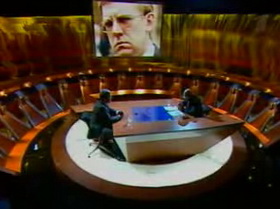
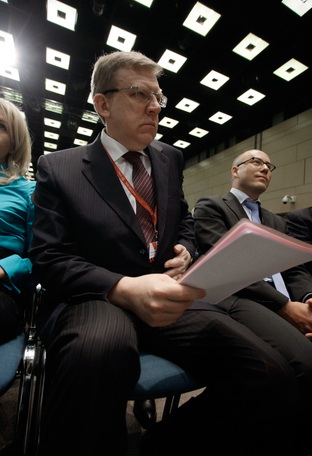 The sharp statement of Alexei Kudrin addressed to United Russia one of the sensations of this week. The crisis has just passed in the relationship between the “United Russia” and the Socialist -Revolutionaries, which came after the neat distance Sergei Mironov from Vladimir Putin in the television program of Vladimir Pozner on the “First Channel”. Then the high -ranking representatives of United Russia spoke extremely sharply about Mironov and announced its possible displacement from the post of the Speaker of the Council of the Federation. The Socialist -Revolutionaries responded with oncoming sharpnesses. It was just that it was possible to resolve the situation (with the involvement of the country's top leadership), how a new informational occasion arose, and in the same Pozner program.
So what did Kudrin say? The first part of his statement is an almost direct quote from Dmitry Medvedev’s speech on the State Council - about the vices of the administrative resource and the need for real political competition. The second part is that the party is not a legal -centric, but to the left -centric one, so that the government course manages to implement only thanks to Putin. All Kudrin words are designed in an extremely loyal form in relation to both participants in the ruling diarchia. Moreover, only last week, Putin at a meeting with the “United Russia” stated that party members should not turn into “promise”, who powder the brains, but it is necessary to learn to explain the problems facing them. And although its chairman did not make direct reproaches to his own party, the fact of such statements is very indicative. Thus, Kudrin is political correlated, moreover, emphasized the balance between the two leaders - Putin, whose associate he has been for two decades, and Medvedev, with which the head of the Ministry of Finance is not easy. Last year alone, Medvedev was publicly “dive” with Kudrin when discussing the issue of creating a national payment system.
Why, then, a minister, traditionally not dealing with political issues, suddenly made such a statement? It seems that there are two circumstances. The first - United Russia has long chosen Kudrin as a target for criticism, unlike other members of the government to which the party is loyal. Only in the fall of last year, the United Russia said that the Ministry of Finance does not make enough effort in finding additional budget revenues. In turn, Kudrin never strove for a public political career, did not run for deputies, was not a party party - so popularity among the population is far from the main thing for him. In addition, criticism from the “United Russia” does not cause him real hardware damage, as the minister enjoys Putin’s support, allowing him to stay in his post for almost a decade. We add to this that during the crisis the influence of Kudrin only increased, since the maintenance of macroeconomic stability depends on him. In addition, the budget “cube”, which Kudrin gathered for many years, helped the Russian economy in the most difficult time.
Criticism of the "United Russia" addressed to Kudrin, however, it does not prevent them from voting for the budget, even if not always popular. United Russia voted in the State Duma even for raising transport tax (this is perhaps the most unpopular Ministry of Finance initiative of recent years), and only after the Kremlin’s intervention was this decision hastily revised. It is clear that the coincidence of the interests of the Ministry of Finance and United Russia is not connected with the ideology, even conservative, at least liberal, at least any other. It is difficult for party members to consistently withstand the conservative line officially fixed in their software document. After all, they are not at all ideological conservatives (with the ideology of the Party of Power there are always problems, except for such pragmatism), but rather are instinctive supporters of the preservation of the “CVO status” in politics and economics. As for voting, they have no other choice; This is the flip side of the Party of Power, a fee for the numerous advantages that it has.
 However, this does not mean that the minister is completely calm and is ready not to respond to criticism. Another thing is that until recently, the topic of claims to United Russia was actually taboo for representatives of the Russian authorities. In the same way, before the Medvedev Epistle of 2008, the taboo extended to questions about administrative impact on the judicial system and the electoral process (now the reasoning on these topics is represented completely ordinary for people who are quite loyal to the authorities). In the same way, before the President’s criticism of the state corporations was also incorrectly correctly touched on this topic. Of course, these informal restrictions did not apply to representatives of the opposition, but their influence was minimized. Now the taboo is gradually being removed, the theme of serious public discussions is expanding (the newly published report of Incor can serve as an example). After Medvedev spoke at the “political” meeting of the State Council, other statesmen had the opportunity to criticize the previously inviolable “party in power”. Apparently, this is precisely the second reason for such a decisive behavior of Kudrin in relation to the “party in power”. Moreover, for Mironov, an acute skirmish with United Russia ended not by resignation, but by an honorary agreement, in which his party’s right to criticize the authorities in socio-economic (the most important for “Socialist-Revolutionary” voters) sphere is actually recognized.
Author-First Vice President of the Center for Political Technology
Photos of RIA Novosti