
Translated material
Providing?
In uniform
 Providing?
February 15, 2010 Alexander Golts
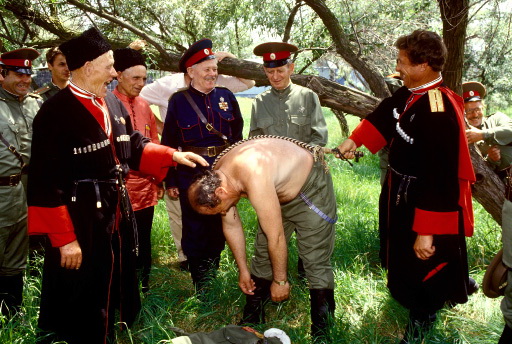
The Russian government leaves no attempts to include Cossack communities somehow in the existing system of power. The president signed decrees that give the “register Cossack troops” by emblems and banners, and the Cossacks themselves with the approved form, ranks, as well as special certificates similar, as they say, to a military ID. At the same time, the Cossacks themselves will no longer be able to appropriate their titles. Generals - Atamans of the Cossack troops (of which in Russia as much as ten) is appointed by the president. And the senior officer titles are assigned by the representative of the president in the federal district. It seems to be happy that the state is trying to restore order in their relations with those who consider themselves the heirs of the estate, who served as the support of the Russian Empire and underwent terrible repression under the Soviet regime. And now, instead of the brutal Soviet “testing”, a civilized “rendering” is carried out.
The main problem that the Russian state has been trying to solve in relations with the Cossacks since the beginning of the 90s is to integrate a community that wants to be an estate in a modern democratic (at least form) state.
This contradiction is obviously manifested in Russian legislation, which indicates that “the Cossack society is a voluntary association of citizens of the Russian Federation in the form of a non -profit organization, formed in accordance with federal legislation, introduced in the state register of Cossack societies in the Russian Federation, and whose members have assumed obligations to carry out state or other service.” That is, on the one hand, we are talking about certain non -profit voluntary associations. On the other hand, members of this community assume obligations to carry out "state and other service." Meanwhile, in tsarist Russia, with which in this case they are trying to take an example, in general, the Cossacks, in general, had no “other” service, except for the military. It was in military service, in a constant campaign was the meaning of the life of a Cossack.
In general, it looked quite logical that the deputy head of the Presidential Administration, the chairman of the Presidential Council for the Cossacks of the Cossacks, Alexander Beglov, who represented the decrees that had just signed, told: “There is an idea - and it is in the air: to create a military unit, where Cossack youth will be called, which will not be subordinate to the chieftain, but the Ministry of Defense of the Russian Federation.” “Now this idea is being worked out at the Ministry of Defense,” he added. “This is, of course, there is: traditions must be preserved, taking into account the fact that the Cossacks have the corresponding skills of owning cold weapons, horses management and much more.”
It is strange that the deputy head of the presidential administration was not aware that 15 Cossack units and formations have existed in the Russian army for the past ten years. And more recently, 13 of them were disbanded. For one reason - there were no representatives of the so -called “register of Cossacks” at all. In particular, the motorized rifle Siberian Cossack regiment of the 85th motorized rifle division in Novorossiysk, the Cossack units of the 122nd motorized rifle division in Borza (Chita Region), the 128th machine gun artillery division (Jewish autonomous region) were liquidated. According to the chief of the General Staff, Nikolai Makarov, about 30 thousand recruiting guys in the registers of the Don Army. And only five hundred people went to the army. An unnamed source in the Ministry of Defense told Interfax that the general staffing of Cossack units by immigrants from Cossack societies "was a little more than 2%, and in a number of units, not a single Cossack served."
Three years ago, an official conference “Cossacks in the history of Russia” was held at the Institute of Military History. One pathos report followed another. In the end, Major General Alexander Valyaev, representing the General Staff, could not stand it and began to cut the truth-uterus. According to him, among the so -called Cossacks there were ten times more “slurry” than on average in Russia: “In 2006, 823 people were subject to call from the Cossacks, 680 were included in the nominal lists for the Cossack part, and 110 people were actually called up for military service.” Valyaev emphasized that "in the spring of 2007, with the total number of Cossack society, more than 650 thousand people, 270 people were included in the lists for military service, and 189 people were sent to the troops." I do not think that the situation today looks different.
So, the Cossack “community” completely does not want to fulfill its main function, namely, to serve in the armed forces (which, in truth, is no different from the rest of the Russian people). All talk about the special breed of people who absorb the traditions of protecting the Fatherland with mother’s milk - an empty concussion.
Another story is “another service”. Our Cossack "communities" show a clear interest in concluding contracts with the local authorities to protect public order or protect reserves. The practice of domestic law enforcement suggests that we are talking about elementary roofing. Thus, either hoping to replenish the ranks of the armed forces, or wanting to get loyal power in the event of riots at their disposal, the Russian government is ready to give a certain social group with attributes and the functions of the “power structure”. With all that it implies. Let us recall how just the liberation of the “communities” of the Afghans from taxes immediately put forward them to the center of criminal activity. State rendering can turn into the same.
Photos of RIA Novosti