
Translated material
The European Parliament adopted a resolution calling for sanctions against Russia because of the poisoning of Navalny
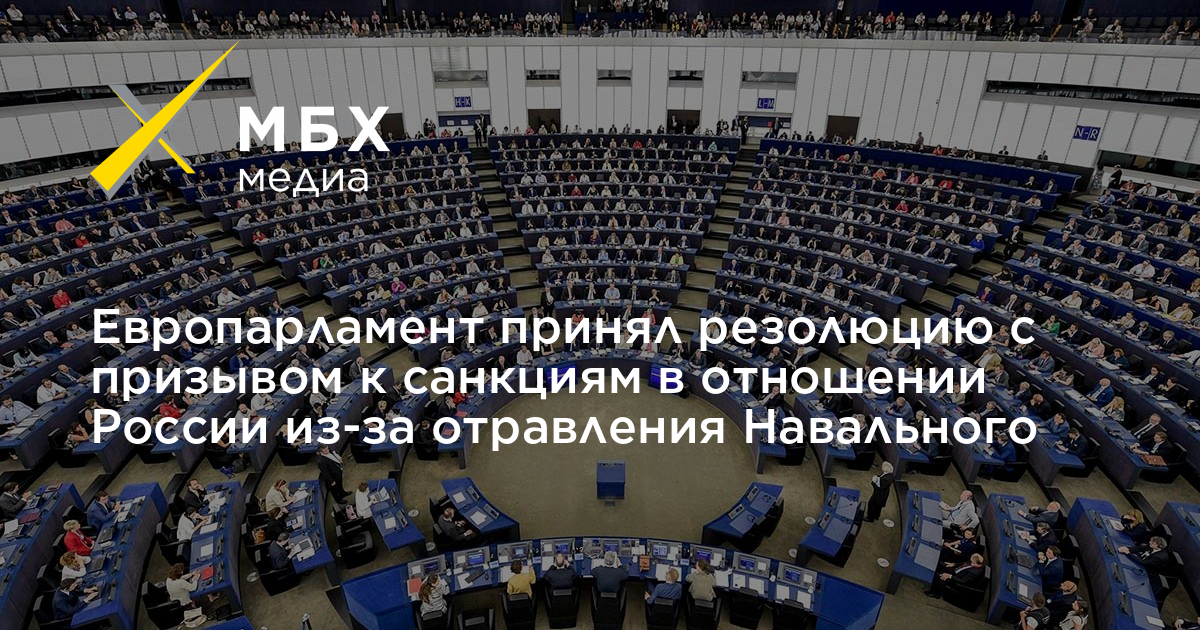
The European parliament with a majority vote (for-532, “against”-84) adopted a resolution calling for the European Union to strengthen the sanctions against Russia due to the poisoning of Alexei Navalny. This was announced by the journalist of Radio Free Europe Ricard Yozvyak.
In particular, the European Parliament asks to begin an international investigation of Navalny’s poisoning and requires the Russian authorities to provide the OPCO with information on the program of the Novice poisons.
In addition to tightening existing sanctions, deputies urge the EU leaders to introduce mechanisms that would allow to search and freeze European assets of corrupt persons on the basis of investigations of the Corruption Fund.
In addition, the resolution calls for special attention to “approval and implementation in the near future of a sanctioned mechanism in the field of human rights by the type of“ Magnitsky List ”, which will include (physical) persons and may provide for sectoral sanctions against the Russian regime.”
The European Parliament also proposed to stop the construction of the Northern Stream 2 gas pipeline.
Resolutions of the European Parliament are advisory in nature, that is, they are not a legally binding document, but a guideline for the governments of the EU countries.
On August 20, Alexei Navalny was hospitalized in Omsk after an emergency landing of the aircraft, on which the politician returned to Moscow from Tomsk. Two days later, he was transported to Germany to the Chanita clinic, where he was in a deep coma, his condition was evaluated as stably serious. Only on September 14, politics was disconnected from the Ivl apparatus.
The German government later reported that Navalny was poisoned by a substance from the Novice group. The Military Laboratory of Germany found traces of the poisonous substance from this group in samples of the skin, blood and urine of Navalny. The laboratories of France and Sweden came to the same conclusion.