
Translated material
Education or death. Part 1
In society
 Education or death. Part 1
November 9, 2012 Evgeny Kozachenko
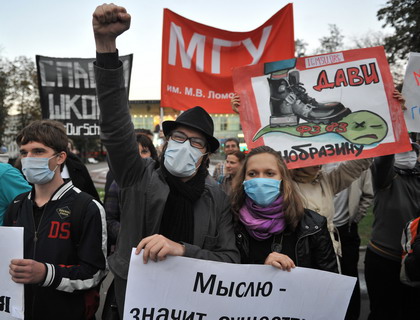
At the June march of the opposition, which swept along the Boulevard Ring and Sakharov Avenue, a new force, which compiled a separate column, stated itself: students joined the protest. Here I want to get better and say: “Students” - but it is too early to talk about consolidation in the student environment. The scientific and educational column totaled 3 thousand people and consisted for the most part of the marginalists personally infringed on by the reforms conducted by the Ministry of Education contrary to the pressure of the professional community and seething on the Internet. In the world, students often lead the protest and set him tonality: this happened, for example, in Quebec (Canada), where in mid-February of this year the perpetual strike broke out, the perpetual strike broke out, the perpetual strike. directed against raising training fees. Each manifestation ended with rigid detentions and the dispersal of the demonstrators. On May 19, a law was adopted , imposing serious fines on organizers and participants in unauthorized shares and prohibiting mass meetings at a distance of 50 meters from any educational institution. However, on May 22, from 300 to 400 thousand people took to the streets, according to various estimates. According to Globe and Mail Poll in May 2012, 62% of Quebec students and 69% in Ontario supported the strike. The result of regular rallies was the negotiations of the authorities with student organizations, the resignation of the Minister of Education of the region Lin Bosham in May and the holding of early parliamentary elections in September, ended with the victory of the opposition Social Democratic Party and, as a result, by the resignation of the former government, headed by the Prime Minister of the province of Jean Share, the main apologet in raising the fee for the fee Higher education. Social Democrats promised to abandon the plan of the ball and maintain previous prices. An interesting detail that radically distinguishes Canadian rallies from ours: in Quebec, the protest developed according to the inductive scheme. From private requirements (“Down with the privatization of education!”), Students quickly moved to anti -government slogans. And they achieved their own. In Russia, social requirements were made only in June. Before that, they found support from the left minority and were extremely blurry and inaccurate. The scientific and educational column first made a detailed mass criticism of education reform.
The embodiment of the reform will stretch for several years, over time it should affect all levels of education. If you try to describe it in one word, it will be the word “reduction”. Schools, universities, teachers will be reduced, the number of budget places and free educational services will be reduced, financing of science, education and culture is cut. This is not always mentioned openly, some prepared innovations can be judged by the comments of developers and lawyers. Today there is no single document or resource on which the plans of the ministry would be briefly outlined, so it will be useful to reduce all the worthwhile information in one place and evaluate whether the changes in the education system will be so beneficial, as officials present this.
So, school. Today, the hottest dispute is held around new educational standards ( GEF ), the emergence of which was preceded by a long story. The modernization of education began with the Minister of Eduard Dniprov (1990-1992) and continued at the new round Vladimir Filippov (1998-2004): in January 2000, on his initiative, the All-Russian congress of education workers was held, the result of which was the approval of the national doctrine of education for the period until 2025. The text contains many curious statements, we are talking about it below. In 2004, on the last day of his stay, Filippov signed the order “On the approval of standards in the field of education”, few people liked the standards, but there was no one to criticize: Andrei Fursenko occupied the minister for eight years. Under him, the new edition of the Federal State Educational Standard appeared and approved. The ice moved in January 2011: many probably remember the scandal caused by rumors that four mandatory items (physical education, OBZh, “Russia in the world” and an individual project) will retain in high school, and the rest will be studied at will. They wanted to drag the project without public discussion, but it did not work out: at the end of January, an open appeal of literature teacher Sergei Volkov appeared to the president and officials responsible for the introduction of new standards. The appeal collected more than 20 thousand signatures and forced the innovators to back down. In 2012, the final version of the Federal State Educational Standard was developed and approved, differing from last year's editorial office, but continuing to cause sharp discontent.
The Federal State Educational Standard serves the introduction of specialized training and individualization of education. Some of its elements at the choice of an educational institution will appear in 2013, the final transition to a new standard should take place in 2020. Six disciplines will remain mandatory for everyone: literature, mathematics, history, foreign language, lining and physical education. The remaining objects of the high school student gets from six educational areas. The state pays for 37 academic hours a week, the student needs to meet this limit. If the schoolboy does not want to take the items in a piece, he can choose one of the five profiles: humanitarian, natural-scientific, socio-economic, technological and universal (“just a little bit”). Each profile is a balanced set of objects. The standard spells out several levels of training: integrated, basic and profile. Integrated-the development of the most-most basic basics (if you supervise the requirements for the results of this level of training with the skills that the current graduate receives, there is a suspicion that today the programs of secondary schools are carried out only at the integrated level). The basic level requires knowledge of the context in which science develops. It seems that there are no specialized level in some universities: a student who connects his future, for example, with literature, is obliged to be able to conduct a linguistic experiment on a way out of school, have the skills of a comprehensive philological analysis of the text and understand literary criticism. And this is not all the requirements. It would seem wonderful. However, few understand how it will work in practice, in particular, how to accommodate several specialized disciplines without prejudice to other sciences for free 37 hours.
Almost 70% of Russians are afraid of the commercialization of education. According to the deputy minister of education and science Maxim Dulinov, "there will be no introduction of a paid education." He emphasized: "The new standard provides for a large block of extracurricular work." However, Deputy Minister Igor Remorenko clearly makes it clear: everything that goes beyond 37 hours will pay parents. Extracurricular work is possible on the basis of studios and circles, however, in additional education from January 1, 2013, changes will occur. Firstly, children under the age of 10 will be engaged in no more than 4 hours a week. Older guys - no more than 6 hours. Secondly, education will become paid for adolescents over 18. Thirdly, you will also have to pay for preschoolers.
The standard spells out the conditions (see paragraph 24), which the school should provide for the implementation of the general education program. The wording is important: “must”, and not “maybe” or “if necessary”. Among other requirements: the equipment of lingaphone offices and technical workshops, assembly and choreographic halls, information and bibliocent centers. The school should have pools, tyres, car engines, stadiums, sports grounds - and all this is generous, in the plural. The standard does not spell out the sanctions provided for non -compliance with these requirements: obviously, schools that have not accumulated funds for modern technical workshops lose the right to open the appropriate profile. Where to get the money for car horn or school television? It is clear from nowhere: “Educational institutions independently due to the allocated budget funds and additional financial funds involved in the prescribed manner should ensure the equipment of the educational process at the stage of secondary (complete) general education.”
January 1, 2011 entered into force FZ-83 , significantly supplementing the Law "On Autonomous Institutions". According to the new law, all educational institutions are divided into three types: state -owned, new budget and autonomous. The school status is chosen by a school team, not the founder. Kazyna institutions retain the signs of previous budgetary ones: their initiative is limited, but all financial guarantees from the founder are preserved. The founder is usually the federal body of state power or the authority of the constituent entity of the Russian Federation, i.e. The administration of the city or district, the Department of Education, etc. New budgetary institutions receive the same property and money at their disposal, and activities can conduct a profitable activity. But they are also controlled more than state -owned ones. Obtaining the status of a new budget institution is automatically. The status of an autonomous institution is decorated longer and dreary, but makes the founder independent from the founder and gives the right to independently set prices for educational services. As the lawyer Anna Vavilova admits : "The budget and autonomous institutions (...) are interested in conducting income activities."
In January 2013, the bill “On Education” approved at the end of December 2011, in which such concepts as a lyceum, gymnasium, boarding school, etc., are not deciphered. As officials explain, the money will now be allocated not on the name, but on the content of special educational programs. And the position of schools for gifted children will not deteriorate-as officials say, and Yuri Tikhorsky, director of the Moscow Intellectual Boarding School, is in a hurry to agree with enthusiastically. However, since 2008, exams are prohibited in the lyceums and gymnasiums of a special type. Residents of nearby houses and those whose relatives have already graduated from school use the priority. Simply put, if a gifted child lives in another area - he will be drawn up. If the child is not enough from the sky, but his mother brought him to the preliminary list of students in time - he will be credited.
Schools in which special conditions of the set are preserved, continue to exist - but there, mediocrity gradually begins to raise their heads and demand equal opportunities. Everyone well remembers the recent scandal around the Novosibirsk Physical and Mathematics School (NSU SUNC): the mother of the child deducted for poor performance was set by Rosobrnadzor, who wrote out a hundred thousandth and demanded to replace university teachers (260 people with 500 children) with ordinary teachers. FMSH director Nikolai Yavorsky promised to fight, if necessary, in the courts until then, "until the whole state is taken to the street in handcuffs." The prosecutor’s office intervened, and on September 18, the Novosibirsk Regional Court canceled the decision of the district court “for the lack of the composition of the offense”.
The Novosibirsk School is not an isolated case. Suppose Chelyabinsk : there, as elsewhere, schools and gymnasiums are attached to microdistricts, entrance exams are prohibited, one who will take place in line before. Previously, schools recruited gifted children from all over the city, now - only those who live nearby. Such a "school of equal opportunities."
From the new year, financing will be deprived of elite schools, whose programs for one reason or another will not be made to the taste of the verification commissions. The taste, however, is fifth. The draft budget for 2012-2014. It provides for a reduction in culture and education costs, so financing will be cut, regardless of how good the programs of special schools are.
Experts call the budget for the current and next two years “military-oriented”. According to Evgeny Gontmamer, "it is almost impossible to live with such a budget." Defense expenses will grow from 13.9% to 18.8%, for national security and law enforcement - from 11.3% to 14.2%. According to the director of the Department of Strategic Analysis of the FBC Igor Nikolaev, “the share of education expenses, reaching 5.1% in 2011, will sharply decrease in 2014 - to 3.4% of all federal budget expenditures. The same thing happens with health care expenses ... By 2014, their share will fall to 3.2%. ”
The national doctrine of education adopted under the Minister of Filippov was already mentioned. In 2011-2025 The volume of financing of education was planned to increase to 10% of GDP, "including at the expense of budgets of at least 8% of GDP, of which at least 1.5% of GDP (at least 9% of the federal budget expenditure)."
The promised 9% over 12 years have quarreled up to 3.4%. Compared to 2007, the amount of financing has not changed significantly: then, according to the UNESCO Institute of Statistics, it amounted to 3.6%. Education continues to remain a “priority sphere” in words, the participation of a professional environment in the management of social policy (about this in detail by Putin in a software election article) does not bother anyone. “Once (...) two ministries - education and culture - decided to call for a meeting on the upcoming reform of famous arts, teachers of art universities. And, apparently, they immediately repented of this. The project of their reform was roared with a roar. They tried to explain to the authorities that they mechanically adjust the upbringing of painters, musicians, actors, directors for a common ranking with engineers and chemists, break the principles of art pedagogy that are passing from generation to generation - pure madness. At the same time, no one denied the need for serious, or even radical changes. The bosses immediately swept away, scorched and seemed to be backward. And it concluded: henceforth do not burden yourself with discussions with professionals, you need to put them before the finished fact. Which was successfully done, ”the theater expert Alexei Bartoshevich writes in January 2011 at the time of the adoption of education reform. Why, Bartoshevich yells, laws are adopted in the cabinet wilderness, behind closed doors, in isolation from experts? Communication with the wall.
Published in February 2012, the article by Vladimir Putin on social policy contained the intention to increase the salary of university teachers by reducing universities providing low -quality educational services. The same was announced in July: “If funds from structural transformations in the social spectator to solve social problems, including to increase salaries, will not obviously be enough, you need to find these funds in a sufficient amount in the budget. We will have to go to a certain increase in budget financing. ” And he added, referring to Sergei Sobyanin and the heads of the constituent entities of the Federation: “Of course, you decide on which sources an increase in wages should be ensured, but this should be done.”
Let me remind you that the draft budget, which unequivocally says about the cutting of social payments, was adopted long before this meeting.
The Minister of Education Livanov hastened to subscribe to the president’s words and said that in the next three years the number of universities would be reduced by 20%, their branches - by 30%. This statement was made before monitoring the quality of education was carried out, so it remains to guess what the numbers named Livanov were dictated.
What can I say, financing of linden academies and universities does not benefit anyone and the idea of reorganizing and reducing ineffective universities has long been suggested. And the monitoring criteria, voiced by Livanov Deputy Alexander Klimov, do not look cannibal. But the minister set a quantitative rather than a qualitative task: it does not matter which universities, it is important - how much (October 10 updated data appeared on the results of monitoring. 23% of universities - 126 educational institutions were recognized as ineffective, among which, if we take Moscow, RSU, Markhi, Literary Institute - and 48% of branches).
At the end of July, the Russian Union of Rectors proposed to clarify and supplement the list of criteria for evaluating the effectiveness of universities. Something suggests that the proposal will remain unaccounted for.
The main wave of abbreviations will be the next two years, and pedagogical universities will be the first victims . Many are afraid that the expenses of the association will exceed potential benefits. According to the chairman of the Russian Student Union, Artyom Khromov, "often in the process of merging of educational institutions they save on teachers and greatly reduce the professorship, and the premises are leased to commercial structures." Supporters of the reforms talk about the opposite : students and teachers will be distributed by avoiding the reduction of universities with similar specialization. True, there they will present higher requirements for newcomers, which can lead to dismissal and deductions for poor performance.
In addition to an excess of universities, officials see another problem: there are too many state employees in education. In March 2012, Andrei Fursenko (he managed to speak out of almost everything), referring to the demographic situation, proposed reducing the number of budget places in universities: this will increase salaries to teachers. «У нас на сегодня практически каждый второй выпускник школы имеет право поступить на бюджетные места. Такого не было ни в Советском Союзе, ни в постсоветские годы». В мае, покидая должность, добавил : «Бюджетных мест должно быть столько, сколько необходимо, чтобы обеспечивать возможность учёбы мотивированным людям. С другой стороны, количество обучающихся за счёт государства должно соответствовать нуждам экономики и общества».
Андрей Александрович проговаривается даже тогда, когда излагает много раз согласованные с верхами и, казалось бы, вполне безобидные вещи: что за досада, каждый второй «имеет право» учиться бесплатно! Между тем, право на бесплатное обучение есть у каждого. А вот возможность учиться бесплатно, должны иметь те, кто подходит университетам по интеллектуальному уровню. Но при чём тут количество бюджетных мест, если дело в планке? Повысьте проходной балл — и оставьте бюджетников.
Важно то, что «слишком много бюджетников» — мнение не одного Фурсенко. Это общая позиция чиновников от образования. В майском интервью «РГ» Дмитрия Ливанова спрашивают , одобряет ли он идею закрытия трети вузов страны. «Дело не в количестве вузов. А в том, сколько студентов там обучается за счёт государства. Я думаю, эта цифра может быть уменьшена в два раза с одновременным повышением финансирования для оставшихся мест. (…) Как только мы уйдём от всеобщего бесплатного высшего образования, появятся механизмы, которые помогут привлечь на предприятия ценные кадры. Например, образовательный кредит. Если хорошее образование будет стоить дорого и человек вынужден за него платить, он сможет взять кредит, а будущий работодатель в обмен на обязательства погасит его».
Понимаете, «дело не в количестве вузов», но к 2015 г. их отчего-то должно стать на 20% меньше. Сверка интервью и брошенных мимоходом замечаний убеждает в том, что подлинной целью сокращений является не повышение качества образования и не доведение зарплаты преподавателей до 200% от средней зарплаты по экономике, как обещает Путин. Чиновнику плевать на преподавателя: отныне должны увольняться все, кто подрабатывает на стороне. У человека должна быть одна работа, считает чиновник, и его не волнует опыт развитых стран, в которых профессор может ездить с лекциями по всему миру, оставаясь штатным сотрудником одного-единственного вуза. Вот, скажем, Дмитрий Быков, который преподаёт в школе, а ещё умудряется писать для дюжины изданий, регулярно печатать стихи и прозу и периодически появляться на нескольких радиостанциях, — его ведь тоже нужно уволить, много работ — низкое качество, уверены бесконечные министры, замы и помощники ассистентов.
Истинная задача власти — отказ от всеобщего бесплатного образования, Ливанов говорит об этом без обиняков. В числе проблем не значатся лоснящиеся от взяток отборочные комиссии: избавление вузов от коррупции обяжет правительство искать новые средства финансирования в дырявом бюджете, поэтому выгоднее закрыть глаза на источники неофициального дохода и стричь студентов.
В июньском интервью «Эху» Ливанов сказал , что в этом году сокращения бесплатных мест не будет: «В следующем году, я надеюсь, мы перейдём к более жёстким требованиям поступления. В результате применения этих правил количество студентов сократится». Перечитайте: «количество студентов », а не бюджетников. Студентов как таковых — и забудьте о поисках логики и последовательности в высказываниях высших чиновников.
«Всё чаще вузовское сообщество заявляет, что в школе стали плохо учить, что раньше были лучше абитуриенты. При этом вузы забывают, что раньше в вузы шло 20% выпускников школ, а сегодня практически 90% становятся студентами», — это уже глава Рособрнадзора Любовь Глебова, по чьей вине чуть не лишилась компетентных педагогов новосибирская школа.
Бесплатное высшее образование сегодня получают 200-240 человек на 10 тыс. населения. Подняв планку финансирования каждого студента с 60 до 200-250 тыс. рублей, Дмитрий Ливанов планирует сократить количество бюджетников вдвое. Это, однако, не распространяется на негосударственные вузы: по новому закону «Об образовании» им будет отдано от 5 до 10% бюджетных мест. В негосударственных вузах впервые появятся бесплатные места. Обычно именно коммерческие вузы критикуют за низкий уровень образования и лояльность к платёжеспособному, а не одарённому абитуриенту. Ректор ВШЭ Ярослав Кузьминов не видит в этом большой беды: «Согласитесь, молодой человек, который имеет 42 балла по математике и собирается учиться на факультете, где с первого курса начинается высшая математика и нужно сдавать сопромат, — это явная профанация. И это нисколько не ограничение доступности высшего образования. Если такой абитуриент действительно хочет учиться на факультете с профилирующими математическими дисциплинами, то пусть сам платит». Если молодой человек с 42 баллами по математике будет платить сам, это, видимо, не будет считаться профанацией образования, поскольку образование сегодня имеет к знаниям опосредованное отношение. При этом Ярослав Кузьминов полагает, что «имитация высшего образования никому не нужна». На министра Ливанова возлагаются большие надежды: «…сейчас речь идет об упорядочивании, повышении качества образования до минимально приемлемого уровня». Такая планка, господа.
Существует закономерность: масштаб затрат на образование ведёт к повышению его качества. У нас, напомню, доля образования в ВВП в ближайшем будущем составит 3,4%. Для сравнения, в скандинавских странах и США она достигает 7-8,5%.Затраты — не панацея, при особом усердии их можно пустить на ветер, например, на щедрое содержание чиновничьего аппарата. Затраты спасают там, где они идут на создание условий для обучения и поощрения талантливых и способных; там, где государство заботится о неимущих детях и не отказывается от немотивированных. В конце концов, там, где человек не может списать свою профессиональную несостоятельность на несправедливую политику государства — потому что государство сделало всё, чтобы он состоялся, и выпадение в маргиналы может произойти только по вине самого человека.
Принято критиковать американское образование и писать о снижении качества подготовки британских учащихся: ну как же, они путают Ирак и Иран и несколько минут ищут на карте Россию. Однако в рейтинге лучших университетов, составленных QS World University Rankings и Times Higher Education, первые места занимают американские и британские вузы. Лучшим российским вузом в 2012-2013 гг. признан МГУ: в первом рейтинге он занимает 116 место, во втором помещён за пределами второй сотни. Сравнивать российские и западные вузы некорректно: американских объёмов вложений в образование (более 900 млрд долл.) нам не достичь, однако разрыв будет расти тем вероятнее, чем больше средств будет пожираться управленцами, правоохранителями и оборонкой.
Автор — педагог и социальный психолог