
Translated material
Gray mass
Cycle " School of Life "
Gray mass.
Research on how higher education has become paid and bad
Project team, February 6, 2019
Higher state education in Russia has long ceased to be free - most students study for money and the main part of the income universities also receive not from the budget. But has the education became better?
As we thought
For research, we used the financial reporting of 495 state and municipal universities in Russia, published on the Bus.gov.ru website (power universities are not included here - they either do not publish reports or publish in a cut form). In the reporting, the university shows its income, which consists of three sources:
- Subsidies for the implementation of state assignment are the state coverage of the cost of studying students and conducting research work.
- Subsidies for other goals - funds for the payment of scholarships and additional financing of the university, for example, funds for the repair, purchase of equipment, and events. These funds are not related to any standards, as well as budget investments - the capacity of the founder (in our case of the state).
- Extrabudgetary income. This is the university’s own income from paid training, grants, research and development work (R&D), renting premises, and so on.
Data on the number of students and extra-budget students are taken from monitoring of the universities of the Ministry of Education and Science; data on state contracts of universities - from the website of state payments (Clearspending.ru); data on the personal income of the rectors - from declarations published on university sites; Data on the number of students in the specialties and forms of learning - from the statistical data of the Ministry of Education and Science.
Data on admission to universities of students-bunks are taken from the monitoring of HSE (ege.hse.ru). HSE collects orders for the enrollment of points to undergraduate and specialty, including data on the USE points.
The study covers the quality of full -time admission to universities from 2012 to 2018 and information on university income in 2015-2017.
How higher education has ceased to be free
Most students in Russia pay for themselves, and the state has ceased to be the main source of income for most universities
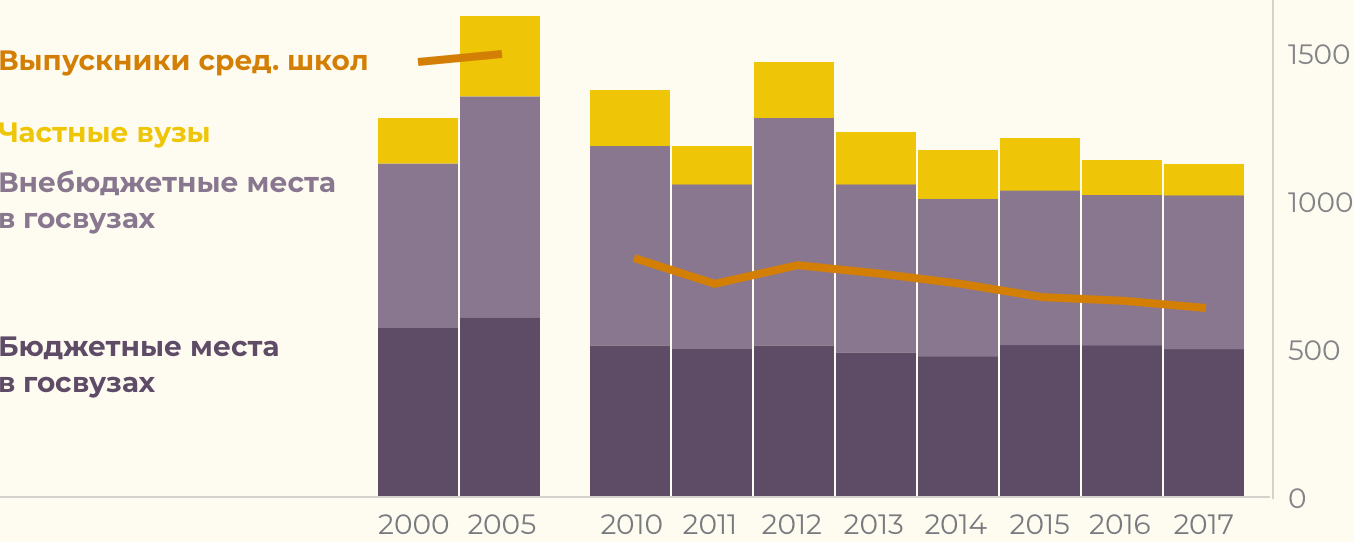
Free higher education was the pride of the Soviet Union. But not everyone could get to the university: for example, in 1980, 613 thousand people entered universities-every fourth of 18-year-old citizens. As soon as private universities began to appear in Russia of the 90s, as well as contract places in state bodies, everyone began to use this opportunity. Already in the zero number of payer students was equal to state employees, and by the beginning of the 2010s it was exceeded. In 2012, 65% of freshmen (given private and state universities), paid for themselves. Even in the state bodies of the wings were 60%.
After 2012, when the Ministry of Education and Science began the campaign to close “ineffective” private universities, the ratio began to align a little. In addition, the number of school graduates continued to contract. In the mid-2000s, children born in the mid-80s entered the university-it was a Soviet gear peak, after which it went down and over the next ten years fell twice. Graduates could easily enter budget places, the number of which almost did not decrease.
Read also:
A study on how several families divided the private education market in Russia
The ratio of the number of admission to universities and graduates of secondary school
Data on the number of admission is given for all forms of training, including the magistracy
65%
freshmen in 2012 paid for themselves
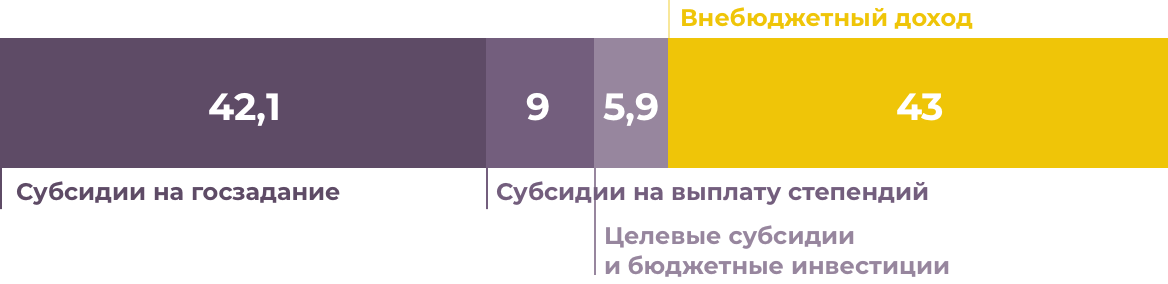
There is a second indicator demonstrating changes. In 2017, extrabudgetary income of 447 federal universities overtook the share of subsidies for state assignment, that is, the state ceased to be the main customer of universities not only in the number of students, but also in terms of the volume of earned.
The structure of the income of federal state universities in 2017, as a percentage
What universities live well
The study shows a deep abyss of prosperity between the overwhelming mass of Russian higher state -owned and a group of "privileged" institutions and universities.
Distribution of state bodies of income in 2017
Only
3 university
earned over 15 billion rubles
The state finances budget places (subsidy for state assignment) to all its universities, but this money is enough only for the salaries of teachers and the basic maintenance of buildings. Additional financing - targeted subsidies for repair, construction, purchase of equipment - not everyone gets. In 40% of universities in 2017, there were less than 10 million rubles. Or completely absent. But some universities get very large subsidies and investments - sometimes more than 1 billion rubles. per year.
Who is included in the group of "privileged"? This, firstly, is 21 participant in the 5-100 program-these universities should fall into world ratings. Among them, for example, St. Petersburg and Tomsk Polytechnic Universities, RUDN, Higher School of Economics, MEPhI, first medical named after Sechenov, Far Eastern Federal University. They got 40% of 44 billion rubles. targeted subsidies and budget investments (excluding scholarships) received by all state bodies.
The fifth part of the state injuries of Russia - 100 largest in income of universities - takes almost half of all students, 62% of the income and three quarters of the target subsidies.
At 21 university programs 5-100 are:
11% of students
19% of the income of all state units in Russia
41% of target subsidies
At the 100 largest universities (income) is:
46% of students
62% of the income of all state bodies in Russia
74% of target subsidies.
Universities that are not included in special groups, but for various reasons have a special status: mentioned above the RANEPA and Moscow State University, also receive large subsidies. Lomonosov, as well as St. Petersburg State University, Marine Universities, Crimean University, Financial University.
TOP-20 Russian universities, which the state loves most
Rating for the sum of targeted subsidies and budget investments without taking into account scholarships, billion rubles.
3/4
targeted subsidies falls on 100 largest universities
These are the flagships of higher education. But most universities receive almost nothing.
What universities live poorly
More than half of Russian universities receive only tiny subsidies. However, these universities also need overhaul of corps and new hostels.
Distribution of state bodies by the amounts of targeted subsidies and budget investments
Adequate reporting on targeted subsidies in 471 out of 495 state bodies
The largest number of state bodies receive subsidies before
10 million rubles
The worst of all is agricultural universities. Of the 54 universities of the Ministry of Agriculture, 40% received less than 10 million rubles in 2017. Since 2012, the Ivanovo agricultural machine has been asking for money for the repair of emergency premises in the Ministry of Agriculture - everything has been flowing in the old buildings - both roofs and pipes. In 2017, the university managed to repair one office and toilets in one of the four hostels, as well as to conduct water, sewage and “partially furnished” the bomb shelter - this is the instruction of the Ministry of Emergencies. The average salary of employees is 19 thousand rubles.
The university also does not have their money: there are only 20% of the Academy of 1.6 thousand students - extra -budgets. This is half as much as the average in Russia. There is almost no competition for admission to the Academy, even on the budget, the average score of the Bujnitnikov otnikov is 55: these are “hard” three-year-olds according to the calculations of the Ministry of Medical Sciences. Even more the Academy was leaning in 2017, when accreditation was withdrawn to her undergraduate for land management, economics and management and veterinary specialty, and she lost 281 students, mostly warders, mainly.
"Those who showed high results left to conquer large cities"
“On the ground floor there is a steady smell of sewage, on the second and third - toilet. The walls are scattered. On the ceiling in the corridor - ramps. In several places on the walls - metal screeds on the thread: they hold the spreading walls. In the household, so that the ceiling does not collapse, there are special designs: two wide metal strips (one rests on the floor, the other on the ceiling), two pillars between them, ”the Ivanovo Gazeta describes one of the hostels of the Ivanovo agricultural cabinet.
“The whole situation is still complicated by the fact that not all of the graduates passed the exam, not everyone overcame the minimum threshold, and those who showed high results left to conquer large cities” - from the report of the Academy on the 2018 self -examination (the spelling of the source was preserved - “Project”).
How big universities got the bulk of students' money
For the bulk of the Russian state bodies, the only way to scrape money for repairs, purchase of equipment and surcharges to teachers are students and other paid services. But not everyone can earn money. And not on everything.
Extra -budget income is distributed in universities extremely unevenly. For the 100 largest universities in general income (this is a fifth of all state bodies) accounts for 62% of the income of the total sector and 64% of all extra -budget revenues.
TOP-20 federal universities in the share of extrabudgetary income
The share of the top 100 universities in the income of all universities from all sources
62%
The share of the top 100 universities in extrabudgetary income of all universities
64%
If we analyze what education state bodies earn in, it will become clear that often it does not correspond to the profile of educational institutions.
The Kazan Agrarian University, for example, has a very high share of extra -budget income for agricultural university - 81%. In 2018, the university reception plan included 712 points: 379 state employees and 333 raiders, and only two of the latter - in agricultural specialties. The rest are economists, managers, Kadastra specialists. The average score of a beltov (state employees and raiders) in 2018 is not bad - 59, higher than the conditional border between the Troika and the Four. But the correspondence-in-laws, whom the Ministry of Education and Science in the analysis of the quality of admission does not take into account, were able to enter the specialties “Land Management and Cadastre”, “Economics” and “Agricultural Procedure” (this is the cross between the mechanization and automation of agriculture) with an average score of 40–45. Correspondence education at this university is fantastically cheap: from 30 thousand rubles. per year. The minimum USE score is 27 in mathematics and 36 in the Russian language. In other words, future designers of greenhouses and elevators could hardly finish high school.
It is most stable to earn money to large universities: all universities with an income of more than 2 billion rubles. More than 20% of extrabudgetary income is obtained per year, and the majority - more than 30%.
As the most state universities in Russia became the most paid
Paradoxically, the “most paid” universities in Russia turned out to be two forges of personnel for the state: RANEPA and MGIMO.
In the largest university in Russia, the RANEPAS is 83% of students out of 93 thousand - payers, the university in 2017 received 60% of their income of 20 billion rubles from extrabudgetary sources. The education is expensive: up to 320 thousand rubles. per year.
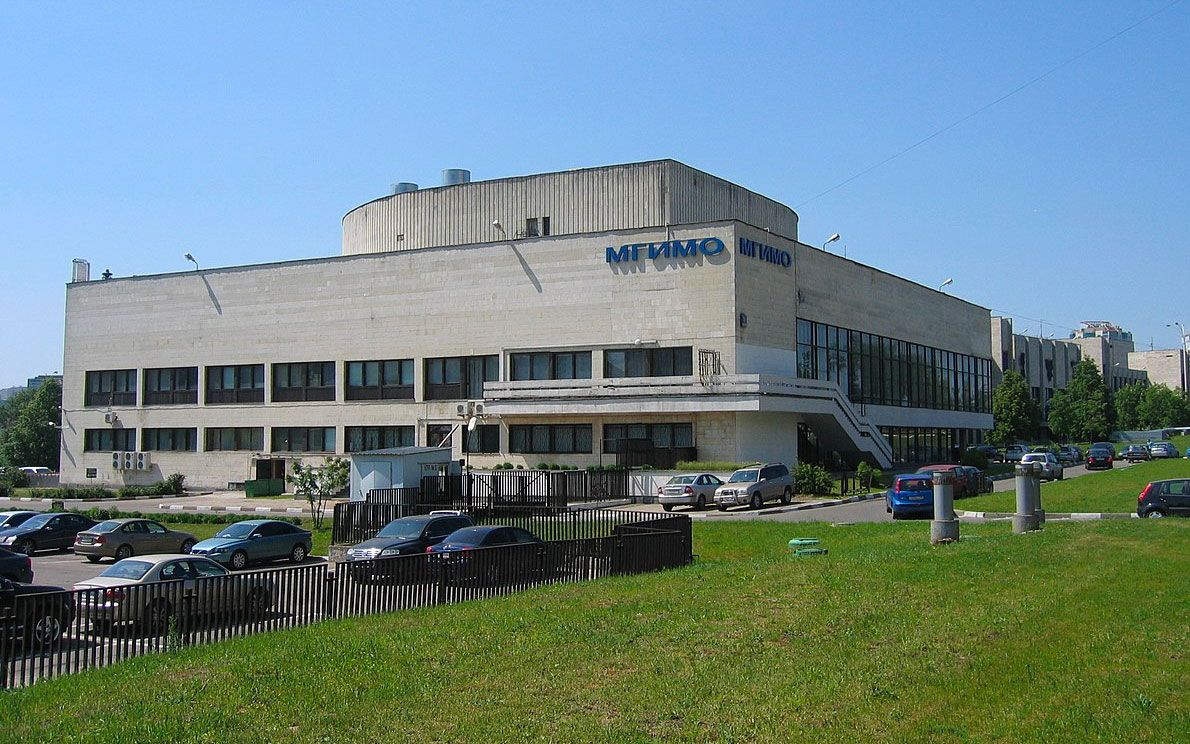
In 2017, MGIMO received 78% of his income of 4.2 billion rubles from extrabudgetary sources. There are 63% of 9 thousand students - extra -budgets and the most expensive education among state universities: full -time undergraduate costs more than 500 thousand rubles. per year. Despite the high entrance score, which, it would seem, should guarantee the intellectual level of those received, graduates and students of MGIMO often find themselves in the center of scandals. In 2016, the rector of MGIMOM Anatoly Torkunov was forced to personally respond to the gross public statements of the daughter of a Chechen entrepreneur, the owner of the Alliance group Musa Bazhaev, Elina, and on the quality of life in Russia.
In MGIMO, the same feature as in less well -known universities - he teaches for money that he does not teach for free. For example, in the specialty "Management" - these are 93 places of all 840 paid - you can only learn at your own expense. For 86 paid places in the "public administration" accounts for only 10 budget ones. In more than 40 regional branches of state bodies, there are no budget places at all: these are the branches of the RANEPA (there are 38 of them in total, without budget places - 9), REA named after Plekhanov, Kuban State University, Russian State Social University.
In REA to them. Plekhanova with an income of 7.6 billion rubles. In 2017, extrabudgeters - 77% of 44 thousand students. In RUDN, extra -budget income in 2017 - 72% of 9.1 billion rubles. General income, extrabudgetary people here are 71% of 25 thousand students (25% of students there are foreigners).
TOP-10 richest rector of state bodies
Rector's personal income rating in 2017, million rubles.
How poor universities become even poorer
If large state bodies with sonorous names have learned to earn money on payers (albeit teaching them not always what corresponds to their profile), then there simply is nothing to earn on some institutions and universities.
For example, half of the universities of the Ministry of Culture (45 of them) receives less than 20% of income due to the extra -budgetary sphere. At the Oryol Institute of Culture, for example, only 5% of students study for a fee. The average salary of a teacher is 24 thousand rubles with an average of 26 thousand rubles in the region.
The ratio of total income (billion rubles) and the share of extrabudgetary income of universities (%)
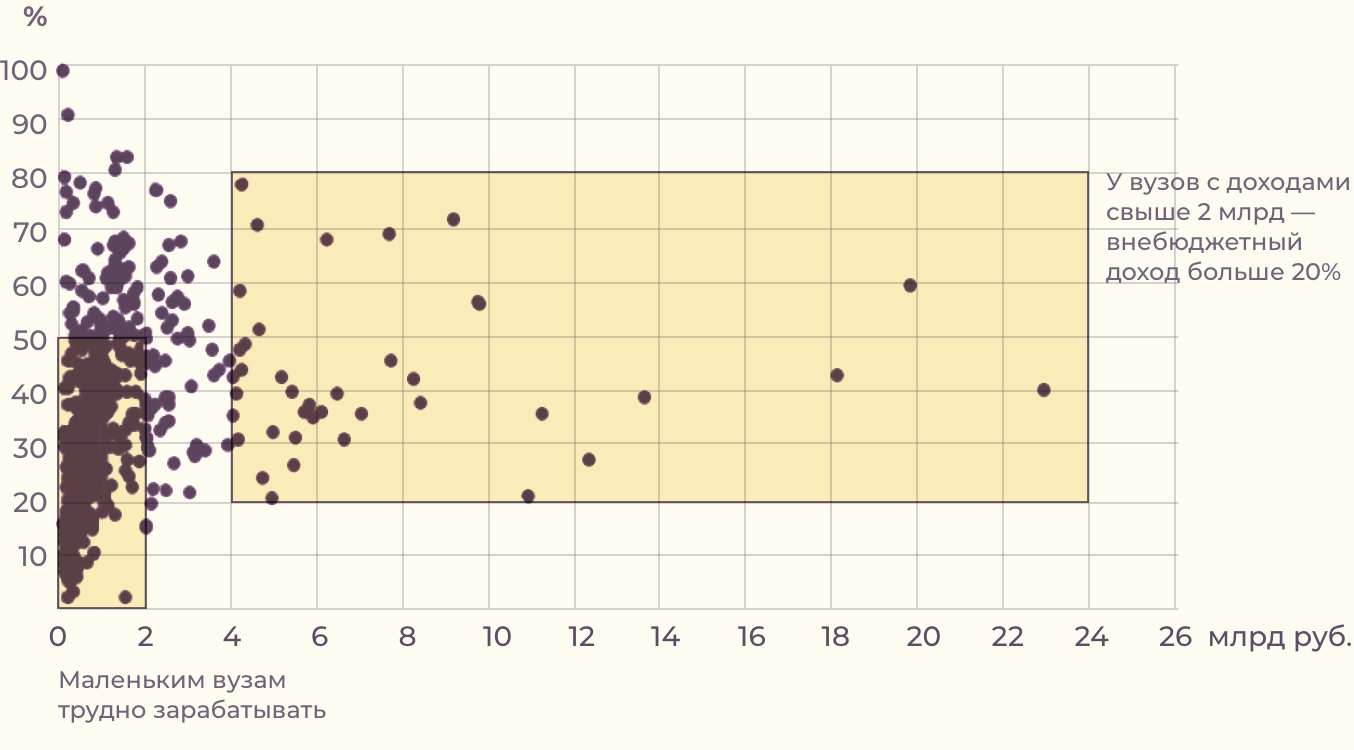
142
the university received in 2017 less than 10 million targeted subsidies, 42 - nothing
In this “gray zone” of universities, “economics”, “quality management”, “psychology”, “government”, “management”-specialties that appeared in Russian higher education back in the 90s, and became a symbol of its poor quality reign. It is with the help of these specialties that small universities are trying to survive.
In 2017, economics, jurisprudence, management, government received 25% of freshmen for groups of specialties. And from among the extra -budgets - 40%.
In addition to these traditionally well -sold specialties, the demand for pedagogical education has grown in recent years. According to the Higher School, in 2011, 10% of freshmen-sculptures entered pedagogical specialties at their own expense, in 2018 there were 31% of them. The teacher’s salary is a good and, most importantly, stable income, especially for rural areas. For the budget for pedagogical specialties, the average score is almost more than 60 everywhere. On extra-budget with future teachers, everything is worse: in a quarter of universities, where in 2018 teachers were received, the average score did not exceed 56.
“Chronic troecleers have not disappeared from the system of Russian higher education. Clients of the institutions of management, business and design, which gave diplomas to anyone, are now entering a little big money to pedagogical institutions, ”says Mikhail Sokolov, professor of the faculty of sociology and philosophy of EUSPB
How Russia has become a country of three engineers
The desire to somehow earn money led to a significant deterioration in the quality of admission to universities: both for paid and budget departments.
Each year, HSE publishes data on the quality of admission (average USE score) for full -time departments of state bodies. According to these data, in 2012, when the Ministry of Education and Science of the Combating the quality of the reception began, the average score of all the scams of the budgets was 63.5 points, extra-budgets-56.6. But it was possible to enter the budget even with an average score of 30. For example, at Mechanical Engineering at the Bryansk Technical University - with an average score of 32, for energy at the Astrakhan Technical University and for the operating specialist of aviation systems in the Volga Academy of Water Transport - 36 points.
In subsequent years, the “triceps” became smaller, however, the average points of the USE grew in Russia: the Russian language, for example, from 57 points in 2009 to 71 in 2018 (the nature of growth, however, was not explained in any way).
In 2018, the largest universities in the number of students received points with an average score above 60. Leaders in quality of budget reception-MFTI, MGIMO, St. Petersburg State University, and the Higher School of Economics in Moscow and St. Petersburg-also occupy the first five places in the quality of extra-budgetary reception.
Again a deuce
EGE points
Conditional "Troika" - up to 56 Bathing Four - from 56 to 70 points "Excellence" - above 70 points
Minimum points for admission:
Mathematics - 27 Russian - 36 attribution - 42physics - 36 English - 22informatics - 40
But ordinary provincial institutions have to deal with a much more rough reality. In the Buryat State University in 2018, the average score to budget places in the specialty “Physics” - 51. In extrabudgetary places in the specialty “Quality Management” at the Saratov Agrarian University - 37 points, budget - 53 points.
In 2018, most universities scored economists-universities with an average score below 60, a quarter below 56. There were no budget places in the Ural University of Railways in Urals, only 330 extra-budgetary places, the average score received amounted to 56. There were no budget places in the North Ossetian University in the specialty of Oriental Studies and Oriental Studies and Oriental Studies and Oriental Studies Africanism ”, but the university scored 8 points-in-laws with an average score of 52. At the Orenburg Medical Institute, the invaders-in-laws barely overcame the threshold of the Three with an average score of 57.6, and there are more than half of them at the university.
What awaits state higher education
In order to improve the quality of admission, officials will have to reduce the number of budget places. And you can just do nothing, waiting for a new demographic peak.
To increase the interest of young people in the so-called “real sector of the economy”, the Ministry of Education and Science reduced budget places in socio-economic directions and increased them, for example, in computer science, and in some years and on technical specialties. As a result, there was a dangerous skew that made complex specialties available to the three -eatingrs.
Например, в 2018 году на бюджет на специальность «авиационная и ракетно-космическая техника» в Ульяновском техническом университете поступили абитуриенты со средним баллом ЕГЭ 52. На «авиационные системы» в Мурманском университете — 55. На «автоматику и управление» в Северо-Кавказском горно-металлургическом институте — со средним баллом 47.
Еще больше их на внебюджетных местах: по специальностям «автоматика и управление», «энергетика» и «информатика» больше половины вузов набрали очников-внебюджетников со средним баллом меньше 56, по «геодезии и землеустройству» и «строительству» почти все вузы довольствовались студентами с такими баллами.
Зато журналисты и лингвисты на внебюджетные места чаще всего поступают со средним баллом больше 65. Даже в Санкт-Петербургском университете аэрокосмического приборостроения средний балл лингвистов-внебюджетников — 76, ну, а в ведущих классических университетах баллы еще выше.
Наверное, улучшить качество приема по важным для экономики профилям можно было бы, сократив количество мест в вузах, как бюджетных, так и внебюджетных. Пока Миннауки решилось сделать это для магистратуры: в 2019 году прием на бюджетные места в ней будет уменьшен на 37%, с 205 тыс. до 129 тыс. человек. Но сокращать бюджетные места для бакалавров рискованно, а внебюджетные — очень невыгодно.
Прогноз численности потенциальных первокурсников в России до 2035 года
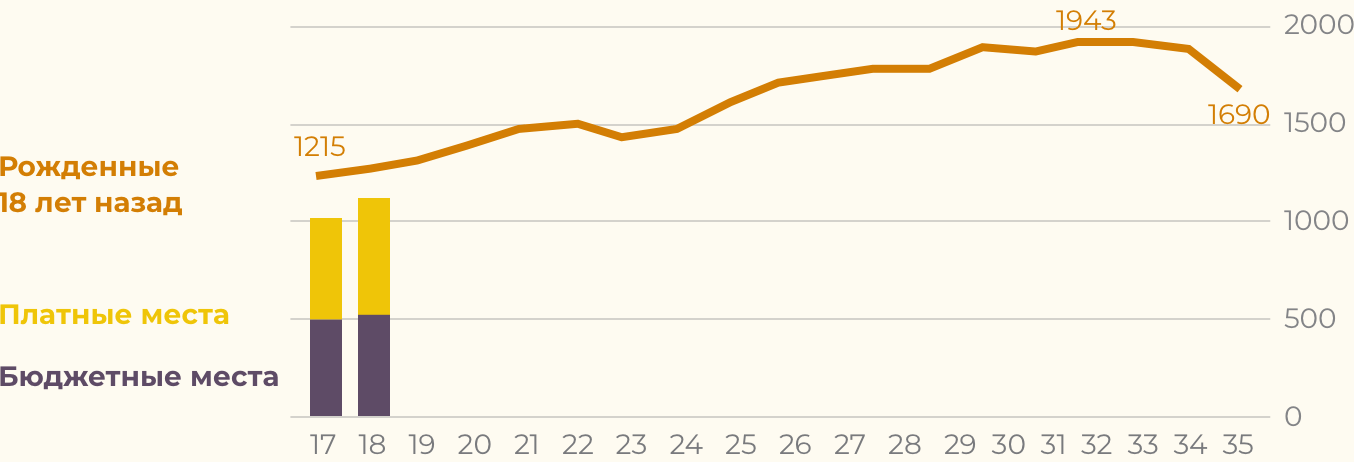
Конкуренция за бюджетные места, скорее всего, будет расти
Есть еще один способ: вообще ничего не делать.
При сохранении текущего количества бюджетных мест конкуренция за них будет все сильнее: как раз с 2000 года, когда родились выпускники школ 2018 года, рождаемость в России начала расти. Если оставить все как есть, к началу 30-х годов этого века вузы автоматически будут получать примерно в полтора раза больше умных студентов, чем сейчас. И, возможно, мы услышим от будущего министра науки и высшего образования России, что это его заслуга.