
Translated material
And about the weather ...
These weather forecasters - well, what they want, then do
? 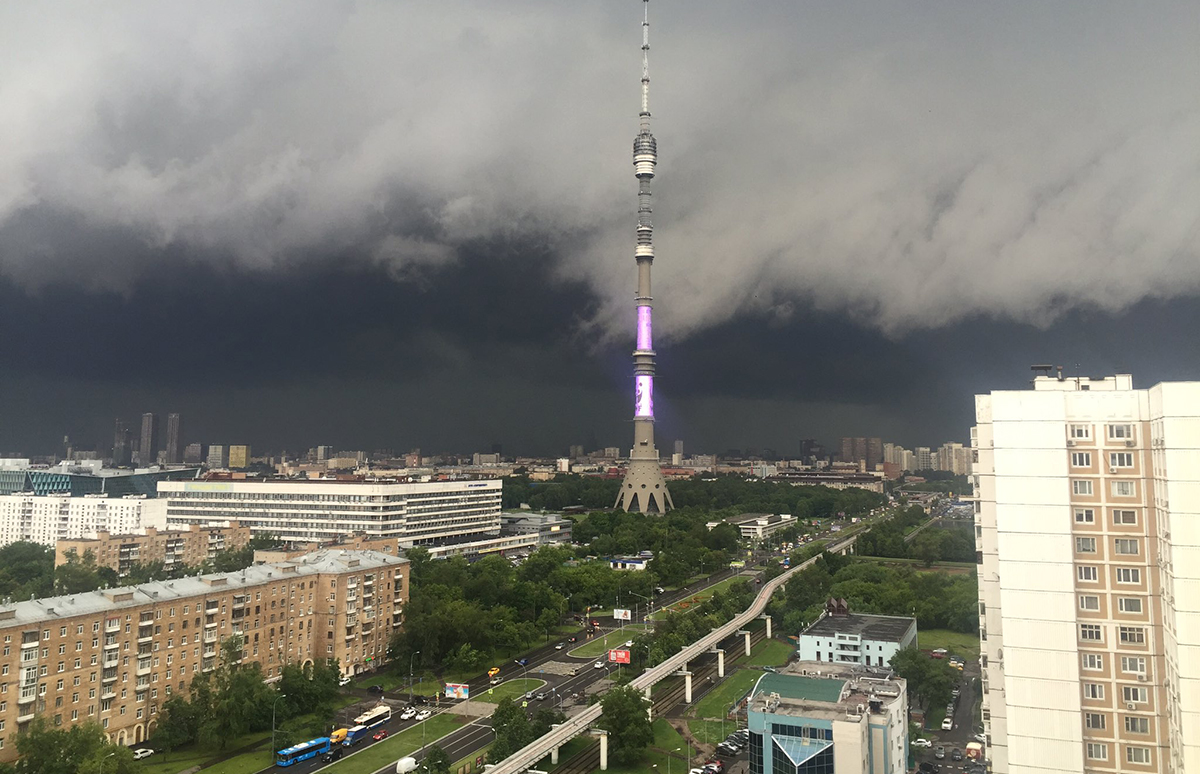
Photo: Twitter.com
We are convinced that weather forecasters, which, according to a well -known joke, are to blame for what is happening outside the window. But what do they do and how long this disgrace will continue - found the New Times
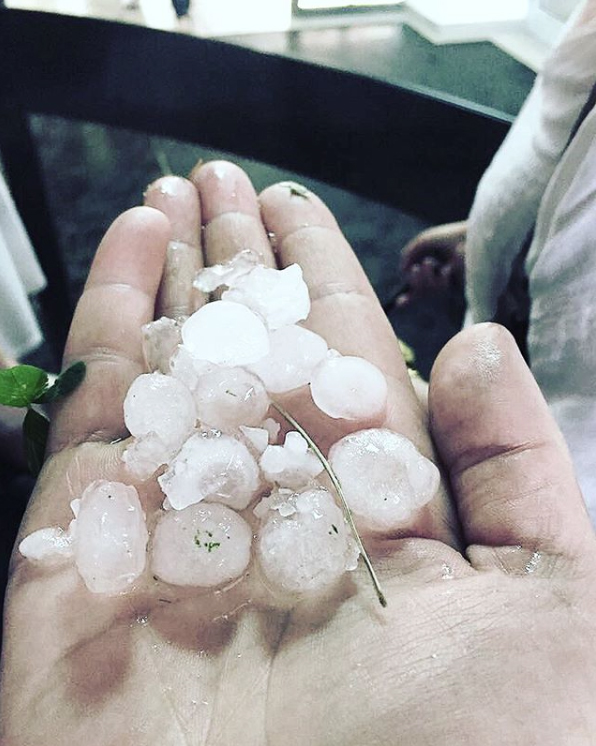
Photo: screenshot from Twitter.com
Moscow was covered again: rain, hail, thunderstorm, squalling wind - all one after another or at the same time. And also a fantastic pierce: in one window, our employee photographed how grades the size of large peas were pounding on the glass, and there was no city in the window of the next room, so, a quiet rain ... and another rare and frightening phenomenon was noted last weekend Muscovites. Before the start of a thunderstorm, impenetrable blackness fell on the ground - just like Bulgakov’s: "Darkness, which came from the Mediterranean Sea, covered the city hated by the prosecutor ..."
Well, who is able to predict this? Well, if at least in general terms it succeeds. As it was sung in Soviet hits: “And outside the window is it rain, then snow ...” and “Northern wind, moderate, to strong ...”
Dear pleasure
If the weather had not changed, nine out of ten people could not start a single conversation. Among the most popular keywords on the Internet are the weather - in an honorable fourth place, immediately after sex. When in 1872 the first subscription to the annual publication about the weather was announced in Russia, a terrible excitement happened in society, although the pleasure was expensive. They say that it was this resonant event, and not preceding him the output of the first daily ballot with the forecast, that made him consider the 1872th date of birth of the domestic weather service. Although by that time meteorology in Russia had already had rich experience.
Tsarist business
Regular observations of the weather was the first to install Tsar Alexei Mikhailovich. At his command, astronomical tools and meteorological devices were brought from Europe, including the invention of Evandzelist Torricelli, a student of Galileo, a barometer. However, Afanasy Matyushkin, the son of the clerk, appointed by the king, did not use overseas tsatski. In the “Little Entities”, he recorded mainly his own observations: when the rain began, when it ended, when the Moscow River froze, when the ice opened.
Among the most popular keywords on the Internet "weather" - in an honorable fourth place, immediately after sex
Peter I introduced observations of weather into fashion. Preparing in Riga for the war with the Swedes, the king daily made notes in the camp journal. “March 31. It was gloomy and warm with the rain: with noon time there was a zyuid-ohst, and Zuyid, and Zyuid-west, frost was neither at night, nor a day, but the rains fell with warmth. With the arrival of our frosts, when they were only in the morning, and at half a day it always melted, as it was not cold from Nord and Nord-west, and in the evening there was never frost, also a Nord-west, although it was cold. ” The fleet commander Cornelius Kruisy sent his observations from St. Petersburg - for comparison. Among other things, the testimonies of the first water meter in Russia on the Neva near the Peter and Paul Fortress. Since March 1722, according to the highest commanding of weather observation in St. Petersburg, they became systematic. All the same Kruis was responsible for them, now in the rank of vice president of the Admiralty-Collegies, he also conducted records. “April 22, Sunday. In the morning, the wind is Nord-west, the water is as mentioned above, cloudy and jelly. At half a day, the wind is small Nord-west and rain in the afternoon, quietly and red day until the evening. ”
In 1725, the first weather station began to work in the newly created Academy of Sciences: now scientists were observed behind the wind and precipitation using a barometer and thermometer. Personal astrologer Anna Ioannovna, professor of natural physics Georg Kraft, between the forecasts for the empress, issued its contribution to meteorology, published a brief description of the most weather and various air changes that have been here in St. Petersburg from the beginning of 1726 to the end of 1736. " Kraft tried to establish cyclicity in the onset of strong cold weather, which occurred in Europe and Russia every 30–40 years. The scientist proposed creating a network of observatory in Russia to anticipate dangerous atmospheric phenomena, but no one supported the idea.
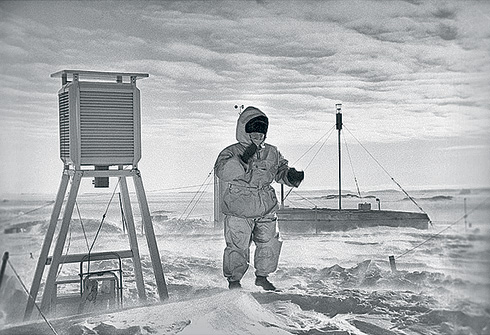
The methods of forecasting the weather in Russia was developed by Alexander Voeikov at the beginning of the 20th century. Now the oldest meteorological institution in Russia - the main geophysical observatory - is named Voeikov and is engaged in research in the field of climatology, dynamic meteorology, aerology, actinometry and other branches of atmosphere physics.
They were the first
Everything changed after the second Kamchatka expedition. Peter was still equipped with the first to study the northern part of the Pacific Ocean and find out if Asia is connected to America. Fierce frosts prevented expeditions, led by Vitus Bering, to carry out the plan. Then he organized the second, larger, which was called the Great Northern Expedition. It consisted of several detachments and lasted ten years. The academic detachment was supposed to organize, in the course of advancement to the east, meteorological observation. This was done by John Gmelin and Stepan Krasheninnikov. Kazan, Yekaterinburg, Yeniseisk, Krasnoyarsk, Irkutsk, Nerchinsk, Nizhnekamchatsk - only 24 weather stations, where they watched the temperature, pressure, wind and polar radiance. ?
Kraft tried to establish cyclicity in the onset of strong cold weather, which occurred in Europe and Russia every 30–40 years. The scientist proposed to create a network of observatory in Russia to anticipate dangerous atmospheric phenomena, but no one supported the idea
“At the beginning of 1739, for the first time, it was thrown out of that place as if a fire ball, which, however, burned out the entire forest near the lying mountains,” Krasheninnikov wrote about the eruption of the Tolbachik volcano. In the four years that Krasheninnikov spent in Kamchatka, he investigated and described all volcanoes, geysers, rivers flowing into the ocean. The great trip to the east not only opened the southern Kurils and the American coast, confirming the presence of the strait (since then - Berengov), but also contributed to meteorology. It is this time that the first historian of meteorology, the author of the famous work “On the Climate of Russia”, published in 1857, Konstantin Veselovsky, considers the beginning of “correct observations”. Since the middle of the 18th century, interest in the weather has become more scientific and in demand. Not a single report to the mayor did without information about rain and wind, there were messages and higher. As a result, in 1777, for example, a warning service was created for residents of St. Petersburg about the dangers of water lifting. In the afternoon, the flood was warned with a red flag and shots from the gun, at night - with the lights of three lamps. Nevertheless, there were few stations, mainly in large centers, observations were carried out differently and irregularly. Mikhail Lomonosov prepared a project on how to organize the weather service in the empire, but the project was put under cloth. Only at the beginning of the 19th century did all Russia's educational institutions receive an order to establish meteorological observation. But no one checked its implementation, especially since he did not collect the data. (Surprisingly, in Soviet times, this tradition was restored - with each, even a small village school, there was a weather site with a weathercock, a temperature booth and a bowl for measuring precipitation. But the data also did not interest anyone).
Monitoring of misfortune
Permanent natural misfortunes are forced by “profile” departments - sea, road routes, land, forest - to organize their own network of weather stations. Scientific societies do the same. Information about the weather is becoming more and more. Information about urban and floods begin to print magazines. The magazine of the Ministry of Internal Affairs, especially the “misfortune” magazine, was very popular in Nikolaev Russia, where the summary menstruation tables of natural disasters were printed. ?
Only at the beginning of the 19th century did all Russia's educational institutions receive an order to establish meteorological observation. But no one checked its implementation, especially since he did not collect the data?
But if you thank for something Nicholas I, it is for the decree on the creation of the main physical observatory-the Federal Penitentiary Service. Its first director Academician Adolf Kupfer was not only a wonderful scientist, his no longer dignity was the ability to convince. The main physical observatory was opened thanks to its efforts. Budget - 500 rubles. In the year, the staff is seven people, and yet it is a center of meteorology, it processes the data of all observations in the country, supplies the stations with devices and methodological instructions, and conducts inspection. The authority of Kommer, who headed the Federal Security Service for 15 years, helped him organize a constant exchange of meteorological data between Russia and France, he agreed with other European countries on telegraphic exchange, but this has already happened without it. Returning to St. Petersburg from Europe, in the March cold, he installed an anemograph brought from Paris on the roof of the observatory (self-recording windmer), caught a cold and died. Another director of the Federal Security Service of Henry Wild was no less vivid figure in meteorology. Under him, the weather service became the largest in the world. At the same time, 30 state weather stations and several hundred volunteers - gymnasium students, priests, military - transmitted information on telegraph to the capital. Under Wilde, the Federal Security Service began to publish synoptic maps of Europe and Siberia, the already mentioned daily weather newsletter. The Russians invited the weather researchers to unite, and in 1873 Congress in Vienna approved the international organization of meteorologists. Wild became the head of the International Committee, which, among other things, organized the holding of the 1st International Polar year. The observatory celebrated the 50th anniversary of the “Climate Atlas of the Russian Empire”, where all meteorological observations collected in half a century were published.
Nature has no bad weather. ?
All weather is grace. ?
Is it raining, snow ...
Any time of the year?
We must gratefully accept ...
Eldar Ryazanov
? Each has its own "time"
Today, the exchange of information about the weather around the world is in real time. The World Meteorological Organization includes 11 thousand ground stations, of which one and a half thousand work in Russia. The temperature, pressure, strength and direction of the wind, the amount of precipitation is measured for centuries with verified methods. Every three hours, or even every hour, the meteorologists “Term” - data transfer. In addition to the classic, digital stations also work. More than a thousand mete -wings are drifted with the ocean current. At an altitude of 30–40 km, aerological probes are observed. At midnight and at noon in Greenwich, they transmit the temperature, humidity, and pressure of the atmosphere. On certain points of the equator at an altitude of approximately 36 thousand km, seven geostationary satellites hang (two - USA, two - China, one - India, one - Japan, one - the European Union). They give an almost complete overview of the earth's surface. Polar-orbiting weather recruits move at an altitude of approximately 800–900 km from pole to pole (one-USA, two-China, one-the European Union, one-Russia). You go to the Internet - and get any information about the weather. We are already accustomed to road weather stations in a car that show the temperature, and the most “sophisticated” are another side wind and wet road. Recently there was a replacement for grandfather-barometer-household weather stations. Show the temperature in the house and on the street, humidity, atmospheric pressure and weather forecast for a day.
? Follow the wind
The weather is constantly experiencing us not washing, so skating. The last winter is frosts and snow, the current one is its enduring. One comfort - this has already been more than once. In 1908, winter stood until mid-April, and then the Moscow River, Yauza and the drainage channel spilled so that they flooded the fifth of the city. The water level rose nine meters. The areas of the right bank of the Moscow River were especially damaged, the Kremlin walls stood in water for more than two meters. So it’s better to relax. The current climate is fundamentally no different from the climate of the last millennia, but it is in the process of constant changes, the main reason for which is the natural cyclicity of nature, the honorary president of the Russian Geographical Society, a member of the intergovernmental group of experts on the problem of climate change Vladimir Kotlyakov believes. This discovery is one of the most significant in the science of the land of recent times. It was made on the basis of the study of the Antarctic glacial core of 3623 m, which allowed to trace climatic conditions for 420 thousand years.
... And now about the weather. Badness always comes from the west. So - follow the wind ...
In 1908, winter stood until mid-April, and then the Moscow River, Yauza and the drainage channel spilled so that they flooded the fifth of the city. The water level rose nine meters
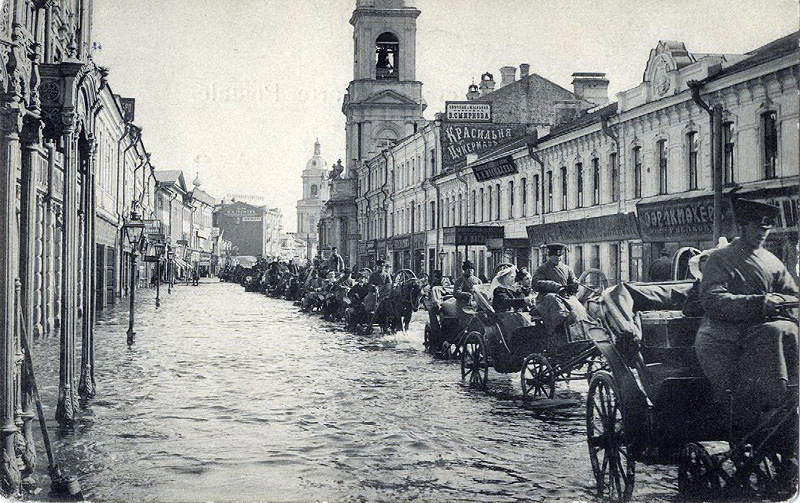
Moscow flood of 1908. Photo: nik191_mirtesen_ru