
Translated material
Songs of Soviet suicide bombers
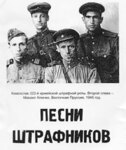
*And the king was drinking with that venom
Their obedient arrows
And with them he sent death
To the neighbors in foreign limits *Alexander Pushkin. Anchar. 1828
With the word “fines”, everyone at least a little acquaintance with Soviet history gives a number of very sad associations: “wine before the Soviet homeland”, “atonement” of this guilt rivers of blood, frontal attacks on machine guns, hundreds of thousands of without a trace that disappeared. It would seem, in such conditions, when death is not only nearby, but also behind, the penaltymen had to lose human appearance. However, there is documentary evidence that even constant mortal danger cannot make people abandon love for poetry and music - for songs.
In the Kiev publishing house "Planet of People" a circulation of 50 (fifty) copies recently a small (152 pages) collection "Songs of the penaltymen" recently published. It arose on the basis of a notebook, which was led by Mikhail Klyuchko, the platoon commander of the 322nd separate army penalty area of the Red Army. This man stayed for three years with a “laborer war”, reached Germany, returned to his homeland and lived until the beginning of 2003. In recent years, in three millionth Kyiv, this was the only veteran penalant.
The young Ukrainian historian Sergei Weigman preserved and published a notebook with songs of people who can be confidently called Soviet suicide bombers. According to data given by Colonel General G.F. Krivosheev in the collection "Russia and the USSR in the wars of the 20th century", "The average monthly losses of permanent and alternating personnel of all penalty units per year were ... 52% of their average monthly numbers. This is 3-6 times more than the total average monthly losses of personnel in ordinary troops in the same offensive operations of 1944."
In relation to the Soviet regime, fines are more likely to be a victim, and not rebels or resistance participants. As a rule, they were not sent to the penal companies and battalions “politically unreliable” - most often they were shot: it was believed that, having remained at the front, such a person could cross the Germans. Therefore, there is no "anti -Soviet song and dance" in the collection. Most of the 74 presented literary and musical works are a regular repertoire from a camping satchel with eternal topics for soldiers: about a distant beloved, victory over the enemy, mortal danger, injuries, support for comrades. Some of the texts are popular city romances, there are thieves' songs: there were many criminals in the penalty parts.
But there is something that in the official collections or repertoire of the circle and Shufutinsky will not be found. For example, songs about "hiking and field wives" (PPZ)-women-military personnel who have become mistresses of front-line soldiers (mainly, of course, officers). Feelings of fines in relation to these women are not the most benevolent:
*When the soul is longing
And curses everything in the soul
Then brings a lot of joy
We are dear PPZh.*
She will come in, shiny,
It will become lighter in the dugout
But cold nights
You are dear to us, PPZ.
Now all the affectionate with you
You have success everywhere,
But I am a soldier's soul
I despise you, PPZ.
Now she lives freely,
All night (the word is crossed out) a friend-friend
But the battle finished - it will hurt
Look at you, our PPZ.
Then you will resort in vain
It offers the right PPG,
Cloud of accusation and scorn
The PPZ is rushing after you.
Often women became PPZ not of their own free will-at the front you will not really argue to the authorities. But in the songs of the fines there is no element of sympathy. To the "simple" PPZ - contempt, to those women who managed to take advantage of their position - contempt in half with hatred. I recall the lines from the novel by Milan Kundery "joke". The thoughts of the protagonist (the Czech penalant) after his comrades were produced to the death of a naive and weak soldier: “I doubted the values of our solidarity, which was caused - under the pressure of circumstances - the instinct of self -preservation, driven us into a friendly flock. I began to realize that our“ black ”team is also able to spend one person (send it into expulsion or death) ... Be, and any human team. "
On the edge of the death, the fines did not alienate humor. Sometimes he was quite a bit with official propaganda. For example, in the collection there is a kind of variation on the famous song "Dark Night" from the film "Two Fighters":
*Dark night
Only the Germans run along the steppe,
And from fear it gets in the eyes
At the running Fritz.*
On a dark night
The Fuhrer is not sleeping in the armored train
And with the car there and back
Day and night is sausage.
How is it a shore depth of his defense,
But still
He failed to hide behind her,
Dark night
Became Hitler twice as dark
And now the position of it
There is no good.
On a dark night
Ministers leave south,
Became Berlin for ministers.
Surprisingly fast.
On a dark night
They think a quick kayuk,
Dark night, therefore in the rear
The ministers are fleeing.
No matter how Verti, they can’t go anywhere now,
Let him rush
They leave the capital.
At least underground, we will be able to find them everywhere,
From the court even on a dark night
No one to hide.
This model of soldier's folklore was printed on February 3, 1945 in the Krasnoarmeyskaya Pravda newspaper. But a parody that it is simply impossible to present on the pages of the official press. Until now, the youth of not only Russia, but all of Europe know the melody of "Song of Victory". The author of these lines heard her from the Italians (though with the text about "the little Cossack Ivanov, who was dancing in the steppe"). “Katyusha” performed by the gypsy “ensembles” willingly listen to passengers of the Berlin metro. It is all the more interesting to find out what the inventive soldier’s mind has reached in a freely mockery of officialdom.
*Bluttered apple trees and pears,
Fogs sailed over the river,
And in the green garden Katyusha
Kissed the feldfebel elderly.*
Katyusha has forgotten the past
Vani's letters in the stove burned everything,
Next from German cuisine
The old man was found.
Brought her a cook daily
Crusts of bread, bacon and sausage.
And for this dear Katyusha
She was given often to him.
You sit and hide that smile
The one that Vanya fell in love with you
And now the old man has stolen a skirt at the mistress
And brought a gift for you.
Relatively few in the collection of lines and longing: death and so close, why still poison the soul before the battle? But still they are - and the most gloomy impression is made by a terrible parody of a pre -war song hit "Comrade flies away to the distant land" (Cinema "Fighters", 1939):
*The guys are leaving to the distant land,
How will their harsh edges meet?
The beloved city in the spring haze melts,
Mother remained, sadness in the heart, in the eyes of longing.*
Let the tears pour goodbye,
Uzkry a tear from a rebellious face.
The border is waiting for a test
Calm and brave fighter.
Shells were torn, wrapping in smoke,
Bullets whistled, carrying death with them,
And through a heavy fight they whispered,
About the house of the native, green garden, her eyes.
We sent the wounded to the hospital,
Treated them, sewed doctors,
And through a heavy dream they whispered
About the house of the native, green garden, her eyes.
When my comrade will return home,
The chest is broken, the leg is torn off,
And they will never smile at him
Those cute, beautiful eyes.
Cripples do not like blue eyes,
You have lost health, friends,
You defended the cities of the native
And forever your eyes closed for you.
12/27/1944, the village of Schillupenen, East Prussia