
Translated material
From the hall - here
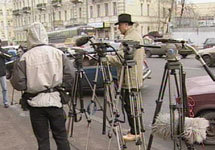
"The dominant of today's process - we were waiting and angry." So the first day of the court in the case of Khodorkovsky -Lebedev described the lawyer of the former head of the Yukos Yuri Schmidt. With these words, more than a hundred journalists would agree, who on this day came to the building of the philistine court.
Troubles began at the entrance. The security service carefully inspected each journalist: it was forbidden to carry any devices with the help of which you can shoot, up to mobile phones with built -in cameras. Although the court was declared open, only those who could present a passport or a press certificate were passed inside. Tabu on cameras was completely illegal - according to the law, the judge can prohibit photography and conduct video shooting only during the court session.
At first there was a hope that the court would meet reporters and try to create the necessary conditions for their work, thereby ensuring the public proceedings guaranteed by the Constitution. Shortly before the process, the chairman of the Union of Journalists of Russia Igor Yakovenko and the president of the publicity protection fund Alexei Simonov specifically appealed to the chairman of the philistine court with a request to help reporters performed by their professional duties. Not spoiled by the assistance of the authorities, representatives of the press wanted only one - to be present in the courtroom. Then the answer came from the chairman of the court that, they say, of course, we will help - we will allocate a large hall for the process. Those who are familiar with the building of the philistine court thought that we were talking about a hall located on the second floor, which could be accommodated about 50 people. But it turned out that the chairman had in mind the choice not between large and small, but between small and tiny. The consideration of the case was scheduled in the hall on the ground floor, where only twenty spectators are placed. As a result, a crowd gathered in the corridor, which was barely restrained by the cordon of the seven riot police.
The cluster of the people greatly interfered with the work of the court: the judges were forced to make their way into the hall with the help of an icebreaker - the bailiff. When the bailiff began to call lawyers in the hall, they at first simply did not hear him. Well, one of the journalists shouted: "Guys, who is closer to the edge, call lawyers!" People parted a little and gave sixteen lawyers to pass. Then the most unpleasant began: the bailiff said that since not only the relatives of Khodorkovsky and Lebedev have a priority right to attend the meeting, but also foreign lawyers who cannot participate in the process as defenders, then only eight places remain in the courtroom. The crush has begun. OMON tried to push the journalists by force. Several points were broken, the recorder was broken, fountain pen was crushed, but eight lucky people entered the room.
As soon as the meeting began and the passions subsided, the journalists tried to somehow agree, so as not to interfere with each other to work. It was decided that the representatives of the press in the hall would change after each break, and in addition, they installed a quota for foreigners: one English -speaking journalist, one German and one Frenchman were taking place into the hall. For simplicity, the Spaniards and Chekhov attributed to simplicity to the English -speaking. So far, lists were compiled, an elderly person-an employee of the Russian-speaking American publication from a group of Russians was all the time: he was constantly thrown out of the domestic lists, because the newspaper is American, and from the lists of foreigners-because he says in Russian.
Journalists who did not get into the hall, waiting for their turn, were looking forward to a break in a stuffy corridor. From time to time it reached them from time to time: "Swo-bo-b-do! Swo-bo-b-do! This is the Conscience group, created to support Mikhail Khodorkovsky, led to the court of the trial of its activists. Then the bailiff appeared again: “Guys, you would disperse along the corridor: the court continues its work, now drug addicts, killers and crooks will be driven by you. In addition, there are police officers here, and they can react incorrectly ...”
Shortly before the break, someone suggested once again to ask the chairman of the court to give the press the opportunity to work normally: to equip the meeting room with cameras and just conduct a broadcast - since not everyone can be present in the hall, even if they look at the corridor how this is done, for example, in the Constitutional Court. Immediately on a sheet of someone’s notebook, an appropriate appeal was written, under which all the journalists present signed. The paper was taken to the chairman’s reception, but they did not receive an answer.
Finally there was a break. Poor lawyers nearly trampled - everyone tried to break through, ask their question, get their part of information. To each of the journalists who fell into the hall, they rushed to the returning one with the advanced: "Well, what is it? What does it look like? What was something? Why so long?" - "Yes, it seems to be nothing. They are sitting behind bars, in the hands of Khodorkovsky a volume of the Constitution and two albums with family photographs, and Lebedev brought a bottle of kefir ..."
The break ends, the composition of journalists in the courtroom changes - and again an angry and languid expectation.
The results of the first day were deplorable - Khodorkovsky and Lebedev were not released. The authorities, this time its judicial branch, demonstrated neglect of the law. The Meshchansky court ignored the recent decision of the European Court of Human Rights in Strasbourg in the case of Vladimir Gusinsky, which, like two drops of water, looks like Lebedev and Khodorkovsky’s affairs. The court neglected and enshrined in the European Convention on Human Rights by the principle of publicity of legal proceedings. At a press conference following the results of the first day of the process, Khodorkovsky’s lawyer Karinna Moskalenko said that in court she primarily announced the need to ensure the publicity of the proceedings, which means to create conditions for the normal work of journalists. The prosecution regarded this statement almost like dirty insinuations. Meanwhile, we are talking about very important things. It turns out that the volume of information available to citizens about a socially significant event is determined by the court - and not legal, but purely administrative means.