
Translated material
How Stalin exposed
60 years ago, February 25, 1956, at the XX Congress of the CPSU, the first secretary of the Central Committee of the Party, Nikita Khrushchev, made a report “On the Cult of Personality and its consequences”
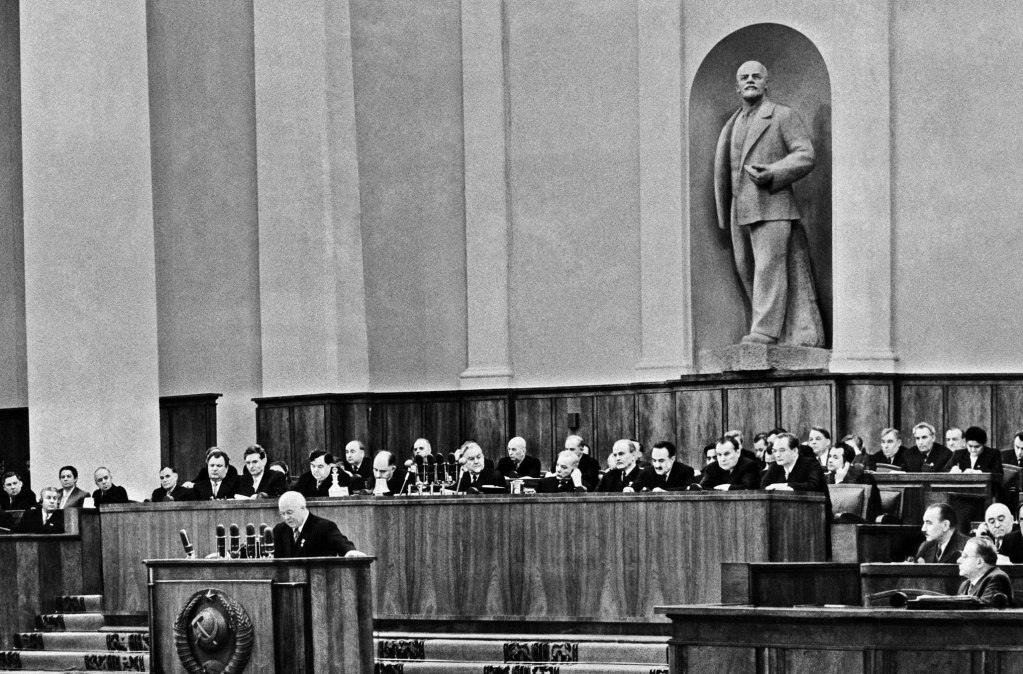
So, at the congress of associates Comrade. Stalin Comrade. Khrushchev said that for 30 years the country has been ruled by a bloody executioner, Moscow, 1956
The preparation of this report and his announcement at the congress were accompanied by dramatic circumstances. In the first months after the death of Stalin, in the framework of the so -called second Berievskaya thaw, some of the repressed were rehabilitated. The defendants in the “doctors' affairs”, “Mingrelian affairs”, “the affairs of the main artillery administration” and “aviation affairs” - that is, those repressions to which Beria had no directly related to. He insisted on depriving the orders of the killers of Solomon Mikhoels, was going to rehabilitate the executed members of the Jewish Anti -Fascist Committee and the defendants in Leningrad, but did not have time. Colleagues in the Presidium of the Central Committee ate the "dear Lavrenty Pavlovich" with all the giblets. However, the reason for the fall of Beria was by no means in his activities to rehabilitate the victims of repression. It’s just that the new Minister of the Interior was too zealously undertook to transfer the economy and policy of the USSR to new, “capitalist” rails, leaving no place for party structures. The party risked turning into an ideological interest club. Members of the Presidium of the Central Committee felt the threat of their power and united the executioner-rely from their ranks together.
Rehabilitation nevertheless continued, albeit a slower pace. In April 1954, the line reached the “Leningraders” - repressions were written off at the Minister of MGB of the USSR Abakumov and Beria, the rehabilitation of the EAA took place only in November 1955. For this case, the responsibility was also assigned to Abakumov’s shot by then. They began to massively release from the camps of convicts according to the 58th (political) article, but this was done without rehabilitation, but as if in an amnesty. They simply reduced the deadline to actually served. However, the public criticism of Stalin was still not allowed.
Closely approach
In the Presidium of the Central Committee, two groups fought on the Stalinist heritage. One-led by Molotov, supported by Malenkov, Kaganovich and some others, offered to rehabilitate the surviving victims of repression and even pay them some compensation, but not to question the political trial of the 1930s and prevent Stalin’s public condemnation, blaming the guilt for “excesses” on executed berries, Hero, Beria and Abakumov. This position made it possible to return to mass repressions if necessary. Another group, led by Khrushchev and his closest ally at that moment, Mikoyan advocated not only the complete rehabilitation of the vast majority of both executed and surviving victims of political repression, but also for public condemnation, albeit with reservations, Stalin himself. Disagreements were by no means determined by the role of the post -Stalin leaders in repressions. Khrushchev and Mikoyan of innocent blood shed no less than Molotov, Malenkov or Kaganovich. Although Nikita Sergeyevich was in the Presidium of the Central Committee in the minority, on his side there was support for the nomenclature masses, including those represented in the Central Committee, and “solid Stalinists” could not help but take into account. The secretaries of the regional committees and district committees, ministers and director of giant enterprises, suffered fear during the years of large terror, saw in public condemnation of such practice and the leader who allowed it, they no longer threatened to be shot in the Lubyansky basement. Therefore, at the end of 1955, a commission was created, headed by secretary of the Central Committee, Peter Pospelov, who was instructed to deal with the role of Stalin in history.
The group led by Khrushchev advocated not only for the complete rehabilitation of the vast majority of victims of political repression, but also for public condemnation, albeit with reservations, Stalin himself
The commission introduced its conclusions on February 9, 1956. According to her, in 1937-1938, more than one and a half million Soviet and party leaders were repressed, of which 688.5 thousand were shot. Of the 139 members and candidates for the CPSU Central Committee, 98 were shot. In fact, a significant part of the executed were persons who were not part of the nomenclature: participants in the White movement, members of the Malyshevik parties, priests, fists and other former representatives of the property classes, as well as recidivistical criminals. At the meeting of the Presidium of the Central Committee, where the report of the Pospelov commission was discussed, which formed the basis of Khrushchev’s “secret report”, Kaganovich said: “We are worried, but in order not to untie the elements. The editorial office of the report is politically given so that the 30-year period does not lubricate, to approach the bloodstream. ” And Bulganin proposed the thesis that was supposed to take guilty from the party and from the post -Stalin leadership: “What was revealed, we did not know. Lists of 44 thousand (meaning shooting lists signed by Stalin and other members of the Politburo. –NT) is an incredible fact. Closer to the truth. In two stages, the role of Stalin is divided. In the second stage, Stalin ceased to be a Marxist. ” In fact, those present not only knew about everything, but were also active guides of repression in life. Incidentally, the future participant in the “anti -party group” Saburov then sharply criticized his future associates: “Molotov, Kaganovich, Voroshilov take the wrong position, fake. One Stalin (and not two). Its essence has been disclosed over the past 15 years. These are not disadvantages (as Comrade Kaganovich says), but crimes. T. Molotov says: "He was 30 years old with us." But his role in the war is known. But in the post -war period, relations with all the peoples (speeches about the straits) spoiled. We have lost many because of stupid politics (Finnish war, Korea, Berlin). ”
Two Stalin
Khrushchev himself was not ready for a radical revaluation of the role of Stalin. As a result, he read out a report on the “cult of personality” at the last closed meeting of the congress, when there were no longer foreign communists. Many of them, after reading the Khrushchev’s performance later, chose to leave the Communist Party. The report divided the biography of Stalin into two parts. Until 1934, he is good, plays a prominent role in the civil war and the construction of socialism, fights for the unity of the party against the Trotskyists and Bukhariners. And then it becomes bad, creates an anti -marksist cult of its own personality and begins mass repressions against the innocent, practices extrajudicial reprisals with the help of “triples” and “doubles”, torture investigation, and also forcibly relocates entire nations. Stalin was also charged with ignoring intelligence warning about Hitler's impending attack on the USSR. Khrushchev criticized Stalin for improper conduct of military operations, for large losses in the frontal assaults. Khrushchev considered Kirov’s murder, not directly calling him the customer of Stalin in two, the line that divided the biography of Stalin, but hinting at this quite transparently: “After the murder of Kirov, the leading workers of the Leningrad NKVD were removed from work and subjected to very mild punishments, but were shot in 1937. One might think that they were shot then to cover the traces of the organizers of the murder of Kirov. ”
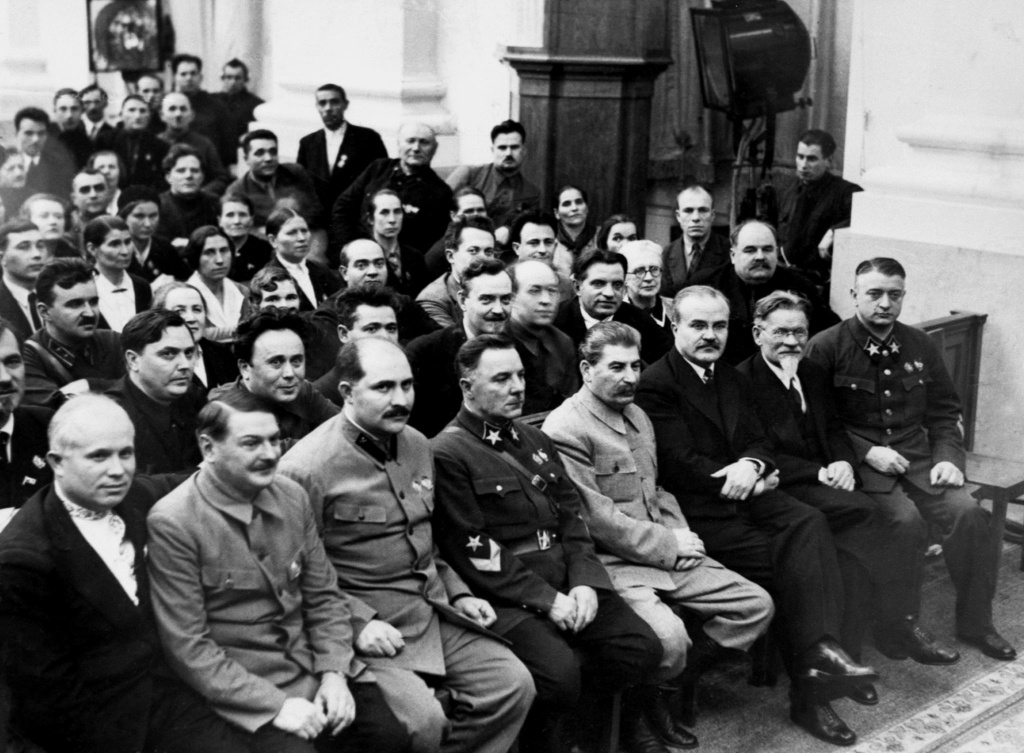
Twenty years before the exposure of Stalinism, the delegates of the Extraordinary 8th All-Union Congress of Soviets (from left to right in the front row): Nikita Khrushchev, Andrey Zhdanov, Lazar Kaganovich, Clement Voroshilov, Joseph Stalin, Vyacheslav Molotov, Mikhail Kalinin, commander Tukhachevsky, 1936. A year later, Tukhachevsky will be shot, and the wives of Molotov and Kalinin will go in stages
Today, historians are inclined to the fact that Kirov killer Leonid Nikolaev acted alone, and Stalin had nothing to do with this murder. But Khrushchev was right in that it was the murder of Kirov that served Stalin with an excuse for the new campaign of mass repressions. Nikita Sergeyevich preferred not to mention the previous campaign associated with collectivization and holodomor. After all, the Stalinist collectivization continued to be considered as one of the achievements of socialism and no one was going to refuse the collective farm system. But at least, after the XX Congress, political prisoners not only began to be released from the camps, but also rehabilitate.
Resignation instead of execution
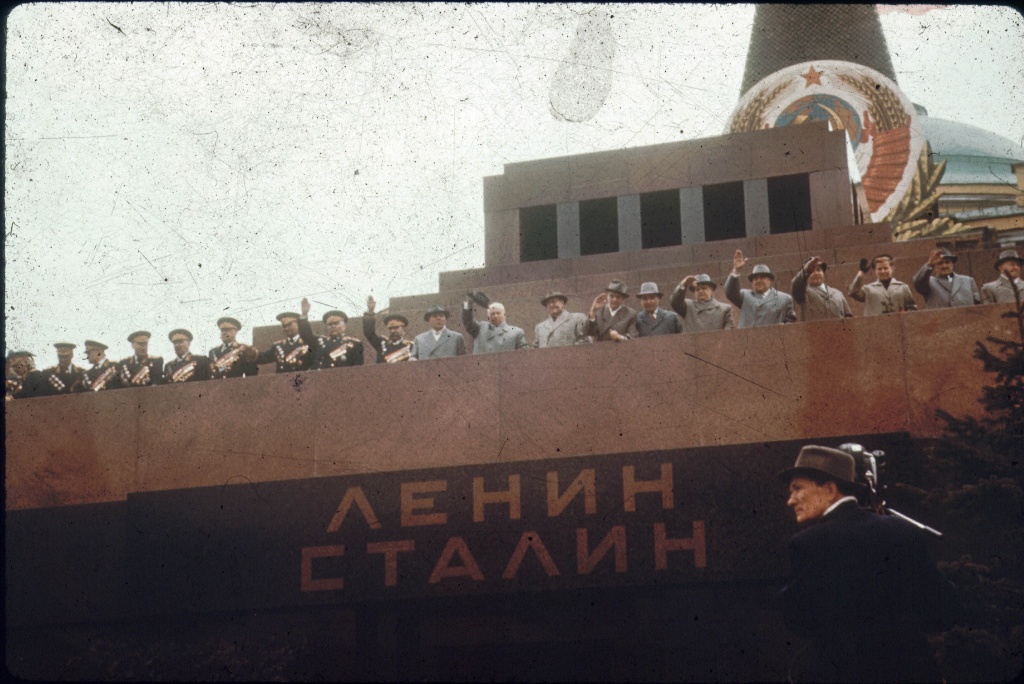
The heads of the party and government on the rostrum of the Mausoleum, the end of the 1950s. After the XXII Congress of the CPSU on the night of November 1, 1961, the body of Stalin was carried out of the mausoleum and reburied by the Kremlin wall
Although the report was not openly published in the USSR, it was distributed among the party members and laid the foundation for public criticism of repression. The report, in particular, said: “Take the first plenum of the Central Committee after the XIX Party Congress, when Stalin spoke and at the Plenum gave characteristics to Vyacheslav Mikhailovich Molotov and Anastas Ivanovich Mikoyan, presenting these older figures of our party with unreasonable accusations. It is possible that if Stalin had been at the leadership for several months, then at this congress of the party, comrades Molotov and Mikoyan would not have performed. Stalin, apparently, had his own plans for reprisals with the old members of the Politburo. He repeatedly said that it was necessary to change members of the Politburo. After the XIX congress, his proposal to elect 25 people to the Presidium of the Central Committee pursued the goal of eliminating the old members of the Politburo, to introduce less experienced so that they praise him in every way. It can even be assumed that this was conceived in order to then destroy the old members of the Politburo and hide the ends into the water about the unseemly actions of Stalin, which we are now reporting about. ”
Khrushchev considered the murder of Kirov in two a line that divided the biography of Stalin in two, not directly calling him the customer of Stalin, but hinting at it quite transparently
After this story, the congress delegates believed that 1937 would not return. Indeed, Khrushchev did not repress his political opponents after the execution of Beria. Malenkov, Kaganovich, Molotov, Bulganin and other participants in the Anti -Party Group, who tried to shift Khrushchev from the post of head of the party in 1957, escaped with his posts, and then with an exception to the party and personal pension. And the Minister of Defense Marshal Zhukov, who was suspected in an attempt to make a revolution, was just dismissed with the preservation of the rank and the Marshal pension. There is no doubt that in the 1930s and in the early 1950s, this kind of guilty was waiting for the misconduct of this kind. Such humanism, unusual for Stalin, Khrushchev largely ensured the success of the conspirators who overthrew him in October 1964. But by his public condemnation of Stalin and his methods, Nikita Sergeyevich, at least, achieved that after his shift from all the posts they did not shoot, as was practiced in the Stalin years, but only sent on a well -deserved rest. There were no more mass repressions in the country - up to the very end of the communist system.
Photo: Vasily Egorov/Photo Chronicle TASS, Moscowwalks.ru