
Translated material
Persuad the woman
Former Governor of Vermont Howard Dean arose, one might say, from political non -existence. The national press recalls the small state in the north-east of the United States infrequently, Dean did not gain particular fame in his post. Many are inclined to explain his success in rivalry with single -party people with smell. It would seem that there is already a nonsense there - the stars of the Democratic Party, its leaders and ideologists are fighting for the presidential candidate: Dick Gephardt, Joe Lieberman, John Kerry. Their, not Howard Dean, Americans are used to considering the face and voice of the opposition. But, it seems, this habit played a bad joke with them - they are simply tired. According to the latest survey of Gallup’s service, they were ahead of the retired General Wesley Clark, who gained 17 percent of the democratic electorate. The first place with 22 percent is firmly held by Dean.
What are his chances in a duel with Bush? 49 percent of voters are ready to vote for the current president today, 42 for Dina, and 9 have not yet decided for anyone. There seems to be chances, but Bush’s rating went up again: excellent economic indicators and just signed law on old -age medical insurance affected. If the stock exchange suddenly does not collapse (which there are no prerequisites) and there will be no disaster in Iraq (which is also unlikely, especially against the backdrop of the capture of Saddam Hussein), the president’s Dean is afraid of the Democrats political technologists.
The most pessimistic scenario is that the explicit leader will not be determined to the national congress of the Democratic Party, which will be held in Boston next July. Dean will come first, but will be weakened by the fight, and the closest competitor will not want to surrender. This is only with a normal, typical campaign the party congress does not essentially solve anything. Delegates are required to vote in accordance with the results of the primary elections in their electoral districts only in the first round. With dense rivalry, the second is also possible. In addition, the so -called "superfluids" participate in the vote - party functionaries and persons holding elected posts; They are not connected by any obligations and vote, so to speak, by "heart." The split of the congress is the worst nightmare of the Democrats, from whom they want to insure themselves with all their might.
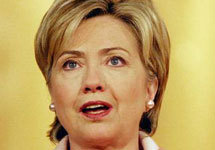
Meanwhile, there is no need to look for another strong candidate. His name is heard by Senator Hillary Clinton. Its popularity among the democratic electorate is not in doubt - it does not even need to prove it in the primary elections. Observers note that Hillary in recent months got rid of excessive leftist and shifted to the center. Previously, she dealt with a lot of social policy and almost did not participate in solving the problems of national security. In order to fill this gap on her track record, she became a member of the Senate Committee on Armed Forces and stubbornly works in this field, often with the Republicans, including those who voted in 1999 for the impeachment of her husband. This is also said by her recent trip to Afghanistan and Iraq. And her participation as a hostess in an annual charitable dinner in favor of a democratic party in Iowa, where the first primary elections will be held, turned this relatively modest event into an event of a national scale.
With each of his appearance before Hillary Clinton cameras, Clinton has to answer the persistent question if she is going to join the race. She answers the same thing: no, not going. Often adds that she intends to work out her senatorial term to the end, that is, until 2006. He speaks evasively about the 2008 presidential election - they say, he does not make plans for such a distant perspective. It follows that it does not exclude its participation in the next electoral cycle. Here, however, there are nuances. When in March 1968 the current President Lindon Johnson got off the election distance, he put it extremely accurately: "I will not seek and will not accept the nomination from my party for the second presidential term." In Hillary’s statements, only half of the formula is present - they never said that she would refuse the nomination if she was offered to her. The fact that she, unlike former vice president Ela Gora, stubbornly refuses to support one of the candidates-says that she supports everyone, is eloquent. (The mountains supported Dina, which incredibly offended his partner in the 2000 elections Joe Lieberman.) The expression of such support would mean the lack of his own ambitions. If the democrats really face the threat of a split, the best Deus ex machina than Hillary, they cannot come up with.
Of course, in 2008, when the president’s post is vacant, it will be easier to win the battle than now. But what if Dean, contrary to all fears, will become the president in the 2004 elections? The current president is not safe from defeat: after all, they failed in the struggle for a second term, despite the administrative resource, Gerald Ford, Geimmy Carter and George Bush Sr.. In this case, Hillary will have to wait for his presidential ambitions 2012 when she turns 65 years old; At a more venerable age, only Ronald Reagan won in the competition for the White House.
Trying to crawl from the other side, the journalists ask if she will be re -elected to the Senate for the next period - but she replies that it is early to think about it. But is it not interested in her position in the office of the newly elected president-democrat-say, a Secretary of State? Not interested. However, there is another opportunity. Knowing the potential of Hillary perfectly, one of the candidates can invite her to be elected to the vice presidents and thereby increase their own chances. Wesley Clark has already said that "he will keep her in mind." Representatives of Dina said the conversations about this are premature. Hillary herself says that such a proposal is "outside the probable." But many consider it quite real and strategically accurate.