
Translated material
Past the urn
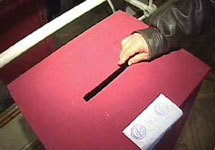
In conditions of controlled democracy, as the elections turn into a tool for legitimation, and not real selection, the authorities are concerned not so much by the substantive results of the will of voters as by the decorum. However, this decorum is increasingly problematic: the voter is losing interest in the elections, but is not yet ready to go to them for the sake of demonstrating his loyalty to the authorities.
The 2003 Governor's Elections of the 2003 can serve as a fairly serious warning. If we compare the results in all seven regions where the elections have passed (Chechnya do not count) - Belgorod, Sverdlovsk, Omsk, Tomsk, Novgorod, Leningrad regions and St. Petersburg - with the results of the previous elections, is striking, which while maintaining the average number of candidates, the result of the winner and his detachment from the nearest fifth - the turnout fell and sharp twice - the share of votes against all candidates increased. You can, of course, partially explain this by the effect of accumulated fatigue from the governors who have been sitting in the chairs - because they did not change anywhere except St. Petersburg. But, perhaps, there are no less reasons for tired of the Duma elections. By the way, during the year, the fall in the regions increased: from Belgorod five percentage points in May to September 12-13 in the Novgorod and Leningrad regions and 18 in St. Petersburg. In the north-west, participation in the governor’s election fell by almost a third.
Sociologists are still quite cheerful about the predicted participation of voters in the Duma elections at the level of 55-60% - although less than last time, but still within the framework of decency. The problem, however, is that with all -Russian optimistic "closer to half than to two -thirds" in a number of regions to vote will be noticeably less than half of the voters. If in the 1999 elections only in the Leningrad Region there were less than half, now it can be compiled by Petersburg, Sverdlovsk, Sakhalin, Kemerovo, Irkutsk Region, Krasnoyarsk Territory-in all these regions, participation in the range of 50-55%ranged four years ago. Note that mostly these are the most democratic regions, bastions of liberal forces. With their transition to the category of “rather not voting than voting,” the party of power will lose not so much a voice as a face. And it will not be possible to compensate for these losses due to the "guided" Bashkortostan, Tatarstan and other regions.
The fact that the problems of low participation are really disturbed by the authorities are also evidenced by the transfer of elections to a more convenient time from the point of view of turning, and the large -scale campaign program of the Central Election Commission, carried out by the ORT Expert Council, RIA Novosti and others. The invitation of Governors as leaders of regional lists should play an important role in administrative mobilization.
The trouble, however, is that low participation and high negativity in the elections are the consequences of the disease, not the disease itself. These are symptoms indicating an increase in the rupture between the authorities and society, about the decline in public activity and a decrease in the legitimacy of power. And if the alarming calls ranging in the recent regional elections will not be heard and understood by the authorities, in the Duma elections it will be waited for the blows of the bell. Bells according to the electoral system and the power institutions based on it, throughout the young Russian democracy.
Urna.ru - pre -election special project