
Translated material
Crimean V-Bank
“There is no money now ... you are holding here,” so during recent communication with the Crimean pensioners, Prime Minister Dmitry Medvedev reacted to complaints that 8 thousand rubles. It is impossible to live in Russian Crimea. Cubmile media immediately shamed the complainants: they say, to those who returned Crimea to their native Havan, Sergey Aksenov and Vladimir Konstantinov, it was much more difficult, they took a risk of everyone two years ago. The financial documents that The New Times got acquainted with the conclusion about another motivation for Crimean leaders: do not separate the peninsula from Ukraine, they could be in a deep debt pit
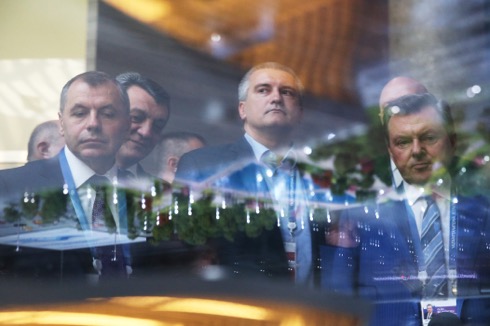
Vladimir Konstantinov (extreme on the left) and Sergey Aksenov (right) at the opening of an economic forum in Yalta, April 14, 2016
From the information about income, expenses and property of the first persons of the republic published shortly before the May visit to the Crimea, it follows that the head of the Crimea Sergey Aksyonov earned 1,404,152 rubles last year. (about 120 thousand per month). Another 3 426 558 rubles. He brought to the family budget his wife, the head of the Russian Unity interregional public organization. Thus, the income of Aksenovs decreased by 200 thousand rubles. Compared to 2014, but this did not leave Sergey Valerievich without bread with butter.
But the chairman of the State Council of Crimea Vladimir Konstantinov in 2015, on the contrary, managed to triple his income, receiving 9,115,127 rubles. (approximately 760 thousand monthly) against 2,782,827 rubles. the year before last.
The difference in the income declarations of the first two persons of the peninsula is also that Konstantinov, judging by the documents, draws up real estate for himself, and Aksenov - for his spouse.
It seems nothing new. If not for one “but”: the spring of 2014, both officials met, according to the documents, almost bankrupt: Sergei Aksenov was seized on all property of the construction business, and the assets of the construction business Vladimir Konstantinov were sold from the hammer for unpaid loans.
Mad money
In January 2014, when the Maidan in Kyiv was in full swing, and before the start of the dramatic events in the Crimea, which ended with the annexation of the peninsula to Russia, there were only a few weeks, the Ukrainian news agency “New Region” published documents indicating the problematic debts of the leader not very popular (only three hundred mandates in the Crimean parliament) of the Russian Unity party Sergey Aksenov. Then the head of the Republic of Crimea was not considered a significant political figure and the publication of a special resonance did not cause.
Meanwhile, it was a question in the publication about loans that Sergei Valerievich took at the dawn of his political career, engaged in the project “Civil Asset of Crimea”. Then, in the crisis of 2008, it was very difficult to get a bank loan. Perhaps that is why businessman Aksenov (officially in those years he was listed as the deputy director of the Squada company LLC) turned to his countryman Nikolai Kirilchuk (both natives of the city of the Balti of the Moldavian SSR), who just moved to Ukraine and received Ukrainian citizenship. Two years later, when Kirilchuk led the Ministry of Industrial Policy of Crimea, and Aksenov elected to the Verkhovna Rada of Crimea, the deputy’s debt to the Minister, according to the media, grew up to a total of $ 3.85 million (see scan of the receipt of October 1, 2010 with the signatures of the debtor and creditor - photo 1). The presence of Aksenov’s debt obligations is also confirmed by the decision of the Central District Court of Simferopol of October 9, 2012, which obliged the current head of Crimea to pay about 35 million hryvnias.
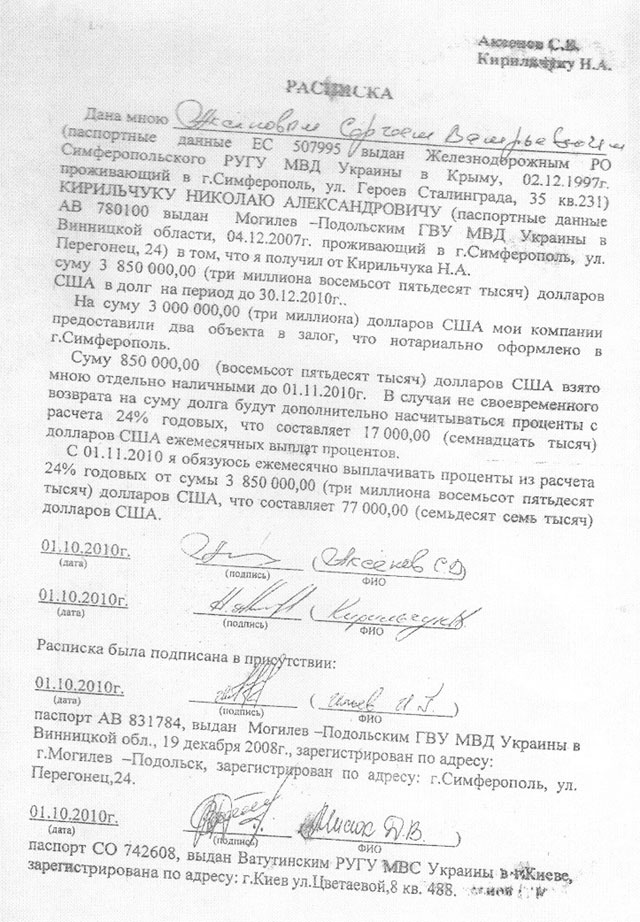
Photo 1
By the time of the annexation of Crimea, Sergei Aksenov had not only significant financial difficulties, but also turned out to be bankrupt: his property, if it were found, would immediately be under arrest
Interestingly, the amount of the main debt on this receipt was only $ 1 million, or 7 million 984 thousand 200 hryvnias at the course of the National Bank of Ukraine. The rest is the interest, which, due to errors in the receipt, were accrued in the amount of 3 % of the loan amount for each day, and not for a year of delay, as is usually prescribed in such agreements. Aksenov’s claims did not satisfy the receipt of the receipt of an invalid court, deciding to pay all the amount requested by the creditor - the main debt and interest, which were ultimately designed at the rate of 1200 % per annum.
The poor businessman
Sergey Aksenov took loans secured by real estate. However, personally, according to documents, this property did not belong to him. Anyway, judging by Ukrainian registers, real estate and business Aksenov did not register. The guarantors in credit transactions with him were legal entities. So, on one of the loans in the pledge was a rather attractive object of Astoria LLC, a restaurant building at the intersection of Gorky Street and Kirov Avenue in Simferopol, in the very center of the Crimean capital.
Further court decisions on this lawsuit could not be found, but you can notice a clear deterioration in Aksenov’s credit history: in the Ukrainian register of property rights there is a record that in October 2013, all his real estate was arrested. True, it remains to find this very real estate: judging by the same registry, Aksenov, without changing the fact of the established rule, preferred to register property for relatives and legal entities.
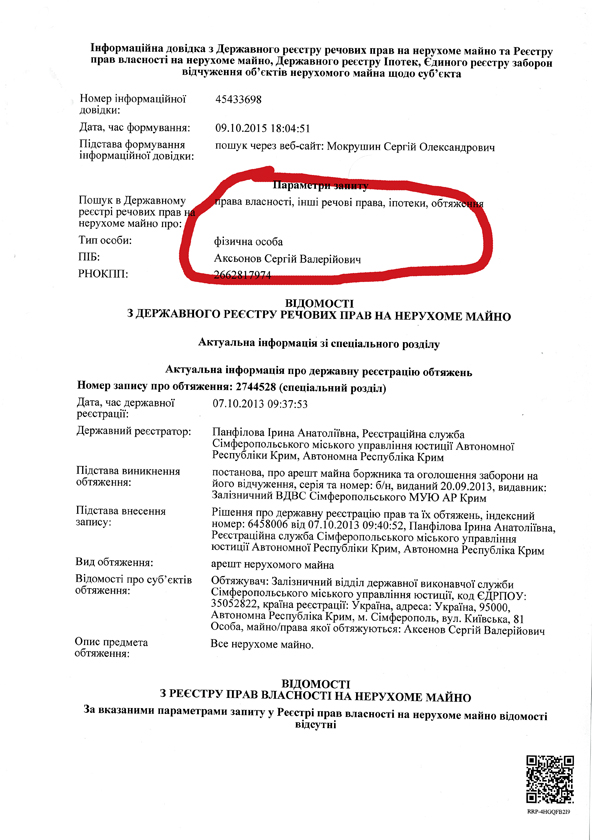
Photo 2
By the time of the annexation of Crimea, Sergei Aksenov had not only significant financial difficulties, but also turned out to be bankrupt: his property, if it were found, would immediately be under arrest. This is evidenced by the data of the Ukrainian register of property rights to real estate found in April 2016 (see information from the official register of property rights to real estate-photo 2). The editors applied for a commentary to the press service of the head of Crimea. At the time of signing the number, there was no answer from Simferopol.
"Console"-system
Vladimir Konstantinov - another hero of the Crimean Spring - came to a policy from the construction business. The galaxy of firms with the word “console” in the title (“console-construction”, “console LTD”, “SK CONSOL-Construction LTD”, etc.) developed quite actively and entangled the entire peninsula. Konstantinov, as it seemed to him, made a win -win move - he undertook to finance the election campaigns of the Party of Regions Viktor Yanukovych. In return, he received attractive land for construction in Crimea. The competitive advantages of the Console over other developers were cemented by the delegation of the company's top management into the power and controlling structures of Crimea. “Conspole” took places in the republican parliament, led the capital construction department of the Crimea Council (it was through this structure that the largest contracts for construction passed, which were also “console”), served in the prosecutor’s office and courts - in general, where the owner of the construction company had business interests. And the ends of the long chains of legal entities united in the Corporation "Consol" were hidden in offshores of Beliz, Cyprus and the Seychelles.
However, the Crimean political scientist Vladimir Egorov believes that the solid political costs of Konstantinov did not “fight back”: “Although he invested in the campaign of the Party of Regions and personally Yanukovych, he did not receive a significant impact on the distribution of financial flows of Konstantinov: everything remained in the hands of Makeevsky, who were close to Yanukia , - first Vasily Dzharta, then Anatoly Mogilev (both of them The Crimean government was headed by Viktor Yanukovych's presidency .
Soon after Vladimir Konstantinov in 2010, he occupied the chair of the Chairman of the Verkhovna Rada of Crimea, the activities of Consoli and affiliated legal entities began to resemble the work of a classic financial pyramid like the infamous "Lord". The only difference is that the depositors were promised not cars, but apartments.
Spring 2014 significantly corrected the cases of Crimean bankrupt. They became inaccessible to Ukrainian justice. At Consoli, things went uphill, today the company is actively building attractive sites on the southern coast of the peninsula
A simplified process looked like this: after pouring the foundation of the new residential complex (the console was practically not building single houses), an aggressive advertising campaign was launched. Most of the money of the shareholders did not reach the construction site, but the construction of a new facility began, another advertising campaign started, new investors were involved. The cycle was repeated again and again, and the construction of old objects either froze or created the appearance of unhurried works. The shareholders of the “console” no longer believed nods on the financial crisis and began to unite: they created the registers of the Consolean long -term construction, exchanged information, tried to sue invested money. Alas, agreements on participation in construction were drawn up in such a way that it was very difficult to return their own, and the all -encompassing connections of Vladimir Konstantinov made this process virtually impossible.
Without unnecessary conspiracy
Having taken the place of the chairman of the Crimean parliament, Konstantinov formally left the founders of legal entities included in the Consol Corporation. Nevertheless, he continued to control this business, which he repeatedly confirmed the Crimean “Center for Journalistic Investigations” with his materials (the editors of this Internet publication after the events of 2014 of Crimea was evacuated from the peninsula, the equipment was arrested, the journalists were conducted). Konstantinov himself, becoming an official, denied that he still receives income from the construction business. He did not say to whom this business belongs, although it is known that his closest relatives continued to own the shares in the authorized capital of the legal entities from the “Conspole” constellation. So, according to Ukrainian registers, the head of the Positive and Coat advertising agency is Tatyana Konstantinova, a daughter -in -law of the Crimean chairman. (See “Conduity of Stroy.” Extract from the Unified State Register of Legal Entities, “Positive and Co” - the data of the Ukrainian registry of the Unified State Exercises - Photo 3).
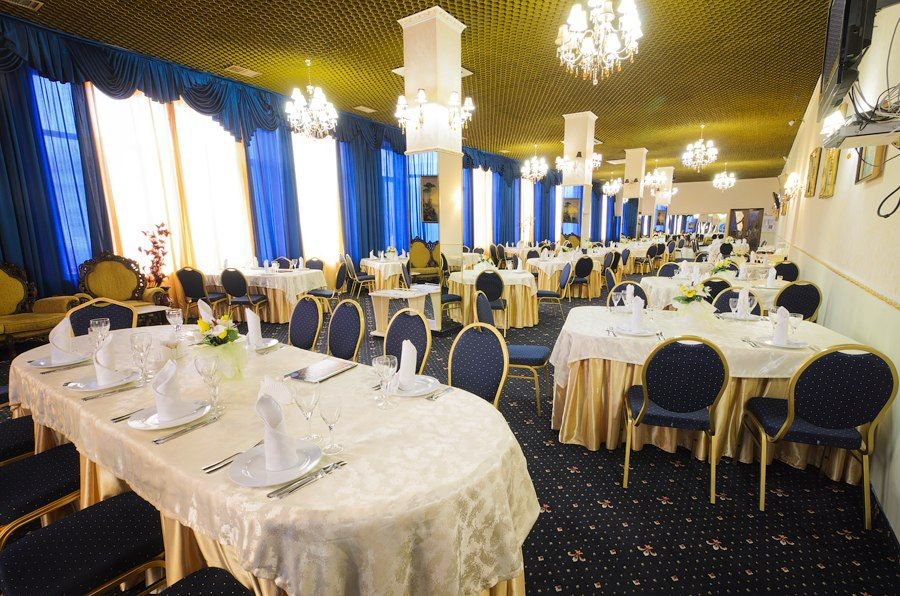
The interior of the restaurant at the intersection of Gorky Street and Kirov Avenue in Simferopol. This object of Astoria LLC was also pledged by one of the loans taken, judging by the Ukrainian registers, Sergey Aksenov
When re -registering these firms under Russian law on conspiracy, they did not bother much, tied them to the same offshore. For example, in the Ukrainian registers, the founders of one of the main legal entities of the corporation-“SK Console-Construction LTD”-are the “positive and ko” and “Molisad Limited”, prescribed on Belize. The same firms are indicated by the founders during the registration of “SK Conso-Construction LTD” under Russian law.
Spring zero
By the beginning of the Crimean Spring, Console came up with serious problems. Not only commercial facilities were frozen, but also those whose construction was funded by the state. For example, at least four kindergartens in Crimea after the development of advances did not rise above the level of the foundation and overgrown with reeds.
The reason for the problems was covered in loans on which the structures of the “consoles” sat for a long time, firmly and, it seems, is hopeless. The total amount they occupied in Ukrainian banks was about 1 billion hryvnias (3.8 billion rubles) by the spring of 2014, and some of the loans were taken in dollars and euros. Debts to individuals - shareholders are not counted at all. As a result, Consoli’s bankruptcy proceedings were launched (it is interesting that a citizen of the Russian Federation from Temryuk was the initiator). For debts to the bank, the sale of collateral property, including the office of the Simferopol Directorate of the company, began.
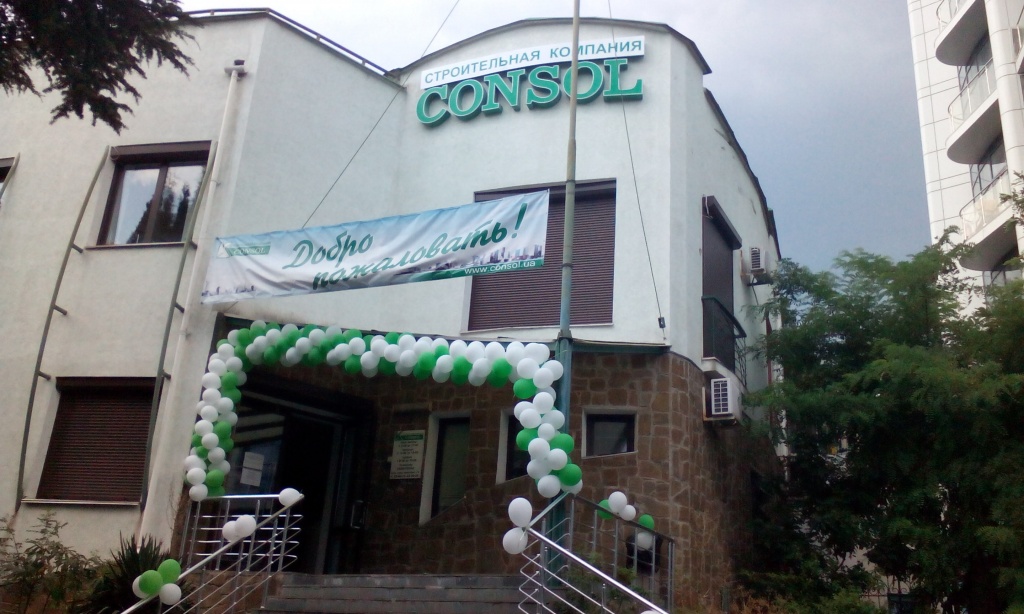
Office of the Construction Construction Company in Yalta holds Open Day, *August 2014 *
At the same time, on the grounds of fraud, which consisted of receiving a loan on the security of the actually sold apartment, a criminal case was opened against Vladimir Yasinsky, the head of Consoli and a long -standing ally Konstantinov.
Spring 2014 significantly corrected the cases of Crimean bankrupt. They became inaccessible to Ukrainian justice. The console, which received even greater preferences in Crimea, went uphill
Of course, the spring of 2014 significantly corrected the cases of Crimean bankrupt. They became inaccessible to Ukrainian justice. The console, which received even greater preferences in Crimea, went uphill, and today the company is actively building attractive areas on the southern coast of the peninsula.
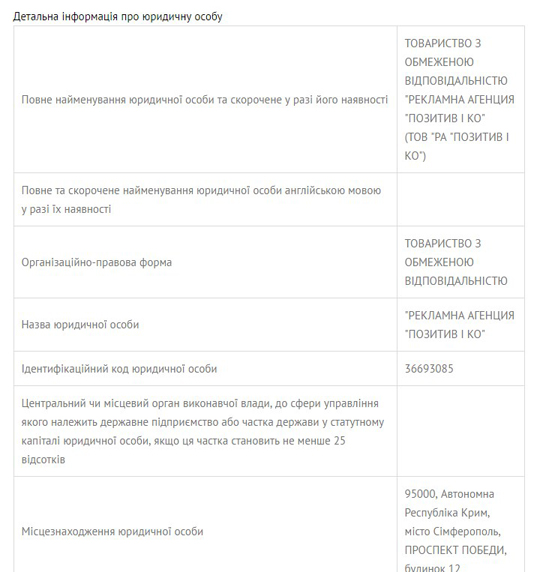
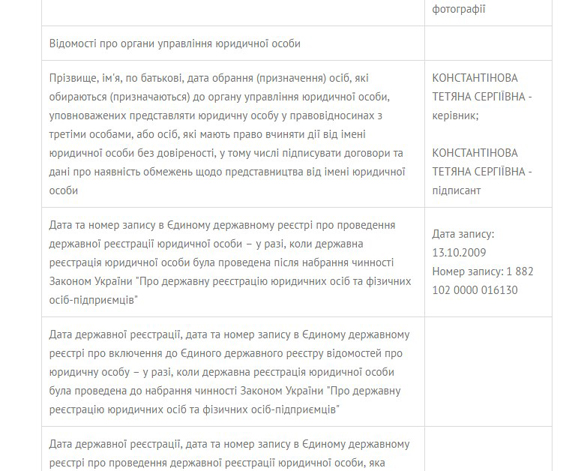
Photo 3
But it seems that you still have to pay debts. The Crimean parliament, led by Vladimir Konstantinov, introduced a bill to the State Duma of the Russian Federation, which froze the Ukrainian loans of Crimeans (which is characteristic, the co -author of the document was, under investigation for these loans, Vladimir Yasinsky). But at the end of last year, the Duma adopted another edition of the law, and the Crimeans will still have to repay debts, albeit with certain exemptions ** . So it is quite possible that the heroes of the “Crimean spring” will soon have nothing to lose again.
The editors applied for a commentary to the press service of Vladimir Konstantinov. The answer came from his press secretary Olga Savenkova. And he came down to the fact that the head of the State Council of Crimea "was not entitled to comment on the activities of a commercial company (" console ". - NT ), which is discussed."
Photo: Anton Novoderezhkin/TASS, VK.com, Consolstroy.ru
* It is believed that some associates of Yanukovych from Makeevka, the suburbs of Donetsk, were planted by him in the Crimea as “watching”.
** In February 2015, the State Council of Crimea asked the State Duma to ban the work of collectors on the peninsula, but this initiative did not receive support in Moscow.