
Translated material
Judge, Isaich
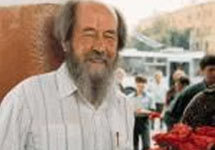
Almost every real writer, regardless of the number of years, has his own eternal age, dictated by books and fate. Lermontov is a very young man with the seal of early death on the Fatalist chela. Tolstoy is a peppy collective farm old man, prone to escape. Dostoevsky is an irritable, middle -aged nervous man. Gogol is a mentally ill, timid young man, not deprived of a sense of humor. Bulgakov is mocking, imaginary, noble, he is 50 years old.
Today Solzhenitsyn turns 85.
This is his age. The age of the patriarch, the loud Old Testament prophet with a quick excited speech, angry modulations in the voice, smart, incredulous, vengeful. A person whose words and deeds are inspired from above. The authoritarian old man, who knows exactly how to live and equip, who is to blame and why, damn it, two hundred years together.
Previously, he was different, younger and a little more likely, but already with the clear awareness of the great mission that he should fulfill. In an amazing book of the memoirs of the memoirs, “a calf with an oak tree”, in fact, two heroes: he and the Lord who leads him in circles of the Bolshevik hell, experiencing him in the camp and on a sharashka, saving from mortal illness, saturating stupidity and blindness to enemies of the swifters and pluralists, giving a long life and rewarding success. He was allowed in relations with other people called and not chosen, deception, lies and betrayal - and he writes excited about all this, admiring himself and his God. He walks around Moscow, as they walk along the board, carpeting the fate of loved ones and distant ones, having casually grieves about the unfortunate suicide who kept his manuscript, and the dedicated magazine, from where his well -deserved worldwide glory came, almost not looking around and in essence not sorry for anyone. Everything is allowed to him.
The insignificant old people who waved to us with their handles from the mausoleum were doomed in a fight with such a titan. Rising in full height, he fought with the power of his bare hands. And then he went underground, hid in the “covers” and was again in the light and beat in the face - with open letters, short aiming statements for printing, but most of all, books that exploded with heavy bombs in the west and in Samizdat. Former artillery officer Solzhenitsyn knew a lot about this matter.
It is ridiculous to deny: the historical merits of Alexander Isaevich to the Fatherland and citizens are huge. And we are not only about the fact that he was a great writer who worked in the best humanistic traditions of Russian literature. And not even about that two or three generations of Russian-speaking, he opened his eyes to their past and the present, that his requiem on the alarmed bell to the whole country and the whole world, which were tormented in Soviet camps. And about the question that Solzhenitsyn was a model of personal persistence and courage, which weakened over the decades of repressions to the public, and readiness to give a life for the right to shout their truth.
Readers do not need to explain those years, and you won’t break the great-grandchildren-who was the author of the Archipelago for us in the years of the 60-70s of the last century. What a shock for society was the publication of "Ivan Denisovich" in the November book of the famous magazine. What a dumbness and hatred caused his name in the gabshniks and party bonz. What vortices of hostiles circled over him.
However, the writer has his own tasks, the prophet has different. The fierce hater of the intellectual “demophy”, the defender of the Chechen war and the apologist for the restoration of the death penalty in Russia, a dull theocrat, the author of unbearable nodes and amazingly mediocre surveys on the topic of Russian-Jewish friendship, Putin’s spiritual interlocutor is also his glorious past, our idol, our Isaich. The writer who ruined an invaluable gift for the sake of a dim ideology.
The person who caught up with his age today.
We will accept this with humility: such is the cross of many great. Having reached the sky, they begin to be burdened by the vain glory of the worldly and, tearing the clouds, turn to us inflamed speeches and eyes. Gogol frightened himself with hunger and had a terrible correspondence with his friends. Dostoevsky was fond of politics and anti -Semitic mirage. And our Isaich, judging by the memoirs, almost since childhood, was this: a harsh, not goodbye insults, who knew exactly how to equip Russia and who its enemies were.
It has long been accurate with God, now he is accurately and with the authorities, which he dreamed about in the Lefortovo cell before expulsion. When, three years ago, Chubais said that the latest Russian history was moving almost under Solzhenitsyn’s dictation, many thought that the power engineer was overwhelming in the service. Meanwhile, the many of the taddy thoughts of the hero of the day are really embodied: senators are built, "speed" in exile or in prison, Orthodoxy gains state religion status, pluralists are excommunicated from the Duma, authoritarianism grows stronger. President Putin has a “living mind”, this is our new Stolypin, who is careful about the benefits of the Fatherland. This is what today's Solzhenitsyn thinks and says, feeling again like 30 years ago, "in the hands of God." The authoritarian old man finally met his political double and ally in his homeland - an authoritarian regime; Both liked each other. That is why he supports the current government, although he rests from it aside, as befits the Prophet. Rejoicing in her victories, like her own. An enviable fraction.
In the latest memoirs, now published by the same "new world" in the same November book, he commemorates Lomonosov to the place: "I do not push about death: he lived, suffered and I know that the children of the Fatherland will regret it." Already, Alexander Isaevich: love, congratulations, sorry. But there are more regrets than the former love.