
Translated material
The darkest
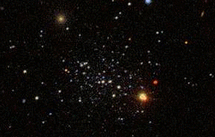
A group of American scientists led by Associate Professor from Yale University ( Yale University ) Marla Geha , discovered the most dull of all known dwarf galaxies filled with the largest relative amount of dark substance. The corresponding article will be published in the next issue of the "Astrophysical Journal" ( APJ ), but for now, you can find it on the website of the electronic preprints Arxiv.org .
The Galaxy, which received the name of Segue 1 (named Sloan Extense for Galactic Understanding and Exploration), is one of the approximately two dozen small satellite galaxies that circle the Milky Way around our own galaxy. The brightness of the new ultrashaba of the galaxy is a billion times inferior to the brightness of the Milky Way, however, despite a very, very modest number of visible stars (the presence of only 24 is confirmed, the total luminosity of which is equivalent to the luminosity of 350 suns), Segue 1 in a hundred or even a thousand times massive than it could have thought, based on its luminous matter. In principle, Segue 1 could not even turn out to be a galaxy, but just a ball cluster, however, the “forgery” was helped by the spectroscopic data obtained using one of the largest terrestrial telescopes “ Keck /Deimos) installed on the top of Mauna-Kaa on the Hawaiian Islands. By the displacement of spectral lines in the light of the stars that are removing or approaching us, as you know, you can find out their radial speed. The measurement of the internal speed dispersion of the source stars in the assumption that all of them, when rotating around the general center of mass are in dynamic balance, allowed to obtain the most likely complete mass of the galaxy - 450 thousand solar masses (a maximum of 900 thousand and a minimum of 200 thousand).
The disadvantage of the star mass there, according to scientists, replenishes the dark substance. Without emailing and not absorbing light, it participates in gravitational interactions. The authors of this work discuss, however, the prospects for the detection of gamma rays from extremely rare annihilations of particles and antiparticles of some candidates in the dark substance (Wimps, Weakly Interactive Massive Particles - weak -producing massive particles, for example, neutralino and super -symmetric partners Neutrino) and show that Segue 1 can in this sense - for indirect detection of a dark substance - to act as the most promising source from all small satellites of our galaxy. In principle, such events will be able to register a gamma-telescope recently launched into orbit, which received the name of the famous Italian physicist Enriko Fermi- Fermi Gamma-Ray Space Telescope in late August.
According to modern theories, the dark substance is approximately 85 percent of the total mass of the universe. The detection of ultralaby galaxies like Segue 1, replete with a dark substance, allows you to look differently at the formation and evolution of all other galaxies, the lower hierarchical level of which the dwarf galaxies occupy. “The dwarf galaxies are very important when it comes to the formation of all other galaxies,” Jea explains, “since various theories describing the formation of large galaxies from smaller ones give different relationships between the total number of dwarfs and giant giants.”
Relatively recently, astronomers managed to show that there are much more dwarf galaxies than it was previously considered. This was mainly due to such projects as SDSS (Sloan Digital Sky Survey) - the Slanovsky digital review of the sky, which allowed to capture the vast regions of the night sky in unprecedented details. Over the past four years, the number of dwarf galaxies known to us - satellites of the Milky Way - more than doubled. Jea is sure that astronomers will find even more dwarfs over time, since the analysis of new data is still ongoing.
Difficulties with the search for new small galaxies surrounding the Milky Way are due to the fact that because of their weakness, these "babies" are easily lost among the clusters of more close to us, which are directly related to our galaxy. In the process of searching, astronomers strive to detect specific types of stars, which should be contained in dwarf galaxies, then reveal small "supercrac" chosen types of stars - that is, those areas of the sky where there are more such stars than in the surrounding areas. In this way, a group of astronomers, led by our compatriot - graduate of Moscow State University Vasily Belokurov , working at the British Cambridge University ( University of Cambridge ), found several smallest new galaxies.
The most famous and largest "partners" of our Galaxy are the Big and Small Magellanic Clouds. The rest cannot boast of size and brightness. This, for example, is a sculptor and a furnace discovered in 1938, Leo I and Leo II, discovered in 1950, a dragon and a small bear discovered in 1954, a keel discovered in 1977, a sextant discovered in 1990, and, finally, a large dog discovered in 2003, and the newly open dwarfs are even smaller.
Sources:
The Least Luminous Galaxy: Spectroscopy of the Milky Way Satellite Segue 1 - Arxiv.org - Astro-PH
Astronomers Discover Most Dark Matter -Dominated Galaxy in University - Yale News
Astronomers Find Universe's Dimmest Known Galaxy - New Scientist
Links:
Astronomers found the most dim galaxy