
Translated material
Found the owner of the first neck in the world
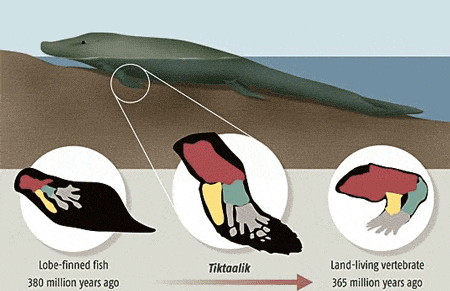
Tictaalik is an intermediate link between fish and tetrapods. Image Nature from New Scientist
The fossils found in 2004 in the Canadian Arctic territories, which was called Tiktaalik Roseae , continues to reveal its secrets. Now it is recognized not only with the “missing link” between fish and ground vertebrates (relatively speaking, between Panderichthys - a fish living about 385 million years ago - and Acanthostega - the most ancient tetrapods known to science, which lived on Earth 365 million years ago), but also the first famous example of the animal with a primitive neck. The relevant article is published in the journal Nature on October 16.
In the language of the Eskimos tribes living in the territory of the North Canadian province of Nunavut (where, in fact, fossils were found), the Tiktaalik means the "large freshwater fish". But this is not just a fish, but a kind of “fish” ('fishopod'): partly still fish, and partly - already a notebook. The discoverers of "Fisheries" - an American paleontologist from the University of Chicago ( University of Chicago ) Neil Shubin, Edward Daeschler (Academy of Natural Sciences ) in Philadelphias) Farish Jenkins from Harvard University at Cambridge (Massachusetts).
Outwardly, the find resembles a flattened fish three meters long with a crocodile head, sharp teeth (which indicates a method of hunting), a pair of nostrils, a scaly torso and joint bone fins. The animal's eyes were at the level of the back, the neck was mobile. A feature of the skeleton is the shoulder belt (bone connection to the chest bone) - it shows that the fins served to maintain the body and movement.
A thorough analysis of the skull finally freed from the stone captivity of the skull, the gills and the palate of the fossil indicate that Tiktaalik was adapted mainly for life in shallow water in subtropics. However, despite a number of internal features of the skull, separated by him with more primitive predecessor fish, the head of the Tictaalik already carried some features of amphibians, and this suggests that the animal may already be able to breathe air and eat right on land. "The new study reminds us that the gradual evolutionary transition from fish to a four -legged animal and the transition from aquatic to a ground lifestyle should have been demanded much more than a simple development of the limbs," explains Ted Dashler
Sources:
'Missing Link' Fossil Stuck Its Neck Out - New Scientist
Fish with first Neck Evolved Into Land Animal - Slowly - National Geographic News
"Walking Fish" Reveals Fresh Evolutionary Insights - Reuters
Links:
FIRST FOSSIL of Fish That CRAWLLED LAND DISCOVERED - New Scientist
Fossil Fish with "Limbs" is Missing Link, Study Says - National Geographic News
Scientists have discovered the petrified remains of the “missing link” in evolution - RIA Novosti
The lost link between fish and ground creatures was finally found - "membrane"
Sensational find in Canada: the "missing link" was found in the evolution between fish and four -legged ones - Newsru.com