
Translated material
Territory without borders
Territory without borders. The most intriguing performance of the Territory festival, invented seven years ago by Kirill Serebrennikov and Evgeny Mironov, will be Pa-de de with an excavator in the park named after Gorky. A view of extravagant art of tomorrow will be held from October 8 to 19 in Moscow 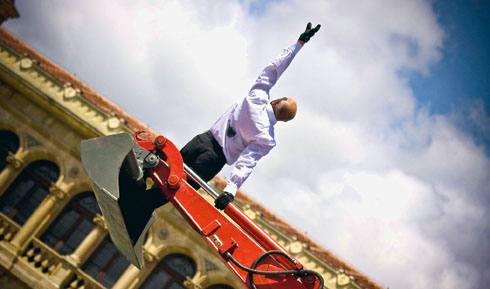
The impression is that the directors and actors gathering on an annual review seem to be too easy to deceive in a word. The body is more complicated, therefore, the more and more of the program is occupied by dance performances and productions that exist on the verge: hybrids of drama and circus, opera and dance, multimedia performances. The declared goal of the “territory” is to look at “art now” and “Art tomorrow”; The performances in the poster are now talking about, about tomorrow-master classes arranged for provincial students of theater universities, whom Fest invites these days. (Twice - in 2009 and 2011, “Territory” went completely to the province, first to Perm, then to Kazan, but Moscow still remains its main place.) The idea is that the cadets will appreciate the revolutionary ideas of today and tomorrow will make a coup in their native theaters. The Moscow viewer not only gets the opportunity to see several boring performances at the Theater of Nations and at the venues rented by him, but can also look into the theater future, which the festival organizers come up with for the country.
Generation without fairy tales
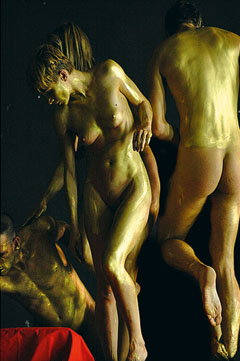
The center of attention in this future can shift from the dancer or choreographer to audiovisual effects - as in the play "Deadly Engine" of the Australian company Chunky Move, which opens the fest on October 8. Six artists do not shine with technology, the articulation of the gydeon of the ranges cannot boast of the invention of new movements, but the viewer captures the infernal rhythm of the performance, attacking the light of the strobe and the shocking ears of the sound. With the help of rather simple techniques of combining sound and light, the director achieves complete emotional submission of the public, and the focus is that when a person leaves the hall in an hour, he thinks about who he was obeyed, and thinking about it is never harmful. Another performance that is not like cozy-offs, familiar to our everyday life, but rather reminiscent of a jumping man out of the corner of a stranger who rushes to you and begins to eagerly and violently interpret, brought from Italy-this is the Grimmless team Ricci/Forte. A small story about a generation that lives without fairy tales (non -Gimmie) and desperately wants to escape from reality into a fictional world. The directors of Stefano Ricci and Gianni Forte give a very beautiful picture with gold paint with gold and scattered apples and enthusiastically create a natural film of horrors, as if slaps are handed out to the escapists: do not dare to run from reality, do not dare! The organizers even set the play “18+” - however, here is the fault and naked nature.
 |
Place for the master
The main part of the multimedia performance “Full Moon”, staged by Philip Grigoryan, is a forty -shock solo of the dancer Tseter Kudo. This is a boto dance. This art arose in Japan after the Second World War as a reaction to the catastrophe of Hiroshima and Nagasaki: artists who decided that all evil from civilization went to villages and forests, rushing to naturalness. The imitation of plastic roots, branches, leaves ... The slow breath of the earth was seen in salvation. And on the “territory” monologue of Tuleter Kudo, one of the outstanding today's masters, becomes not only a demonstration of the unusual wide public of the art of dance, but also evidence that the real skill of the adherents of the theater of the future is also honored. The same is the inclusion of Circo Ambulante in the production of Andrei Mogeliy and Maxim Isaev. The January premiere of the Theater of Nations, in which the tyrannoeboat motifs and hokhma of the third class level of secondary schools (the main character shortly before the final literally take the villain for eggs - however, this is not shown, it is only told), it is difficult to call a great accomplishment, but Leah Akhedzhakova in the lead role is inappropriate. 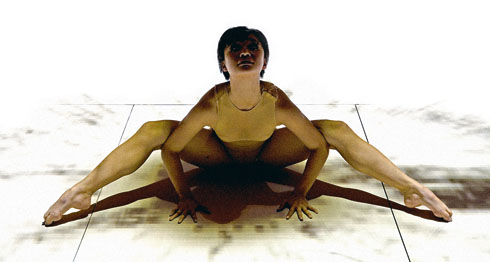
The directorial skill will demonstrate Kirill Serebrennikov-no matter how he collapses in his monologues for a drama theater, he himself perfectly collects performances, works with text and actors. The National Theater of Latvia with the Wojutzek, George Bukhner, will come to the "territory". Of course, the action of the old play was transferred to our age, and the warrior, instead of a clogged soldier, is a laborer who agreed that experiments are put on a certain gallery of contemporary art, but there is no doubt that the tragic essence of history, its desperate Message Serebrennikov will not be lost.
Inappropriate
In the theater of the future (which begins now, and this is already evidence), the genre of the unfinished performance - Work in Progress will become more popular. At the festival, three scenes from Olga Raeva’s opera on the libretto of Vladimir Sorokin “Dreams of the Minotaur” will be shown to us, which will be put entirely only in 2014; As many as three directors (Ekaterina Vasilyova, Kirill Potoptov and Ilya Shagalov) will try to turn these scenes into a performance. Their fate is facilitated by the fact that this is really “dreams” and they are not very connected with each other - but the music is one and very difficult. Another feature of the future theater will be his expansion at the previously non -vertical sites. So, one of the most entertaining performances of Fest, “Pa-de de dex with an excavator”, will be held in Gorky Park, on Fontannaya Square. This duet, in which the dancer and a powerful car (real excavator) become friends or lovers (the actor is stunningly dying in the handful of a colossal piece of iron!), On October 14, you can see the Central Posda for free. And the life-affirming Algerian-French project “Niya” was put into the final of the Theest: combining the “bolero” by Maurice Rael and the songs of Uriah Aichi, the Lyon choreographer Abu Laga with ten Algerian dancers nurses an optimism that overcomes the most gloomy circumstances. According to the choreographer, “niya” is an Arabic word denoting the fact of confidence in life; An important thing on which the world rests.