
Translated material
The robot reached the bottom of the Mariana Slok
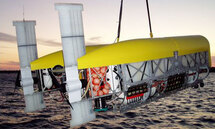
Robot Submarina "Nerbiy" (nereus). Photo from the BBC News website
The American Robot Submarin "Nereus" (Nereus), who received its name in honor of the mythical ancient Greek old man , the father Nereid, the meeting with the sailors promised a happy swimming, managed to reach the bottom of the deepest part of the world ocean - the Mariana cavity.
Immersion to a depth of 10 902 meters took place on May 31. The Mariana cavity (otherwise - the Marian groove ), as you know, is located in the western part of the Pacific Ocean. And the deepest point of this hollow is called the "abyss challenger" (Challenger Deep), it is located near the island of Guam (from the group of the Mariana Islands ). At the bottom, the water pressure there reaches 108.6 MPa, which is 1100 times higher than normal atmospheric pressure at sea level.
The only immersion to the bottom of the Mariana Slok with the participation of man took place on January 23, 1960. The daredevils who risked there to go down to the Swiss bathyscaphe "Trieste 1" (Trieste 1) were Lieutenant of the US Navy Don Walsh and researcher Jacques Piccard . However, robots reached this depth for the first time (the previous such visit took place in 1998).
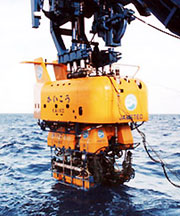
It is necessary, however, to note that at present the Nereus is the only apparatus capable of such achievements (the previous record holder, the Kaiko Japanese robot, which made three immersion in 1995-1998, was lost in 2003, and Tris was written off back in 1966). Unmanned submarine in remotely is controlled by pilots located on the surface - on board the Kilo Moana research vessel. The submarine is usually associated with a uniquely thin fiber-optic cable, comparable to human hair in its thickness and does not interfere with maneuvering. Nereus can also be sent to autonomous swimming, without any cable (it differs favorably with Kaiko).
“With robots such as Nereus, we can study almost any ocean section,” explains the project manager and main developer Andy Bowen from the Woodshol Oceanographic Institute (Woods Hole Oceanographic Instition - WHOI ). I am sure that Nereus will allow us to make many new discoveries.
Among the other “most advanced” deep -sea vehicles - Shinkai 6500, capable of lowering to a depth of 6.6 km with three researchers on board, French Nautile (the team consists of three people, the depth of immersion is approximately 6.04 km) and, finally, Russian “worlds”, also capable of achieving this depth.
Sources:
News Release: Hybrid Remotly Operated Vehicle Nereus Reaches Deaches Deepstt Part of the Ocean - Woods Hole Oceanographic Instition
Robot Sub Reachs Deepst Ocean - BBC News
Link: