
Translated material
Vitya, Chao!
The Ukrainian program at the Artdokfest festival was opened by the new film by Sergey Loznitsa "Maidan"
On the screen is a huge area filled with people. People stand silently, sometimes talking quietly, waiting for something. “Let's start with the anthem of Ukraine,” says someone invisible, and people, taking off their caps, sing together: “Shche did not free Ukraine and glory and will.” Sing the entire anthem from beginning to end. So the film "Maidan" begins.
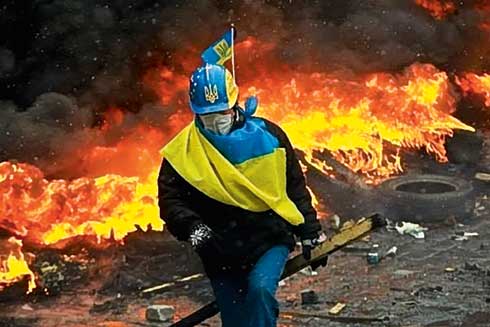
Documentary Sergei Loznitsa showed the weekdays of the Maidan.
Anthems and candles
Somewhere in the middle of the film, an uncle with an accordion will jump out into the frame, on which he will take to eat a hymn in his own arrangement. The uncle will immediately grow in onlookers, who willingly tighten "Shche did not die." But it will be a "non -canonical" anthem. “Canonically” - in chorus, the whole Maidan, with hats down - the anthem will sound three times. Each time he will mean the beginning of a new chapter.
Chapter One - “People on the Maidan” (although he does not give the name to the heads of the heads). Here it is, in front of us - the square, which has become for several weeks of the most famous area of the world, with human bustle and cheerful fear of an impending danger. The shooting at Institutskaya has not yet begun, heavenly hundreds have not yet been settled, it seems to everyone that the enormous authorities will have the mind to leave herself. "Oh, Vitya, Chao, Vitya, Chao, Vitya, Chao Chao-Chao!" - You can still frolic, joke, Maidan - another field for games, albeit dangerous. (“Oh, Vitya, Chao!”, By the way, it rushed over the azure shore when a loser with its tiny film crew rose along the famous Cannes ladder. Could this chapcracus, this “tongue -tied yanyk”, as his name in Ukraine, dreamed of such popularity a couple of months before?) A new mythology is happening here, here is a huge creative element, new Ukraine is born here. And the Ukrainian nation. The Maidan is busy with their own business - they build barricades, distribute food, make up on duty lists, dance from the cold.
The second chapter can be conditionally called the "battle". The most terrible days of the Maidan - the motionless camera seems to absorb, absorbing all the horror that was happening in those days on the institute and around, then to give the viewer - “look how it was, and do not believe anyone.” Explosions, flashes, screams, someone dragged, someone is running.
Chapter Three, Memorial. Silent mournful march. The Maidan burns heavenly a hundred under the crying of mothers, wives, fathers. Candles, uncovered heads. When the crying is silent - silence, unreal, such silence cannot be in many thousands of areas, where the fate of a large country has just broken. But there is silence, and it is worse than all shots.
A striking, pharmaceutical accuracy and pedantry - Loznitsa, the whole film holds the middle plan, not bringing the camera closer to large and not deleting it to general plans. The shredder camera every second seems to fight with temptation to come closer to look into the faces of the protesters, then move away to show the immense sea of people. But no - only a general plan. Everything should be visible, but no one in detail. And still it is not a faceless crowd.
Only twice the camera breaks down, jumps off the given tempar. Both times - in the second part, during the battle. The first time she suddenly seems to come to life and run away, continuing to remove from a strange angle, with strange races. Then it turns out that the operator Sergei Stechenko could not stand it, he ran to a safer place, hearing nearby “bitches - they shoot at journalists!” I forgot to turn off the camera. Then the Loznitsa will not wash this shooting - she perfectly “lay down” on the nervous atmosphere in which the city lived then. The second time the operator could not stand it again and made a sharp zoom at the Berkutovites, who began shooting in peaceful people.
The hero of the Maidan is a story that makes a story. Yes, just like that, with large letters. The Loznitsa is not shy about Paphos - why is it shy if he took up the textbook tragedy, with all its attributes - in chorus, crying, sorrow? How is not shy about its political addictions. He is not only not shy-he does not even see the opportunity for the manifestation of any other sympathies, because there is no one else in the film, except for the people. There are no politicians - who are they, this Shusher? There are no opponents - what are the opponents of the people? One hero, one choice, one path.
This path - towards true, not declared independence, towards civilized policy and European democracy - is winding and slippery. While Ukraine is just trying to stand on him. Andrei Konchalovsky, whose film “The Battle of Ukraine” is trying to find for Ukraine another, its own, not ordered path, is convinced: Ukraine will turn the situation. The picture was completed in 2012 (and it was shot for several years), but even now, after the Maidan, this film is certainly valuable as an attempt by an intellectual artist in the 21st century to break out of the captivity of stereotypes built centuries.
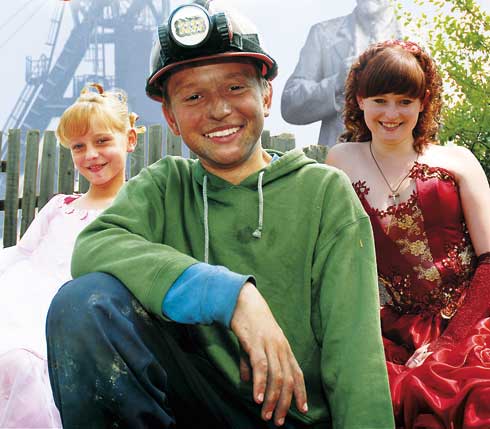
“Mine No. 8” is the story of a 15-year-old boy from the Donbass village.
Why is Ukraine not Russia?
The impulse for the filming of the film was the book of former president of Ukraine Leonid Kuchma “Ukraine NOT Russia”, which gave the name of the entire Ukrainian program “ArtdoxFest”. Konchalovsky goes to Kuchma-Pensioner, he takes the fish with him, travels around the neighborhood and asks: well, after all-why is Ukraine not Russia? In addition, in addition to Kuchma, dozens of people are subjected to similar interrogations, including former presidents of different countries - Eduard Shevardnadze, Alexander Kvasinevsky, businessman Boris Berezovsky, former ambassador to Ukraine Viktor Chernomyrdin, employees of the State Department, which was distinguished by the great power of Political Science Sergey Markov, Ukrainian political and public figures. All of them are here-like a large round dance around Konchalovsky, because, strictly speaking, the film is about Konchalovsky himself. About his long -standing errors, about his sympathy/antipathy, about the joy of discovering the fact that Ukraine is not Russia, about the gradual birth of respect for Ukraine as an independent state and to Ukrainians as a nation. He does not admit these misconceptions, as not a single Russian liberal and intellectual admits, but the phrase attributed to Vladimir Vinnichenko, “the Russian democrat ends where the Ukrainian question begins,” is not only fools at all. Just someone, like Konchalovsky, fights with his errors with the help of art, and someone prefers to live with them.
Protective swamp
The Ukrainian out -of -competition program “Artdokfest” is relevant not only and not so much because Ukraine is now the main pain of any thinking citizen of the Russian Federation, his shame, his complex, but also because many of her films shot to the Maidan and before the war now look like a belated warning.
“Mine No. 8” of the Estonian director Marianna Kaat-a film about a 15-year-old guy from the village of Snezhnoye in the Donbass, at night illegally developing an abandoned shaft and a coal that saves a large family-what other warning was needed? I wonder where is this guy, who is now 18? For some reason, it seems that he, who has lost in all power, is now with those who call himself militias. He doesn’t care - Yanukovych or Poroshenko. He, his parents, entire villages and the cities of Donbass, exhausted by unemployment and poverty, became enemies of power. Any. But how not to become if the fat local authorities are more concerned about the successes of Shakhtar than the failure of the native economy?
"The other" Chelsea ". The story from Donetsk ”by the German director Jacob Pris, also a three -year -old film - is this not a warning, and unambiguous? Football, which has become a national idea in the Donbass, into which billions pour into - even it is not as scary as a poor, tired population of the mining region, joyfully supported the idea. This is the main horror and the main problem of the authorities is already the current one. The unemployed former miners, protecting their swamp, where there is their God - football, will protect their small world from the “orange”, from the mythical “right -wing sector”, from anyone who will try to select their small national idea.
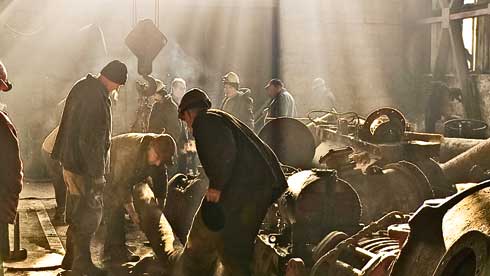
Frame from the film "Another" Chelsea ". History from Donetsk. "
The dying of memory
But it was in these parts that the hunger raged the most strongly in 1932-1933, later called the Holodomor. Almost half of the victims of the Holodomor died here, and here the whole memory should be more alive - genetic, social, human. It would seem that a sickle and hammer, the Red Banner and other attributes of the USSR should be afraid here, and not dream of its return, as the heroes of the “other Chelsea” do. This is about this - about the dying of memory - the film of the Ukrainian documentary Sergei Bukovsky “Living”. This is the story of the last living witnesses of the Holodomor, the old women, who to this day, sweeping the crumbs and carefully sending them into their mouths, the elderly crying under the word “hunger”. The stories of the latest witnesses are interspersed with chronicle personnel, historical reminiscences, which not only give us a terrible picture of hunger. Here they are looking for an answer to a secondary, it would seem, question: why did the silence surround this tragedy then? Why did Europe be silent about terrible hunger? An explanation of this, of course, will be found - first of all, it is a fear of Europe before Hitler and her desire in that situation with the Soviet Union in friendship in 1933. But explanations - they are not always reconciled.
History is a road with a constantly turned on the yellow traffic light. Go, but look around, turn your head, think about danger. The Ukrainian crisis gave not only the residents of Donbass, but also to Russia, the Russian government, the opportunity to stop and think. But our power, it seems, is not able to learn at least something ...
Our state moved the Artdokfest festival beyond its interests. Well, the festival will survive. But what the state will acquire, closing from it, is a big question.
Here it is, in front of us - the square, which has become for several weeks of the most famous area of the world, with human bustle and cheerful fear of an impending danger. 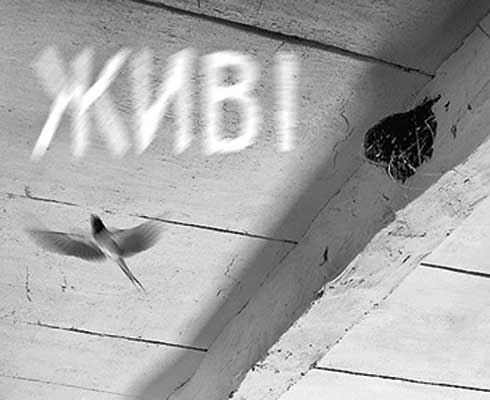
The film by Sergey Bukovsky "Living" talks about the Holodomor