
Translated material
Free or quiet?
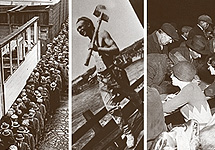
Meanwhile, as liberal experts insist on an innovative scenario of overcoming the crisis, the voices of supporters of the mobilization economy are heard louder. Is the Kremlin’s economic policy possible possible and what is it fraught with Russia? They say Dmitry Oreshkin, Evgeny Gontmamer, Evgeny Yasin, Igor Bunin, Igor Harichev.
Dmitry Oreshkin , political scientist:
Here we are not talking about the economy at all - here we are talking about the interests of people who control power. This is a priority - they need to keep this power by any means. For this, any explanations can be used, in particular, an option with a mobilization economy. The fatherland is in danger - either the crisis threatens us, or the external enemy - introduce extraordinary measures. Since extraordinary measures, it means that the horses are not changed at the crossing, it means that the elections are not relevant, which means that the task of maintaining themselves in power has been solved.
The mobilization economy (and we have extensive experience with it) is justified only if there is a war or preparation for the war: then at all costs, then maximum consolidation, then the effectiveness is not important - the quantity is important, the competition is not important - it is important that all cash resources are collected under one hand, and so on. This economy is not peaceful, but wartime, and the Soviet Union, which had a mobilization economy, mainly lived in the conditions of war (with internal enemies or external) or preparation for war.
Talking about to get out of the crisis with the help of a mobilization economy is, to put it mildly, crafty, harshly speaking - hypocrisy, and pragmatically speaking - a rather cynical way to preserve itself in power, canceling the institutions of civil control, canceling the elections, canceling the opposition, criticism. Mobilization economy - it write off a lot, justifies a lot.
Evgeny Gontmamer , Head of the Center for Social Policy of the Institute of Economics of the Russian Academy of Sciences:
It must be understood that the mobilization economy, which is discussed now, is not a Soviet -type economy, it is not nationalization. Although the Amur shipbuilding plant was taken and nationalized at the request of the workers. But if it becomes massive, as Yuri Mikhailovich Luzhkov suggests, this is not the best option. The mobilization option means that budget money will be concentrated in some very narrow sectors, that prohibitive duties on a number of imported goods, etc. But this is still not a Soviet -type economy.
I think that most likely our economic policy in the coming months will be built in the same way as it is built now: as an eclecticism, as a combination of incompatible. On the one hand, the same Kudrin, as the Minister of Finance, responsible for the budget, will try to pursue an anti -inflationary policy, a policy of impulse of government spending. But on the other hand, the opposite measures will be realized, as with AvtoVAZ: I wanted to give 23 billion rubles - they took and Dali. Or with this Amur shipbuilding plant: there are billions of rubles of debts, respectively, the state takes on them, it is necessary to somehow close it all. Some single whole economic policy is not carried out, this is the whole problem.
Evgeny Yasin , Scientific Director of the Higher School of Economics:
In our country, anything can be, including self -eating. A mobilization economy is just a kind of self -eating. Moreover, in a country that has lived in a team economy for 70 years and already knows well what it is - empty regiments, the absence of everything around. They say correctly that the rake is our national offensive weapon.
The mobilization economy is not suitable for the current stage of development of the Russian economy, it is only in case of war. I hope that no war is expected in the near future if we do not untie it ourselves. As for the current stage, we more or less safely passed the descent stage - that part of the crisis cycle, which is characterized by a decrease in the main indicators. Now, apparently, both of us and around the world begin the period of stabilization and movement to find outputs. If we take a mobilization economy as a basis, then we will not go anywhere.
There is such a stable thought that is swarming in the heads of Russian business executives and some workers like that Astrakantsev, who explained Putin why the shipbuilding shipyard should be nationalized in Komsomolsk-on-Amur. And Putin said: yes, we will take from the private owners of the enterprise, which turned out to be ineffective, we will pay them a symbolic price, there will be no reproduction. I want to remind you of the famous interview of businessman Oleg Schwartzman, who outlined modern methods regarding honestly ownership: when they come to businessmen, they present as those who have the powers from the law enforcement agencies, explain to the owners that they received property illegally and say: give it for a scanty amount and Canate, until you were nailed here. Schwarzman said that this policy enjoys very high protection, called Mr. Sechin, etc.
I don’t take it now to say how reasonably this is - maybe this shipyard in Komsomolsk had to be privatized right away. Each case is individual. But I want to say something else: each case is a precedent, and if you create a precedent of the property back every time, then you will never have effective property. Including with people who were owners, you need to figure out: why they worked so badly, whether they paid them a state order or paid only now, when the state received this property. These issues indicate that we again succumb to our illusions, our old mistakes, our prejudices, and all the time we will back.
The mobilization economy is a curse for Russia. Innovative economy can help, it is the key to bringing Russia to new borders, making it a civilized state so that it ceases to envy, it would be no worse. This is freedom, it is democracy, these are opportunities for the free development of a creative person. Well, who will think about it, if we build a mobilization economy in which a person is shit, this is what needs to be used and then throw it off as a rag or at best to put it on a wall, which was successfully done for 70 years.
Igor Bunin , President of the Center for Political Technology:
There will be no transition to a mobilization economy. The same policy will be pursued as now: smart enough, quite far -sighted. Unless, perhaps, they will more rationally spend reserve funds - first take the project, all planned calculations, and only then give money (now sometimes it is done thoughtlessly). And the same will be the same: the help of unprotected layers, unemployed, banks will help a little less, will help individual enterprises, especially those that are in a deplorable position. Nothing grandiose. If the price of oil rises - now it is under $ 60 per barrel - then, perhaps, there will be more long -term projects, a little more than now. The reduction in financing of such projects will be suspended, and maybe some of the canceled projects will return. And there will be no team system either - I want to live calmly.
Igor Kharichev , General Director of Knowledge-Izili magazine:
Russia has always been distinguished by the unconditional priority of the state in front of man. Here, a long -term decision was made on the basis of the interests of the state, and not man, here they were treated to people as a consumable material, which was especially manifested in the Soviet period. In turn, this was turned by the hope of a significant part of citizens to the state, gave rise to the bureaucratic character of the state, invariably accompanied by the omnipotence and irresponsibility of bureaucracy.
Russia is now ready for a mobilization scenario more than inertial, and even more so for innovative. But the bitter truth is that in the post -industrial time, returning to the mobilization economy will not eliminate the entire growing lag of Russia in relation to developed countries. Because, unlike the thirties and fifths of the last century, the current economy is not only on high technology, not only on advanced science, but also on the initiative of economically active citizens. And you can’t replace its bureaucratic zeal. It requires a change in the very priorities that we are not able to change.