
Translated material
The name of the Buddha
Safranian revolution
## 
It seemed that nothing could interfere with the rule of the generals in Myanmar (former Burma), who have been at the helm since 1962.
   |
It seemed that after decades of repression, all living things, capable of resistance, were long destroyed in this country in Southeast Asia. And there were no hopes. Especially after in 1990, when the opposition party “National League for Democracy” (NLD) won a convincing victory in the elections, the military junta refused to give power.
It seemed that Aung San Su Zhi, NLD leader and Nobel Laureate of the World, a fragile woman who is either sent to prison or keeps under house arrest, or transports to the hospital - a prison for the insane ones - that she is the only one in the country can say “no”.
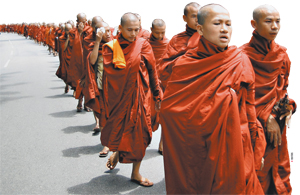
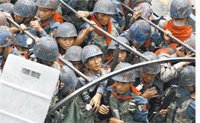
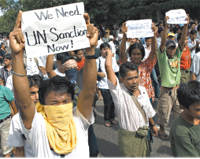
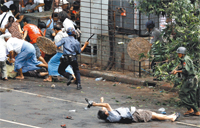
But on the streets of Rangun - the capital of Myanmar came out of Buddhist monks. 10 thousand. As usual, in their saffron robes (Uttarasangs) and with uncovered heads. The convinced supporters of non -violence, Buddhist monks and nuns, and then just suddenly forgetting the fear, citizens demanded to stop killing people in their country and returning political freedoms to them. And 100 thousand people had already entered the streets, and the junta was forced to introduce troops into the city and declare a commandant hour. Then the troops began to shoot. But day after day, the monks took to the streets again and led the crowd. So it began, as the media already christened it, the “saffron revolution” - by the color of monastic robes. “Socially included Buddhism”-this is the name of the religious scholars by the direction of this one of the fastest growing religions in the world (according to various sources, Buddhists are 350 million people today), which was born in Southeast Asia, primarily in South Vietnam, in the early sixties. Then, in the terrible corrupt and repressive South Vietnam, Buddhist monks went in protest for the act of self -immolation. The famous Buddhist theologian Tich Nhat Khanh then stated that when the Buddhist is faced with terrifying suffering, he cannot remain aloof, despite the whole tradition of asceticism and the desire for nirvana, he is obliged to join in his country and act.
“The word“ Buddha ”in its root has“ Budh ”, which means“ wake up, ”said Hanh. - Buddha is the one who is always awakened. But did we wake up? .. Our Earth is like a small boat that is constantly at risk that it will drown. We need a person who could say what to do with the silent conviction. Who is this person? The texts of the Mahayana give an answer to this question: this person is you. "
“This man is you,” say Buddhist monks on the streets of Myanmar today. They call them to wake up.
#