
Translated material
Martian Jity
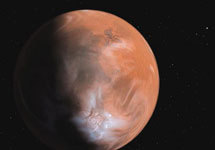
Mars found another, the fourth “Trojan” Asteroid-Companion. The object that received the designation 2007 NS2 was discovered on July 16 by the astronomers of the La Sagra observatory located in the south of Spain. According to preliminary estimates based on the visual brightness of this object, the dialect of the celestial body is approximately 1 kilometer.
2007 NS2 is moving after Mars in its orbit, occupying the L5 L5 point, which is 60 ° behind the Red Planet in relation to the Sun (this is at a distance of one radius of the Martian orbit). Two more “Trojans” are in L5, while the fourth of such an object moves before Mars 60 ° to it at the L4 Libration Point (there are five points of stability, while not mentioned here L1, L2 and L3 lie on the line connecting the Sun and the planet).
After the opening of 2007 NS2, the astronomers found the same asteroid in old photographs taken in 1998 as part of the Loneos and Linear projects (Lincoln Laboratory Near -Earth Asterid Research) - the programs for the search and research of near -Earth objects (NEARTH Object - Neo ) laboratories. This allowed researchers to clarify the parameters of the orbit (in particular, this was facilitated by the calculations of Aldo Vitagliano from the University of the University II University ( University Di Napoli Federico II ) in Naples)
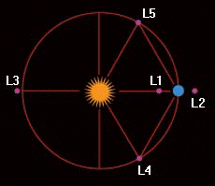
Mars is among the three planets of the solar system with " Trojans ) objects in their orbit. Approximately 2200 famous Trojans and Greeks accompany Jupiter in this way and several of these objects were found in Neptune. There are no “Trojans” by the land, although they can also exist (observations of such objects, presumably located at the points of L4 and L5 in the earth's orbit, are complicated by the fact that they are always unsuccessfully illuminated by the sun and are also visible only in morning and evening). But the so-called coorbital asteroids (for example, 2005 GU9, 2003 YN107 , 2002 AA29 or a 5-kilometer cruy (3753 Cruithne ), opened in 1986), which “wrap up” wide spirals around the earth's orbit and gradually drift, retreating or running before the ground (the trajectory of this, are known. Pretty intricate movement resembles a giant horseshoe). Such a configuration is unstable, so such objects are only temporary companions of our planet.
Jupiter and Neptune, perhaps, received their “Trojans” approximately 3.8 billion years ago, at the time when the orbit of these planets changed, and under the influence of their gravitational fields many comet -like objects were also shifted from their orbits. Well, the Martian "Trojans" most likely gathered at the points of Lagrange in a much earlier period, shortly after the emergence of the solar system (over 4.5 billion years ago). At least this is what the Alessandro Morbidelli specialist in the Trojans ( Alessandro Morbidelli from the French Observatory of the Cote d'Azur ( Observatoire de la cethe d'Azur ) in Nice.
Source:
Tiny Asteroid 'Groupie' Found Trailing After Mars - New Scientist