
Translated material
The frame of utopia
Two exhibitions are held in the center of modern culture “Garage” - “Futurology” and “Russian utopias”

Ilya Gaponov, Kirill Koteshov. Zero people. Kuzbass. 2010
According to curators, they demonstrate the development of the traditions of the Russian avant -garde. Malevich tried to see The New Times tried to see Malevich's Black Square in the works of contemporary artists
At first, the exposition is a haystack resembling an architectural structure - the Zikkurat of Nikolai Polisky. Small, but pretty fire extinguishers are located along its perimeter. It turns out very symbolic: a Russian folk zikgurat with an unclear, but unpleasant danger emanating from it, and immediately the fire extinguishers standing ready. True, the author of the installation of fire extinguishers did not mean, they appeared in accordance with the instructions for fire safety. This is a rather characteristic thing for contemporary art: it is not against additions, interpretations and generally from outside. In this sense, Malevich’s Black Square and Polis's stack are no different.
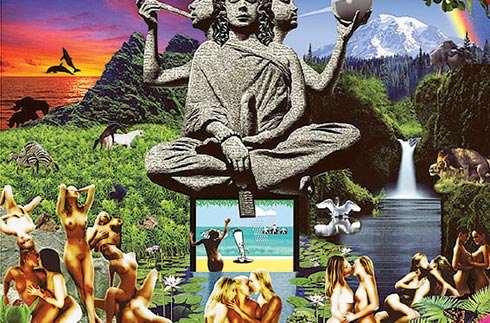
Group "PG" (Ilya Falkovsky, Alexei Katalkin, Boris Spiridonov). Shiva. 2001
“Futurology” goes along the left hand, and “Russian utopias” - on the right. The curator of the Utopius Julia Aksenova is sure that you will not confuse them: “Futurology explains the future through the past. And utopian thinking produces qualitatively new systems. Artists can not only imagine, but also realize today in a completely different way. ”
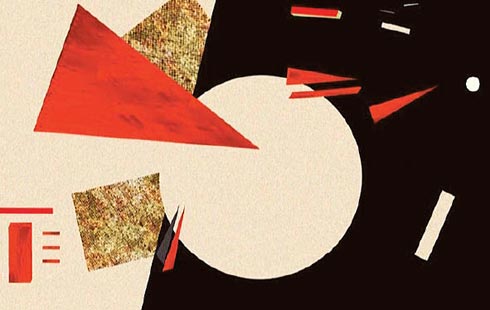
Alexey Buldakov. Lisitsky sex. 2007
Maybe in a different way-when compared with news and newspapers, but it cannot be said that in a new way. Dmitry Gutov continues to make conceptual objects of wire. Boris Orlov still lets out decorative patterns on the wreckage of a non -dying empire: according to the frame of the Soviet aircraft and the bubes of Stalin, blooms the magnificent color of Khokhlom. Again, you can see the computer animation of Alexei Buldakov, on which geometric shapes from the paintings of the Suprematist El Lisitsky make love. “Futurology” is somewhat fresh: all works were created specifically for the exhibition at the request of the independent curator Erve Mikhailov. In 2007, he arranged a group exhibition of young Russian artists in Paris. In Moscow, he continued to work with modern Russian art, dividing it into two parts - into those who are more “about avant -garde”, that is, continuing the abstract and experimental line of Malevich, and those who are more inclined to figure, also continuing Malevich, only late, who returned from squares with circles to portraits of Russian peasants. In the first group, for example, Andrei Molkin got with the “New Architecton”: he repeated Malevich objects in new materials - neon lamps and tubes filled with raw oil. Here, Sergey (Africa) Bugaev, who built an entire laboratory of abstract painting, was here. The heirs of the late Malevich unexpectedly became Ilya Gaponov and Kirill Koteshov, who depicted “zero people” - the harsh miners of Kuzbass with earthlines (coal conceptually used in the composition of paint), as well as Ivan Poysh, who came up with a series of adventures of Soviet park sculptures.
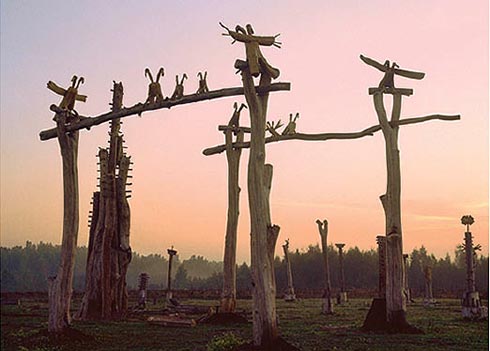
Nikolai Polis. The boundaries of the empire. 2001–2007
Despite the fact that both exhibitions are devoted to the future, it follows that contemporary art knows how to work with the past - from hints in the Russian avant -garde and appeals to the Soviet era, not works, but sweets. But there is a danger. After an hour of wandering on the “garage”, strong confidence that contemporary artists are ready to make sweets from everything. Even from the Black Square. It is somehow not serious for the Russian avant-garde.
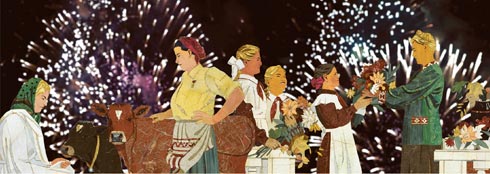
Ilya Korobkov. "To joy ..." 2009