
Translated material
Iran was put on a Geiger counter
The world does not know how to curb the nuclear ambitions of Ahmadinejad
Nuclear Iran will be the main problem of 2010. The situation enters the critical phase. On January 15, the deadline has expired, allotted by Tehran to answer the de facto ultimatum “six” of international intermediaries. What awaits Iran now - the new sanctions of the UN or the war with the United States? The New Times publishes an analysis of the possible consequences of both
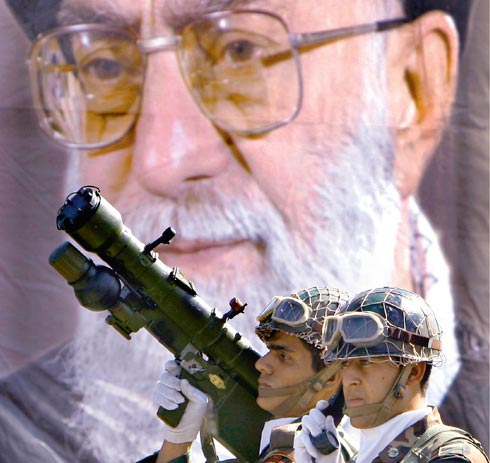
On December 18, 2009, a small unit of Iranian troops entered the territory of Iraq and seized an oil well there, hooking an Iranian flag above it. The well, the Iranians said, is located in Iranian territory that they did not return after the Iran-Iraq war (in the 1980s.-The New Times). Fortunately, there were no casualties. However, such incidents in the border area occurred in the past. It is not surprising, given Iran’s demand to Irak to pay $ 1 trillion “as compensation for the start of war”. But the fact that in another place and at another time it would look like a slight border incident, given the current situation around the Iranian nuclear program, it does not look at all trifling.
Who will start first
The December incident on the border was “ordered” in Tehran, numerous sources say. For what purpose? The Iranian government, of course, is not enthusiastic about the ultimatum of Washington, where at the beginning they established a deadline for taking some measures against Iran at the beginning of January 2010, and then decided to postpone it for another two weeks. For Iran, experiencing a serious internal crisis, the American delay was of fundamental importance. After all, it turns out that the course of events in the region completely depends on the will of America and Israel. So, Iran needs to prove the opposite. Iran has its own options for strength actions, he is able to apply them regardless of America’s intentions to impose sanctions or untie the war. And moreover, Iran is able to bring its ax, without waiting, while the United States does the same. This is the secret meaning of the Iranian sortie, which clearly achieved the goals - at least attracted attention. While in Baghdad and Washington, they found out what happened there, on the border, oil prices crawled up, and the United States had to come to terms with the fact that they were by no means always able to respond quickly and effectively to the “surprises” of the other side.
Another thing became clear: Iran will not wait until Washington thinks out for him all possible scenarios. Iranians themselves can unleash the conflict if they are convinced of its inevitability. Finally, Iran showed the United States that he knew how to raise oil prices, and therefore, has some degree of influence on the economic healing of America.
The arguments of Iran
What instruments do Tehran have in the hands? The first and very serious: Iran can block the flow of oil, which goes through the Ormuzian Strait and the Persian Gulf, "stuffing" their water with mines or putting anti -ship missiles under the sight. Even the very attempt to such actions will inevitably lead to a sharp increase in world oil prices, which will affect the entire world economy.
In addition, Iran is quite capable of using its “fifth column” in Iraq to provoke a large -scale destabilization of the situation in this country, which already suffers from constant terrorist attacks. Now the possibility of attacking actions of the proofs in Iraq is in no way discussed by the American command. Meanwhile, even in case of successful reflection of these attacks, they will not only cause chaos in Iraq, but will also encourage the Obama administration to revise the already declared schedule for the withdrawal of American troops from the country. Which, in turn, is able to influence the situation in Afghanistan.
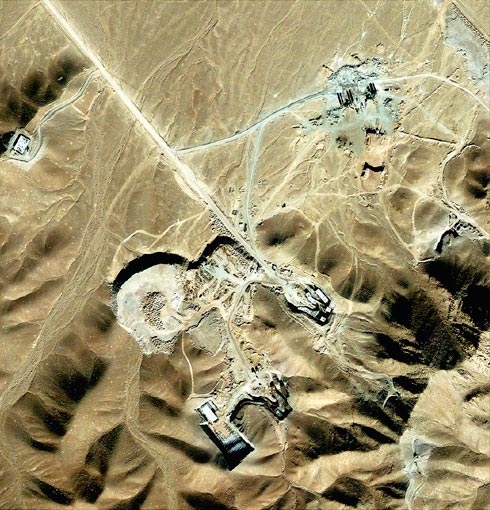
In the picture taken from the satellite, there is a Uranus processing plant near the city of Kum, 156 km
To the southwest of Tehran. Iranians kept secretly from the Iranians for a long time
Finally, Iran may well use on its side the hezbollah -based Shiite group in Lebanon (it is funded by Tehran. - The New Times). With its help, you can not only untie the conflict with Israel, but also carry out terrorist attacks on America and its allies. Hezbollah is a much more perfect and effective organization than al-Qaeda even in its best years, and in the case of its consent to become an instrument in Iran’s hands will be a very significant threat.
Arguments of the United States
Obviously, these options for the Iranian answer will not allow the United States to limit the war only by air strikes. Yes, the United States has greatly succeeded in air campaigns. But they are very weak in terms of struggle with the partisan movement. In any case, before applying a blow to the Iranian nuclear objects, Americans need to consider Iran’s possible response.
For successful hostilities against Iran, Washington will have to take at least three steps. Firstly, destroy the Iranian installations of anti-ship missiles along the entire Iranian coastline, as well as all surface vessels capable of installing mines. Secondly, the Americans will need to destroy the large clusters of the Iranian troops along the border with Iraq and to minimize the Iranian resource in Iraqi territory. Finally, the United States will have to neutralize the potential of Hezbollah, especially outside the Lebanon.
All this will require America of massive, well -coordinated actions immediately before a blow to Iranian nuclear objects will be delivered. Otherwise, Iran will preserve the possibility of quick and destructive for the global economy of a response attack. But Iran, as already mentioned, can resort to proactive actions, if the inevitability of the conflict becomes obvious: Tehran simply will not remain anything, how to act on the principle of “use power, otherwise you will lose everything”. The worst scenario for Tehran is to sit and wait for the start of the US active actions against him.
Thus, Washington should think ten times before taking any steps: the possibility of failure is too great. And Israel here is not a big assistant here: its own resources are too small to really resist the actions of Iran in the Persian Gulf of the Persian or to prevent Iranian sorties in Iraq.
Around - war?
It is clear that the United States is interested in the peaceful resolution of the Iranian problem and rather go to more stringent sanctions against Tehran, in particular, an embargo for deliveries to Iran gasoline. The United States tends to achieve support from Russia and China and, it seems, are ready to spend exactly as much time on it as it takes. The fuel embargo can be the very measure that will inflict a strong blow to Iran. But sanctions and a very risky thing. After all, if they do not work, the Iranians will understand that the war is inevitable, and can resort to proactive actions. However, Iran can hit the first and if the sanctions are crowned with success and begin to threaten the very existence of a theocratic regime: why not use the accumulated military potential before losing it?
Now both sides - both the USA and Iran - are trying to win time. No one wants to concede, and everyone hopes that he will give in another. At the same time, each party understands all the risks associated with a possible war, and therefore hopes that the enemy will back down and accept its conditions: the Americans hope that Tehran will refuse to implement his nuclear program under the threat of the country's destruction, and Iran will come to terms with the fact that it will have nuclear weapons, since another war, and also not too successful, Washington is not needed. The whole trouble is that the parties do not trust each other, and therefore at some point either Iran or the United States can decide that it is no longer possible to wait ...
The Security Council has already imposed sanctions against Iran three times, but all of them were ineffective. What measures could give the desired results? According to most experts, this is:
• Sea blockade of Iran in order to stop supplying oil products. Despite the large reserves of natural gas and the status of the lead exporter of oil-raw, Iran does not have sufficient capacities for the production of fuel and largely depends on its imports;
• freezing Iranian assets abroad. In 2008, by the decision of the American court, $ 2 billion belonging to the Iranian company Citigrupped were frozen. After that, Iran significantly reduced financial transactions abroad;
• A ban on the sale of weapons to Iran. Having an outdated air defense system, Iran seeks to increase military potential mainly due to procurement abroad.Translation from English by Anna Makarova, The New Times