
Translated material
Prohibited classic
The dispute about the authorship of the "Quiet Don" continues. Fedor Kryukov is 140 years old. When will we read?
In the last century, they said: "Soviet power for 70 years cannot forgive Gumilev that it shot him." But Gumilyov was read to the Soviet regime, and after, and after. And this itself is to blame. Let his prose read Gorky, Korolenko and ...
In the last century, they said: "Soviet power for 70 years cannot forgive Gumilev that it shot him."
But Gumilyov was read to the Soviet regime, and after, and after.
And this itself is to blame. Let Gorky, Korolenko and Serafimovich be read out by his prose, let his contemporaries call the “Homer of the Cossacks” ... He was published most often under the pseudonymers (Gordeev, Berezin, etc.) in the Narodnaya magazine “Russian wealth”. There he served as the co -editor Korolenko in the prose department. And all the time I took some narrow, regional ... no fame, no profit. And who, after 1905, wanted to read about the life of the Don Cossacks, if throughout Russia the very word “Cossack” was associated only with a whistle of Nagayka?
The lies of the Soviet myth: Kryukov is a third -rate writer.
Yes, open his first story “The Gulbers” (to the author of 22 years) ...
Don speech never sounded so fascinating.
... I just hear: “Kryukov ... this is which Cossack officer? Yes, leave! .. ".
Since we are talking about a little -known writer, we touch on his biography.
Fedor Dmitrievich Kryukov was born on February 2 (14), 1870 in the village of Glazunovskaya Ust-Medveditsky district of the Donskoy army. He is the son of a Cossack Klborob. Mother is the Don noblewoman. There are three children in the family. (In 1918, the younger brother, who served as a forester, will take off the train from the train and tear off the Red Guards.)
With a silver medal, he left the walls of the Ust-Medvedi gymnasium.
In 1892 he graduated from the St. Petersburg historical and philological institute (institution with such requirements for students that even Alexander Blok, the son of a professor of law and the grandson of the rector of St. Petersburg University, had to be tight here). And he taught thirteen years in Orel and Nizhny Novgorod.
In 1906 - a deputy from the Donskoy army in the First State Duma.
There, on June 13, he acts against the use of Cossacks in the punitive actions of the government. Since then, someone Ulyanov (who Lenin) has been watching a dangerous populist, his same age as a dangerous populist.
By the eight -year anniversary of Tolstoy in No. 35 of the Bolshevik newspaper "Proletarian" (September 1908), Lenin's article "Leo Tolstoy as a mirror of the Russian revolution" appeared:
“Most of the peasantry cried and prayed, resonance and dreamed, wrote petitions and sent“ petitioners ”, in the spirit of Lev Nikolayich Tolstoy! And, as is always the case in such cases, Tolstoye abstinence from politics, Tolstoy renunciation of politics, the lack of interest in it and its understanding, did the fact that there was a minority behind the conscious and revolutionary proletariat, the majority were the prey of those unprincipled, Kholu, bourgeois intellectuals, which, under the name of the cadets, ran from the meeting of the labor straps in the front of Stolipin, and the gear. They bargained, reconciled, promised to reconcile - until they were kicked out of a soldier's boot with a kick. "
All this is primarily about Kryukov, who was the first to raise his voice in defense of the Cossacks.
But back in 1906, in the article “Frequence in the revolutionary environment”, Kryukov was exhibited by a dummy politician, whose efforts to liberate the workers are ridiculous. And 1913 in another article (“What is being done in populism and what is done in the village?”) The future leader generously quotes the Kryukovsky essay “Without Fire”. In fact, Lenin considers his author as a new “mirror of the Russian revolution”, although it was obviously abstaining from the use of this label, not wanting to put the Don author on a par with a classic and thereby add points to “non -authoritative politics”.
In the same 1913, Kryukov and polemicizes with Lenin in the “Quiet Don”. He silently agrees with the role of the new “mirror” assigned to him, but shows that the propulsion of the revolution is the powerful, their selfishness, stupidity and mediocrity. And also - Leninist supporters, zombie radicals like Shtokman, who do not know either Cossack or peasant Russian way, but set the goal of destroying the whole folk life along with the bad and good, to destroy everything to the foundation.
Kryukov answers him in the novel about the Cossacks, which has been working on since the beginning of the 1910s.
This Kryukovo polemic was not seen with Lenin, because the novel was not finished. Meanwhile, she is already 80 years old, in sight, in the “Quiet Don”.
Why did Kryukov need a link to “Russian wealth” with his own essay?
In the second part of the novel, the merchant Mokhov reads the June volume of “Russian wealth”. His son comes to him. And reports to the employee Davydka.
“The Valtsovnik fired from the mill spent whole nights at Valet in Samannaya Zabozchitskaya, and he, eager for evil eyes, said:
-No-e-it, Sha-li, you! They will soon cut the veins! There is little one revolution on them ... ”(TD: 2, III, 135).
This is the ending of the chapter. And in the first lines of the next, the “alien man” Shtokman appears. The one that will put the “larva of discontent”, and from it “after four years, is getting out of the decrepit walls of this larvae of this strong and living germ”.
On October 25, 1917, minus four years and give an end to October 1913. (Shtokman will arrive in Tatar on October 27).
Mokhov’s merchant reads in the sixth book of “Russian wealth” for 1913 the end of the Don essays of Kryukov, published under the general name “In the depths. (Essays from the life of a deaf corner). ” Reads about another merchant living on the Don a few miles from Mokhov and also, like Mokhov, leading the country straight to the revolution.
At the same time, Mokhov’s thoughts are busy with Russia and his own business (in February 1917, he will go to these questions to General Lishtynitsky).
Mokhov reads to himself, but the mirror system does not work.
For an innocent joke, driving away Davydka, he himself grows the "living embryo."
Such an eternal dispute on the native topic "Who is to blame?" Only Kryukov needs to be, like people better, Ulyanov - as worse. (And what to do - he already knows.)
The first world hooks go to the orderly.
His opponent is still bored in Switzerland.
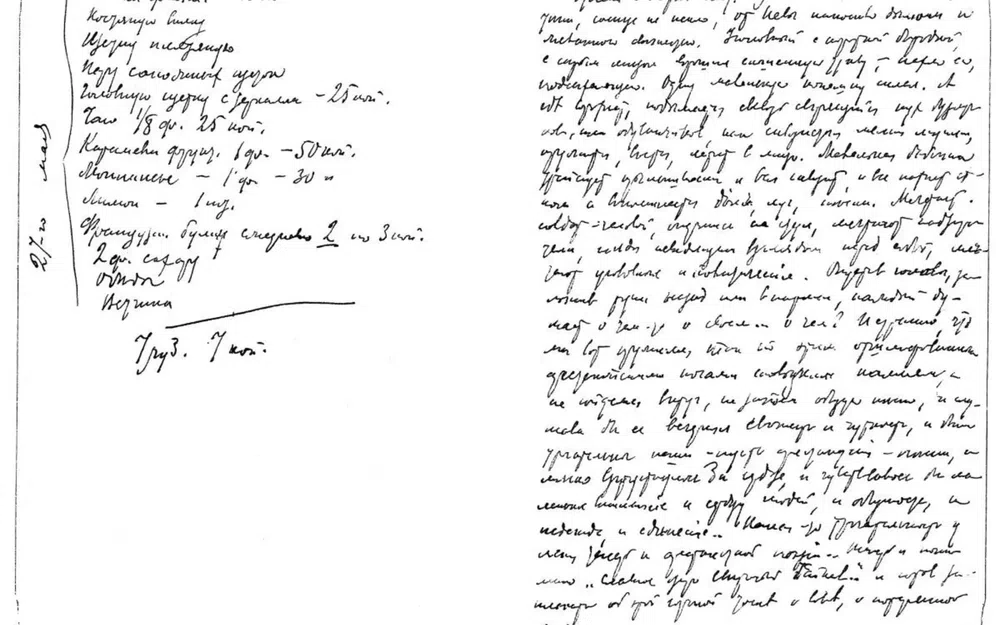
On Taganka in the "Library of the Russian Abroad" I view the archive of Fedor Kryukov and among the drafts of the front-line essay "Group B." (1916) I stumble upon a strange record. It was made on the right page of the double leaf extracted from the “Memorial Book” (in our opinion-note).
The book itself, apparently, is lost.
At the first glance at this leaf, it may seem that the text captured on it is worthy of the monumental, although very boring marginal “NRZB.”: The width of the lowercase letters is almost microscopic - about 1 mm, the good half of the letters are indistinguishable from each other. It will be possible to decipher with the help of Natalia Vvedenskaya (and in two cases the television journalist Viktor Pravyuk and the philologist from Nalchik Lyudmila Vorokov helped):
June 10. We walked at the fifth hour. There were long shadows in the kindergarten, the sun did not bake, from the Neva was applied with smoke and desired freshness. The criminal with a short beard, with a gray face, turned the mowed grass - it smelled of it, drying out. One small penny was wrapped. And where the luminous fluff of the Buzlukov, or dandelions, rises, rises - like through, small flies - circles, curls, climbs into the face. A small butterfly flutters wings and all through; And everything smells of hay and moisture in the rain, - meadow, sand. He dreams of a watch soldier, leaning on the barrel, the warders dream, looking at the invisible look in front of themselves, the criminal and political ones dream. Having put his heads with his hands back or in his pockets, everyone thinks about something about his own ... about what? And it is strange that we are circulating so on these slippery stones polished by princes with princes, and do not get together in a circle, not a collapse of a common song; And they would listen to her evening freshness and sensitivity, and our prisoners were touching-songs-songs, and a lot would immediately get their hearts, and would feel in the lungs to the heart of people-and generality, and hope, and unity ... Some touching of our tenet and prison poetry ... Now I understand “The glorious Lake Bright Baikal ...” and is ready to cry about this mountain me Lost Mira ...
The last word is written through “I” - this, like Tolstoy, about that world that is not the lack of war, but a human community.
Before us is a page from a prison diary. Kryukov in 1909 sat in the “Crosses” signed under the “Vyborg appeal”-an appeal to civil disobedience (this is when the king dismissed the first Duma).
The writer returns home, but by the decision of the Don Ataman he was sent to an unprecedented link in Rus'. From the region of the Donskoy army was exiled to St. Petersburg. In St. Petersburg, however, they tried. And therefore, three years later - a loner in the "Crosses". For three months.
And then he, a state adviser, has been working on Vasilyevsky Island for several years at the Mining Institute. Assistant librarian.
Dreams of "ascending to the heart of people" will collapse in the spring of 1918.
The essay "In the corner", telling about those days, he will finish this way:
“... they searched the bourgeois - both small and larger - confiscated by inspiration everything that came by the arm, sometimes up to children's toys, hid it more obvious. <...>
- Alexey Danilych, will you take firewood? - I ask one friend of the laborers.
- Once. The commission is appointed.
- In which one?
- In the auditory ... in the culinary part.
-Ah ... it's good.
- Nothing: seven rubles of per diem ... has its own pleasantness ... "
And this is to the Bolsheviks. Their invasion of the Don is still ahead.
Unlike Gumilyov, who was shot in a fabricated case, Kryukov was really guilty. He, perhaps, is the only art of all the famous Russian intellectuals of that time, he really tried to stop the "Bolshevik invasion." He was again elected to the Don - now the secretary of the Don Parliament. At the same time, it also edits the government newspaper.
Fraight, book, in 1918 he picked up a Cossack saber. In the first battle, the horse was killed under him, and he was shell -shocked. He joked: "Under the old age, I had a chance to portray the general on a white horse ...".
And then - death during the retreat to Novorossiysk.
Maybe the most mysterious from all the deaths of Russian writers.
He did not "go to the people", like the older generation of launch people. He himself was a people. He spoke and thought in the popular language, sang a lot and willingly with the Cossacks, collected their songs. All the six lines of the epigraph to the “Tikhny Don” are not so-glorious Zemlyushka, our glorious earth is plowed ... ”-completely quoted by Kryukov three times.
His younger contemporary recalled:
“When Kryukov was in the prime of his literary glory, we, students, in the village of a dozen already, and all of us impatiently and joy awaited his arrival for the summer vacation. They knew that our young ladies would laugh at his long, to the knees, blue and black satin shirts and pants. In particular, my sister was pestering:
- And what are you, F.D., all in torn pants go, if only good on the holidays!
- Chavo, A.I., to chase on the gardens - you still tear, so Masha (sister) and does not give me new rod. "
A cheerful person.
Only now colleagues in the literary workshop remembered his eternally sad eyes.
It is easy to explain why this intelligent, soft man of left-wing beliefs, with such sad eyes and such a sense of humor (in the range from something very Nabokovsky to a simple grandfather-Shchukarsky), not only “did not accept Soviet power”, but began to fight it with it. To do this, you just need to read its journalism in 1917-1919. The collection "The collapse. The Troubles of 1917 through the eyes of the Russian writer ”, entirely from the articles of Kryukov, came out in the Moscow publishing house Airo-XXI last year. (My friend and colleague Mikhail Mikheev found in the archive the half -dead bindings of the Don newspapers, hidden on wrapping paper, and with him a philologist from Nalchik Lyudmila Vorokova, we prepared that book.)
When in 1928 the first chapters of the “Quiet Don” appeared in the magazine “October”, the still surviving fans of Kryukov cried out in a voice: “Yes, Fyodor Dmitrievich wrote!” In March 1929, the newspaper “Pravda” “... The enemies of the proletarian dictatorship, an evil slander about the fact that Roman Sholokhov is supposedly plagiarism with someone else's manuscript, was clouded to them. (Funny saying: slander that supposedly ... plagiarism!)
In ten years, these, no longer screaming, but whispering, will calm down in Stalin.
In 1974, in Paris, with the preface of Solzhenitsyn, the book of Irina Medvedeva-Tomashevskaya “The Strury of the Quiet Don” was published. The book that the most famous Soviet novel was written by the fierce enemy of Soviet power.
Since the late 1980s, Kryukov began to publish a little, but, as Bibliographer A.A. The hare, ten volumes of his works are scattered along the period of the end of the before last and the beginning of the last century.
A number of parallels of the prose of Kryukov and the “Quiet Don” were revealed by the Rostov researcher Marat Mezentsev. Not all of them are convincing. But then there were no electronic search engines.
Orlov journalist Vladimir Samarin recalled how he was once struck by the intonation kinship of Kryukov’s novel “Zyb” (1909) with the landscape descriptions of the “Quiet Don”:
“It smelled of plucked earth and wet ditch smoke. He crawled out of the pipes with blue streams and stood in thought over the straw roofs for a long time, then reluctantly went down, quietly poured down the street and wrapped a vertebral turquoise veil at the end of the village. At the top, between the disheveled mowing of rosy clouds, the sky was gently blushing: the sun came up. ”
It will be objected: intonation can coincide with accident.
But dozens of stylistic constructions, plot turns, rare epithets, and nowhere to be fixed sayings, copyright metaphors and such dialect words that none of the Russian writers used it, can simply “coincide” dozens of stylistic structures. (Of course, except for the author of the "quiet Don").
Kryukov’s novel was crazy: in his texts there is a lot of self -citrate. (Each time the writer tried to improve himself the same.) But who knew in the 1920s that the Internet would appear? And in it - the national corps of the Russian language.
In this piggy bank, the volume of texts of Russian writers already exceeded 150 million words.
When the Sholokhov manuscripts surfaced in the late 1990s, according to photocopies of several pages, researcher Zeev Bar-Sella suggested that this is not the original, but an illiterate copy from a competent original, which was also made according to pre-revolutionary spelling.
And in 2006, the Institute of World Literature published the Sholokhov “drafts” and “Beloviki” of the novel. And so he killed him and a festivable myth. Because in front of us is not drafts, but a typical bullshit.
Sholokhokhovs say: the classic provided these manuscripts in 1929 “Plagiata Commission”.
The scribe worked as a buscase at a break: blowing, not understanding the meaning of what he copies. And now the church “Aki Leo” turned into “like yale”, “wheeled month” (moon) into “Kolosyyy month” . Sholokhovsky “Fluffy Goat” , which is stomping in manure, is actually melt (fat). "At the house" - "At the Don." “Scepter of colors” - “spectrum of colors” , etc.
Why do you need a copy by which the text cannot be published?
Then, that the original could not be shown. He was with Youth, Era, “I” ... This is evident from dozens of incorrect readings.
Imagine how Fadeev with Serafimovich swore ...
The “drafts” were fully confirmed by the opinion of academician M.P. Alekseev (1896–1981), who talked with Sholokhov at the Presidiums of the USSR Academy of Sciences: “Sholokhov could not write anything, nothing!” (I know from the academician of the Russian Academy of Sciences, Alexander Lavrov, a student of Alekseev).
However, this was clear 80 years ago. Physicist Nikita Alekseevich Tolstoy recalled that his father A.N. Tolstoy escaped from Moscow when he was offered to head the same plagiarism commission. And at home the question “Who nevertheless wrote“ Quiet Don? ”Answered one thing:“ Well, of course, not a bear! ”
And who?
Now, when the electronic “national corps of the Russian language” is under our hands, we can answer for sure: after all, Kryukov.
And Sholokhokhovam Sholokhov can no longer be saved, and the other author of the “Tiki Don” can no longer be imposed.
Is it conceivable that two different writers come up with a set of identical epithets for the word “voice”: viscous; octavic, damp; perching; The pointing one, etc., if it is known that the first author introduced these constructions into the literature, and the second (in his own words) never read the first. And in the interval between the first and second, none of the Russian writers used these epithets in relation to the “voice”.
Hundreds of dialectisms (not only Don, but also Oryol ”, for example,“ to show off ”in the meaning of“ admire ”) were first revealed in“ Quiet Don ”.
But it turned out that Kryukov had much earlier.
At the same time, even the errors of the Kryukovsky spelling are repeated: Ulysh (earthen share)-he is actually a departure . (Just in household speech, it is found mainly in the nominative case, and therefore at the end the unchanging “w” sounds.)
The methods of transmitting interjections are repeated:
“-I -and, dear ...” (“Cossack”)-“- I-and-and, my little one ...” (TD: 1, XVIII, 92); “-Tyu -oh ! .. Skyd! ..” (“To the source of healing”)-“- Tyu-oh ! .. SKAL! .. (TD: 2, V, 144); “-... I’m not fighting ... well, the stim ...” (“officer”)-“- well, well , the Bolsheviks are the Bolsheviks ...” (TD: 5, XXVIII, 374).
The graphics that betray expression coincides:
" -What is the speaker here?" (“Quiet”)-“- this is possible” (TD: 6, II, 24).; “-... by golly, prick ( so! -A.Ch .). I advise. Very good! " ("New Days") - " - got to your feet? Very good ! We are taking Anna. ” -And confidently, smokingly squinted:-You do not mind? Do not mind? Yes, yes ... yes, very good ! " (TD: 5, XXVII, 299–300).
We will add here several dozen “coincidences” of proverbs, sayings and quotes: the initial dawn; “Cossack works for a bull, a bull for a Cossack”; “Twist the tails to the bulls”; "Glory to the pipe"; “ - our case is a calf - I ate and in the wrapping”; “Like peas from a bag”; "Like rain in the fall"; "Like rust (rzav) iron ..."; «куга зеленая»; «не шурши!»; «огурцом телушку резали» и «шацкие – ребята хватские»; «ноги с пару сошлись»; «пьяней грязи»; «старый прижим» (впервые у Крюкова); «рог с рогом»; «ряд рядом»; «Слово – олово!»; татарник (репей как символ несгибаемости); «Это – не сало, обомнется».
Совпадают десятки микросюжетов и житейских ситуаций. (Но это слишком большая тема, и здесь мы не будем ее трогать).
Даже дразнилки те же: дегтярь, мазница (о донских хохлах). И тот же возглас восхищения «Сукин кот!» , и те же ругательства: «– …Погоди, попадешься и ты когда-нибудь! Воряга!» («На Тихом Дону». 1898); «– А ты – чужбинник! Чужого понахватал, награбил …» («В углу». 1918) – «– Чужбинник! Б... старый! Воряга! Борону чужую украл !..» (ТД: 3, XIII, 273) и т. д..
Скажут: ну, действительно, совпало. И что?.. Шолохов ведь тоже жил на Дону.
Но «Тихий Дон» наполнен авторскими метафорами Крюкова. А это уже совпадением быть не может: между ребер арбы; срезанный (в ТД – обрезанный) месяц; ущербленный месяц (из-за которого рыба не клюет); задумавшаяся курица; цепкая повитель с розовыми цветами; бондарский конь (т. е. бочка); проседь полыни (до Крюкова проседь – это только про волосы или бороду!); головной убор как белый лопух; калмыцкий узел; острый (в ТД – хищный) скопчиный нос (скопчик – вид ястреба); чешуя реки (в ТД – волн); чибис в куге и песня неподалеку; широкоспинный (о человеке); плавать по-топоровому; тело, как всхожее (и невсхожее) тесто; прыгнул через дышло арбы (В ТД – тачанки); канунница, запах меда и лежалое платье; пули как горох; пули и снаряд как бурав; изрытое оспой лицо земли; острая спина (это виден позвоночник); порыжевшие (в ТД – порыжелые) сапоги; лицо человека, как старая голенища ( так! – А.Ч.) сапога (последний пример – находка московского исследователя Савелия Рожкова) и т. д.
До Крюкова никто не писал и так:
«Густой медовый запах шел от крупных золотых цветов тыквы с соседнего огорода» ( Крюков. Повесть «Зыбь». 1909 ) – «…с огородов пахнуло медвяным запахом цветущей тыквы» ( ТД: часть 6, LXI, 400 ).
А вот редчайший глагол – запеснячить (запеть): «– А гораздо слышно? – с удивлением воскликнула она. – Ах ты. Господи!.. Я-то, я-то на старости лет в Спасовку запеснячивать вздумала!.. Это все она меня, будь она неладна... «Давай да давай сыграем, скуку разгоним, никто не услышит”. Вот старая дура!.. – А хорошо пели! – с искренним восхищением отозвался Ермаков» (Крюков. «Казачка». 1896) – «– Это – не проводы. Еланские так играют. Это они так запеснячивают . А здорово, черти , тянут! – одобрительно отозвался Прохор…» (ТД: 7, XIX, 187)
И еще из уникального:
« развязал хитрые – калмыцкие – узлы тонких веревочных вожжей» ( «Весна-красна». 1913 ) – «С этого дня в калмыцкий узелок завязалась между Мелеховыми и Степаном Астаховым злоба». ( ТД: 1, XIV, 70 ).
«… увязая ногами в тяжелой, кочковатой пашне » ( «Зыбь» ) – «…вихляя ногами по кочковатой пахоте» (ТД: 3, VII, 296).
Или вот железнодорожная сценка:
«Опять прожурчала свистулька, и затем лязгнули какие-то железные сковороды, вагон вздрогнул , недовольно, как казалось Егорушке, по-стариковски, скрипнул, но сейчас же спохватился и, скрывая недовольство, засмеялся дребезжащим смехом: прр... фрр... прр... фрр... Маленькая станция с ее огоньками тихо поплыла назад в теплый сумрак летней ночи. Отец Егорушки, снявши картуз, стал часто креститься, а за компанию с ним осенил себя крестом два раза и батюшка – неторопливо и истово. Между тем в это время мимо вагона быстро пробежала водокачка , а за нею какие-то маленькие домики с светящимися окошками . Потом за окнами стало темно , и лишь мигали звезды над краем земли. А вагон теперь уже сам бежал с дребезжащим стуком и приговаривал: ох-хо-хо... ох-хо-хо... так-так... так-так...» ( «К источнику исцелений» ).
Что такое эти железные сковороды? Подсказка в «Тихом Доне»:
«Спустя несколько минут паровоз рванул вагоны, *лязгнули буфера , зацокотали копыта лошадей, потерявших от толчка равновесие. Состав *поплыл мимо водокачки , мимо редких квадратиков освещенных окон и темных** , за полотном, березовых куп» (ТД: 4, XV, 142).
И десятки, сотни диалектизмов, которых русская литература не знала до Крюкова. Более половины из них мы находим и в «Тихом Доне». Но в «Большом донском словаре» 18 тысяч диалектизмов. Как же могли два писателя, взяв по тысяче, почти на две трети так угадать?
И такой вот набор народных словечек:
антилерица – антилерия; аполеты – еполеты; архирей; бонба; воряга; встрел (т. е. встретил); всурьез; дохтур – дохтор; ероплан; етап – етапный; либизация – нибилизованный; мовтобиль и нефтонобиль – антомабиль; обнаковенно; обчество; ослобонить; патрет; пинжак; помочь (помощь); примать (принимать); скрозной – скрозь; страма; собчать – сообчать; струмент; фатера; фершал; фулиган – фулиганить; чижолый; шешнадцать.
Еще один миф: в прозе Крюкова мало диалектизмов, особенно в авторской речи.
Американский профессор Герман Ермолаев утверждал, что Федор Крюков не мог написать «Тихого Дона», ведь в первых изданиях «можно встретить «случаи неправильного употребления одних и тех же слов. Так, «мигать» употребляется в смысле «мелькать»: «И пошел... мигая рубахой », «Дарья, мигнув подолом ...».
Но это тоже Крюков. «…тень от его лохматой папахи размашисто мигала от двери к потолку» ( «Мечты» ), «Кирик мигнул смоляно-черной, широкой бородой…» ( «Ратник» ).
Вот и Ф.Ф. Кузнецов, найдя в рукописях романа «хищный вислый по-скопчиному нос» (а еще «вислый коршунячий нос»), пишет:
«…Шолохов и здесь вел мучительный поиск более точных слов и более выразительных деталей. <…> Конечно же, «вислый коршунячий нос» – куда точнее, чем «вислый по-скопчиному нос», – тем более что современному читателю трудно понять, что значит это слово. Оно происходит от диалектного: «скопа» – разновидность ястреба (по другим данным – из семейства соколиных), то есть действительно указывает на “коршунячий” нос».
Увы, в самом раннем рассказе Крюкова есть такой портрет казака: «Нос у него был острый, «скопчиный» , брови густые и седые, а глаза маленькие, желтые» («Гулебщики»). Замена «скопца» на коршуна была сделана, чтобы развести омонимы и избежать комической двусмыслицы.
Прав Феликс Кузнецов, ссылающийся на Серафимовича, «который справедливо утверждал, что “Тихий Дон» мог написать только человек, который родился и вырос именно в Донском краю».
Другие параллели см.:
http://chernov-trezin.narod.ru/TitulSholohov.htm
В десятую годовщину «Великого Октября» на банкете гостинице «Националь» Серафимович представил иностранным гостям скромного юношу:
– Друзья мои! Вот новый роман! Запомните название – «Тихий Дон» и имя – Михаил Шолохов. Перед вами великий писатель земли русской, которого еще мало кто знает. Но запомните мое слово. Вскоре его имя услышит вся Россия, а через два-три года и весь мир!
Как попал к Шолохову роман Крюкова? Об этом много написано, но всё – только версии. Нет лишь сомнений в том, что дело устроил земляк и поклонник Крюкова Александр Серафимович. По одной из донских версий, рукопись была передана сестрой Крюкова именно Серафимовичу. Следы его знакомства с неопубликованным романом попали и в «Железный поток» (1924). Да и в журнал «Октябрь» он идет работать главным редактором для того, чтобы напечатать роман Шолохова. (Напечатав, – увольняется.)
В 1912 он писал Крюкову, мол, изображаемое им «трепещет живое, как выдернутая из воды рыба, трепещет красками, звуками, движением».
И почти теми же словами Серафимович напутствовал «Донские рассказы» юного гения: «Как степной цветок, живым пятном встают рассказы т. Шолохова. Просто, ярко, и рассказываемое чувствуешь – перед глазами стоит. Образный язык, тот цветной язык, которым говорит казачество. Сжато, и эта сжатость полна жизни, напряжения и правды».
А еще есть записки писателя-фронтовика Иосифа Герасимова (К. Кожевникова «Дождички по четвергам», «Вестник», № 19 (330), 2003). Перед войной, он, студент-первокурсник, пришел со своим приятелем в номер к выступавшему в Свердловске Серафимовичу.
Тот во время беседы пил молоко.
Приятель, тоже студент, среди прочих вопросов ляпнут:
А верно, что Шолохов не сам «Тихий Дон» написал?.. Что он нашел чужую рукопись?»
Мэтр сделал вид, что не услышал – потянулся за вторым стаканом молока… А когда прощались, бросил загадочную фразу: «Ради честной литературы можно и в грех войти».
«Только позже, – писал Герасимов – меня осенила запоздалая догадка: он все знал об авторе “Тихого Дона”, но он лгал, считая, что это – во благо».
Но он и впрямь преклонялся перед Крюковым. И убедил себя, что это единственный способ спасти роман.
В своей книге о Шолохове Ф.Ф. Кузнецов раскрыл тайну цифири на одном из «черновиков» шолоховской рукописи. Речь о начальной странице второй части романа:
«…Но начала первой главы второй части на этой странице так и не последовало. Вместо него написан столбец цифр –
Это хорошо знакомый каждому пишущему подсчет: число строк на странице – 50 множится на число печатных знаков в строке – 35, что дает 1750, далее число знаков на странице – 1750 умножается на количество страниц первой части рукописи – 80, что дает 140 тысяч печатных знаков.
Учитывая, что один авторский лист составляет 40 тысяч знаков, делим 140 тысяч на 40 тысяч и получаем: 3 с половиной авторских листа первой части «Тихого Дона», которые Шолохов написал за месяц».
Поздравим шолоховеда со славной находкой: перед нами действительно расчет «листажа» первой части романа. Однако в рукописи она занимает не 80, а 85 (плюс 2 страницы вставки). На странице и впрямь в среднем 50 строк, но не по 35, а по 45–50 знаков в строке (разумеется, считая и пробелы между словами, как это принято в книгоиздательском деле).
Шолохов механически скопировал крюковскую прикидку.
Это в строке черновых рукописей Крюкова («Булавинский бунт», «Группа Б.») действительно по 35–40 знаков). Почерк у Крюкова был мельче шолоховского, школьного. Крюков оставлял поля в полстраницы. Здесь он делал правку, здесь же, параллельно первому наброску, создавал иной вариант текста.
Шолохова не смутило, что не совпадает число страниц (87 против 80), а количество знаков в строке его фальшивки куда больше, чем в крюковских рукописях.
Он просто ничего не понял. И, скопировав чужой черновик, сам же поймал себя за руку.
Впрочем, с товарищами по партии он умел быть откровенным.
В марте 1939 г. на XVIII съезде ВКП(б) будущий Нобелевский лауреат рассказал о своем творческом методе:
«В частях Красной Армии, под ее овеянными славой красными знаменами, будем бить врага так, как никто никогда его не бивал, и смею вас уверить, товарищи делегаты съезда, что полевых сумок бросать не будем – нам этот японский обычай, ну... не к лицу. Чужие сумки соберем... потому что в нашем литературном хозяйстве содержимое этих сумок впоследствии пригодится . Разгромив врагов, мы еще напишем книги о том, как мы этих врагов били. Книги эти послужат нашему народу…».
О том, что это была сумка с романом Федора Дмитриевича Крюкова, Шолохов умолчал.
На сегодняшний день уже выявлено более тысячи параллелей прозы Крюкова с «Тихим Доном». Будет – в разы больше.
Повторим за Гамлетом:
…Ведь злодеянья в сущности бессмертны.Укрой землею – все равно восстанут,Хоть поздно, а предстанут пред людьми.
Но предстали не только злодеяния Ульянова и штокманов. Предстала русская речь, практически уничтоженного сословия. Спасибо Крюкову с его музыкальным и душевным даром слушать других людей, он сохранил ее, как сохранили древний новгородский язык берестяные грамоты.
Конечно, предстанет и его пророческая проза. Перечислю только самое свое любимое: «Гулебщики», «К источнику исцелений», «Товарищи», «Шквал», «Мать», «Спутники», «Счастье», «На речке лазоревой», «Сеть мирская», «Неопалимая купина», «Ратник», «Душа одна», «Ползком».
Первый рассказ датирован 1892-м, последний – 1916.
А после 16-го года он рассказов не писал. Только очерки.
Да «Тихий Дон».
По официальной, но ничем не подтвержденной версии (свидетельство – неизвестно откуда посланная анонимная телеграмма), весной 1920 Крюков умер от тифа в одной из кубанских станиц во время отступления белых к Новороссийску, по другой, также неподтвержденной, но все же имеющей имя и сообщающей некоторые подробности, схвачен и расстрелян красными.
С возвращением, Федор Дмитриевич!
PS _ Словарь параллелей прозы Крюкова и «Тихого Дона» в день рождения писателя выложен на его сайте. Здесь же и его «Неполное собрание сочинений»:_
http://fedor-krjukov.narod.ru/index.htm