Translated material
Ordered: "Do not read!"
In the shadow of high -profile events, an attack on the print media of Russia remains inconspicuous. And it is carried out on all fronts
In the shadow of high -profile events, an attack on the print media of Russia remains inconspicuous. And it is carried out on all fronts
If, for example, the destruction of the “tape” and “rain” occurs publicly, then the reduction of circulations of printed publications is carried out secretly and in the silence of bureaucratic cabinets. Methods terrible in their destructive consequences. This is not only a hasty abandonment of state subsidizing the subscription, about which the “new” wrote in No. 24 of March 5. (Although this is enough to ruin the industry and drive citizens into information isolation.) There are other misfortunes: an inexorable reduction in the number of newspaper kiosks, as well as an increase in the cost of renting cells in newspaper machines in the Moscow metro.
A possible collapse of circulations is a civilizational problem. Are the economic consequences of these decisions calculated in the long run, and most importantly, and most importantly? Or is it a conscious trend - there is no need to know what is happening in the country.
In the world, by the way, the trends are completely different. Even the owners of the legendary American magazine Newsweek resumed the release of the printed version and plan to pay for it mainly precisely due to the subscription. The fact that qualitative information on paper has withstood competition with the Internet. And this is in the USA, where they have long been earned on online publications. The value of the printed press in Russia is immeasurably higher.
There are no six billion rubles to cover the losses of the Russian Post from the delivery of signature publications, and there are tens of billions of dollars for an annual increase in the military budget. That is, there is money for war, but not for the world. Then we are ready to fight with those who are maliciously or by stupidity on the interests of our and “alien” readers.
Subscription: tariffs have grown almost double
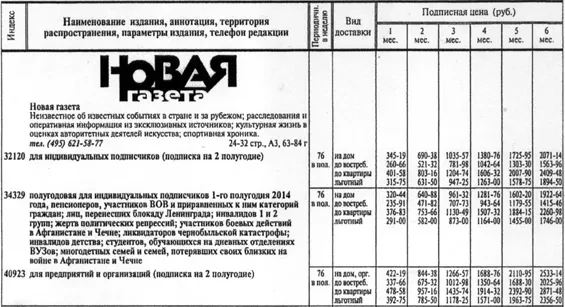
“Russian Post” is late (the promised Ministry of Communications from March 6 to March 13 did not fit), but nevertheless announced tariffs for the delivery of signatures for the second half of the year. They grew up almost twice.
What does it mean? Recall that the subscription price consists of two parts - the editorial price set by the publisher, and the price of the delivery of the newspaper or the magazine to the reader, which is calculated at the tariff. From the crisis of 2008 to today, the state has compensated for the costs of the Russian Post on this so -called last mile (that is, the distance from the post office to the box of a particular citizen) and allocated the company 3 billion rubles a year. In fact, the state did not provide the subsidies “mail ...”, but the benefits of the population. And so all civilized countries do it. Only a little larger volume. In France, for example, 261 million dollars are allocated for subscription. In Italy, an average of 1 dollar 60 cents of state funds is spent on the delivery of one copy. Whereas in Russia-two or three rubles.
Last year, apparently, after numerous scandals, it dawned on the government that the Russian Post should be made by a market enterprise. It's time for a long time. But for some reason it is done panicky and thoughtlessly, in the manner of a military march. The course of the Ministry of Finance also affected the abolition of all subsidies to anyone (it was still far from Crimea).
Since November 2013, when the industry has learned about the absence of this article in the budget, and until the last moment, neither the “mail ...”, neither the Ministry of Communications, nor the government at all, could answer how tariffs would increase. But in order for the postal catalogs to be filled out, the tariffs should be announced back in January of this year. Now the catalogs are in post offices with the "Pustobracles". They will be filled manually. The open letter of the publishers and distributors of the press, published in the "New" and other federal newspapers, did not help.
On March 18, the Russian Post stated that “she did everything possible to prevent a subscription campaign to disrupt,” which “will begin on time”. If you close your eyes to the "Pustograph" in the catalogs, then it will really start on time ... in Moscow. But the regions inevitably expect an inertial complexity.
Consider yourself. If earlier a six -month subscription to the “New” in Moscow for individual subscribers with home delivery cost 1690 rubles, now - 2071 rubles. The beneficiaries who paid 1542 rubles for the same subscription should now pay 1922 rubles. What is 400 rubles for a pensioner in Russia? And in Siberia, the tariff is higher than Moscow another 10%.
“To preserve the Institute of Subscription,” as “Post ...” writes, the company reduced the subscription tariff for the delivery option “to demand” when the reader takes the newspaper in the post office. Previously, Moscow beneficiaries took the “new” in the post office for 1494 rubles, and in the second half of the year they will be able to for 1415 rubles. The difference is 80 rubles. Will a village resident who previously discharged her at home will go to the post office for the newspaper? And will this half -meter save, as the “Russian Post” hopes, the signature circulations of publications, which until this time amounted to 36% of the entire periodicals in Russia?
Not only subscribers in the regions will be left without information, but hundreds of thousands of people can be left without work. Moreover, the further growth of tariffs is likely in the first half of 2015. "New" officially asked the "Russian Post" to report whether such an increase is planned. We hope to get an answer before the next signature campaign starts.
Kiosks: disappear in thousands
In the heat of the fight against illegal stalls in Moscow, several thousand newspaper kiosks were also killed. Somewhere this happened due to the cleansing of the city of visual garbage and the new urban planning policy (for some reason, it touched a greater extent than the protection of architectural monuments). Somewhere-because of the banal and sometimes dishonest displacement of old companies new, as always happens with the change of city government.
The specialized department of the media and advertising in the Moscow government claims that the position of the mayor Sergei Sobyanin is to maintain a network of stamp kiosks, but it is imperative to replace them with modern and multifunctional. So that Wi-Fi, and payment terminal, and coffee machine. Such a transformer costs 700-800 thousand rubles. Last year, the city hall offered assistance to those entrepreneurs who could not change the kiosk on their own. And now, in the Muscovitecture, new pavilions are “drawn”. Businessmen are afraid that they will also ask for new products to the new products that have already updated their kiosks. How many of them will leave the market without pulling the costs - you will not guess.
Newspaper machines in the subway: more expensive than gaming
Press the print not only from above, but also literally from the ground. GUP "Moskovsky Metro" doubled the cost of renting places for newspaper machines. Therefore, the owner of these devices, LLC Gazeta Automobiles, was forced to increase the cost of a monthly rental of one cell by 25% to 3400 rubles. The reason for the two -time appetites of the metro itself is incomprehensible. In 2012, the net profit of the enterprise amounted to 5.5 billion rubles, and in 2013, the financial report for which has not yet been published, the fares only twisted in a large way. "Gazeta Automobiles" note that the metro gradually increased the cost of the rental annually.
Since March 1, the price of products in machine guns has already risen. The same “new” is now sold not for 20 rubles, but for 25. An increase in the cost of renting a cell will occur from April 1. Not only we were thinking about whether to stay in the subway, or to go out at the nearest station.
The collapse of the subscriptions, the loss of the audience in the subway, the rise in price of paper and forwarding (because of which, from April 1, the “new” will rise in price by 10-15% also in retail)-it seems that this is some kind of primary joke. And this is a new reality in which printers, sellers, journalists massively lose their jobs, and the population loses access to a quality press.
Memo to readers "New"
If you came to the mail to subscribe to the “new”, be more persistent. At your request to see the price of delivery in the electronic catalog (if they do not have time to enter it in the printed man) the operator can answer: “We have no Novaya Gazeta.” The “yellow” newspaper will climb into the catalog, and they can be too lazy to “new”. Checked. And Moscow subscribers can come to the mail with this sign.