
Translated material
Space flights on the organ
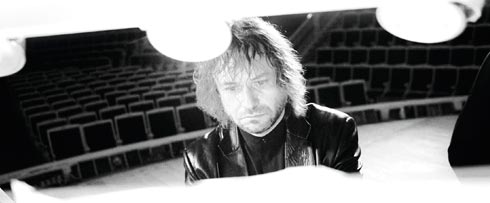
Alexander Knyazev behind the body in the hall to them. Tchaikovsky at a rehearsal before the concert
Alexander Knyazev, a glorified cellist-virtuoso, is considered to be one of the best organists of Russia. The combination is a unique-and unique person, a gloomy musician-philosopher who made Bach's music with his cult. On May 25, in Moscow, in the Anglican Church of St. Andrew, his solo organ concert with a new, unusually complex program will be held
Will there be only a bang in the concert program?
Only bang! Moreover, all six of its trio-components for the organ. Usually, and even then, two or three play in one concert. The fact is that the Bach trio-melting, written by the son of Wilhelm Friedeman, from which he wanted to make a virtuoso organist, in technical and musical terms, the most difficult of what was generally written for the organ by Jogan Sebastian Bach.
In contact with the universe
Why, already being a famous cellist, decided to become an organist?
Then three reasons came together. The first and most important is my love for Johann Sebastian Bach and the desire to play his music. Unfortunately, only six sluds and three more sonatians for Viola da Gamba (tool are the predecessor of the cello) written for the cello. That is, very little. And for the organ, Bach has nine volumes of supernatural, brilliant music. The second reason is that I really love the organ - it seems to me that it is associated with both philosophy and cosmology. This is a cult tool, it is played in churches during services. But therefore he was made cult that he is connected with the universe, some cosmic waves pass through it that connect us with that astral world. And the third reason is that the stars came together. I began playing on the organ in 1988 and quickly realized that in Moscow they would not give me concerts without a piece of paper that I was studying to play on this instrument, so I went to the conservatory in Nizhny Novgorod, graduated from Galina Ivanovna Kozlova and began to play concerts officially, with a diploma.
Where are you doing? Once my music teacher said that, studying at the conservatory, she went to engage in an organ at a large hall at night, and only two light bulbs burned at the presentation ...
No, everything is not so romantic. All organists have electronic organs at home. Previously, they were produced by the Riga Plant, however, they had a vile sound, but purely practically they repeated the remote control of the real organ, so it was possible to engage in, in the sense of teaching the text. But there was no question of any sound exhalation or any musical nuances. Now good electronic organs have appeared, which are suitable for daily practice, for example, Italian. Their sound can already be heard without shudder. But before each concert you need to get used to the real organ on which you will play, and this is a special, separate task. You need to study the tool, penetrate its essence, because each organ is an independent organism that reacts to everything. And not always easy for the musician.
Your attitude to the cello has changed when you started playing the organ?
Attitude - no. My life has changed. I began to burst between cello and organ concerts, which, fortunately, I have a lot. Sometimes you have to play in one concert on two tools, the organizers like to arrange such a circus for the public.
Lure on Bach
Are there many organ music lovers in Russia?
Enough. Oddly enough, there is more interest in organ music in Russia now than in the West, probably because the organ there is a very familiar instrument, most people hear the organ from childhood in the church every Sunday. It’s wrong with us. The organ for many is an unfamiliar tool, therefore interesting. For many years I have been playing in the Catholic Cathedral on Malaya Georgian, and every time there is a full hall.
What would you say about Bach to someone who does not know his music? How to lure for a concert?
I'm not a preacher. If a person did not understand something, did not grown to something, then let him listen to poppies and watch the series-this is his personal right. I am not one of those who will fight eagerly to come to listen to Bach. I just play concerts. Who wants to come. Maybe he will like it, and then he will bring his friend next time. What I really hope for.
I had it with the suits of Bach for the cello. I declared six suunts to the large hall of the conservatory, and my colleagues twisted a finger at the temple and assured that half a parter would come. And I believed that people would come, because it was thanks to their universality that Bach is the most affordable composer. In fact, the most people in the world loves Bach most in order to make sure of this, it is enough to go to any music store: the largest regiment will be with its discs.
But still we must remember that classical music is elitist, that it cannot be mass. Another thing is that our level of classical culture is lower than in Europe - there the classic sounds everywhere, more people go to concerts, and there are more concerts themselves. But I hope that the situation will change in Russia. In any case, I do everything I can for this.
Alexander Knyazev was born in 1961. A graduate of the Moscow Conservatory in the class of cello (Professor A. Fedorchenko), also graduated from the Nizhny Novgorod conservatory in the class of the organ (professor of Kozlov). Laureate of several cello competitions, including the competition named after P.I. Tchaikovsky in Moscow, Unisa in South Africa, named after G. Cassado in Florence. As a cellist Alexander Knyazev performs with the leading orchestras of the world, takes part in many international festivals, holds master classes in France, Spain, South Korea, and the Philippines. As an organist, a lot and successfully performs in Russia and abroad.