
Translated material
Cannes, but not the same
The festival program was surprisingly weak

Unable to evaluate the justice of the jury, since the magazine goes to print earlier than the announcement of the winners begins, we nevertheless have the right to talk about the level of the festival program as a whole. Its frank decrease, of course, can be attributed to the crisis. In Cannes, many paintings did not wait for, for example, the “Tree of Life” of the American classic Terrence Malik counted. By the end of the week, a list of films appeared in which the third main festival of Europe - Venetian. There, the mentioned picture of Malik, as well as the tape of Clint Eastwood, Darren Aronofsky, Sofia Coppola, Denny Boyle, Robert Rodriguez, etc., be they ready for May, Cannes would not have refused them either. It seems that the festival got into the production pit. Berlin got films, the shooting of which began before the crisis. And Venice was finhthaled to catch the first paintings, launched after the economic situation in the main movie lines began to straighten out. But besides these circumstances, it seemed that the miscalculations in the Cannes Filic Policy.
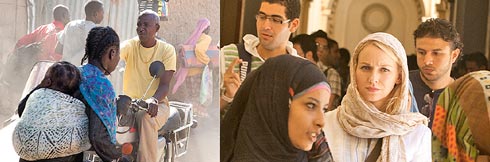
- "Screaming person", dir. Mahamat-Saleh Harun 2. "Honest game", dir. Dag Lyman
Equal to the competitor
Substructure No. 1 - Fear of admitting too many films from directors with not yet established names in the competitive program. Almost everyone saw in parallel Cannes programs “Special View”, “Two -week directors” and “Week of criticism” of the picture, about which he later asked others in amazement: “Why didn’t they take it to the competition?” We will not give examples, the simple listing of names and names will not give anything. But at least five such paintings at the festival were. The business Hollywood magazine Variety wrote that if this goes on, then the “special look” will soon overshadow the competition.
Subscriber No. 2 - New Cannes' orientation to Politics: three films about the economic crisis, four about Iraq, Afghanistan, etc. We have already noted in the last issue that Cannes have become more politicized. But by the end of the festival, there was a feeling that Cannes, for which there was always a movie in the first place and only in the second - an actual topic, decided to compete with the Berlin festival, for which in the first place is an important theme, and the art of cinema is only in the tenth.
Let me, but it always seemed that Berlin hit politics precisely because he realized: he was not a competitor to Cannes in the battle for a real movie. Berlin found his film monitor, admitting that Cannes are stronger. Why did Cannes intend to compete with him, and even on his company field? The losses meanwhile is already evident. The competition program included paintings selected according to the purely Berlin principle: because of an important topic. For example, the film “The Screaming Man” directed by Mahamat-Salekh Harun is a drama about poverty, social hopelessness and the pressure of the military in the country of children. Or the political drama of the master of the Hollywood action of the arc of Laimen “Honest Game”, based on real history: as the Bush administration warned that Saddam did not have weapons of mass defeat, and Bush pretended to be and unleashed the Iraqi war. The movie thestashes of these ribbons are modest. Such films in Cannes have not been taken before.
As a result, it was sometimes more interesting to monitor the program, but for near -Kino intrigues. Here is one of them. The festival participants decided to sign a collective letter in defense of Roman Polansky-it appeared on the website of the philosopher-mayar Bernard Henri-Levy. But it seems that only the French directors, in particular, Godar, Mathieu Amalrik, Xavier Bovois (he even posed to photographers with a T -shirt in his hands, on which Polanski), Bertrand Tavernier and Olivier Assayas signed it. But Michael Douglas, who came to the festival, said that he was against Polansky - like anyone who violated the law.
The blow of the Loznitsa
But the small program made it possible to feel the power of the film "My Happiness" of our Sergei Loznitsa. We say “ours”, although he himself is from Belarus, lives in Germany, and the film is considered the German-Ukrainian-Gollandic. But he is about Russia. The film has split Russian criticism, and it is characteristic that he does not like it primarily to those who like Mikhalkov’s film. And it can be argued that he remained not understood by Western criticism. That, judging at least according to the review in the British Screen International, took him as an invention, metaphor, a gloomy grotesque. She began to compare the Loznitsa with Kafka, as well as with the researcher of unmotivated violence director Michael Hanek. And this is not Kafka, this is a reality, albeit condensed. This is a film about the nation degrading from alcoholism and theft. About the nation with camp thinking - it is not for nothing that the so -called Russian chanson is constantly listening in the film. About the horror of a provincial outback. This is a terrible, obviously painful verdict for the director himself. Yes, of course, we are not talking about the whole nation, but about its part. And far from the whole province. But what is one scene on the square of a small town, where hundreds of people are either shaking something, or just killing time from unemployment. Not a single normal face. Not a single good. Not a single sober. Western critics, I suppose, thought: what a good crowd! This is not a crowd-the Loznitsa is still initially a documentary. This is a genuine crowd.
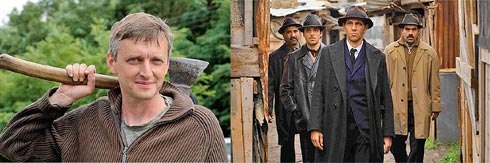
“My happiness,” dir. Sergey Loznitsa
"Outlaw", dir. Rashid Bushareb
A strange misunderstanding: they said (and we wrote in the last issue ) that the film is supposedly about the Great Patriotic War. Yes, it has two long episodes associated with the war; A sort of failures into the past. But actually he is about the present-about the driver, good small, which on his truck drove flour into some hole and disappeared there. One thing is obvious: this film is ideologically opposite to Mikhalkovsky. In addition, he was taken with foreign money, which can give rise to cries of Russophobia, etc. Therefore, when considering these two paintings, the jury had to make a non -cinematic, but a political decision.
Hits are in Kannsky
Unable to embrace the immense, the author of these lines decided to concentrate in his comments on Cannes only on the official program, that is, films from the main Cannes hall "Lumier", which are competitive and out -of -competition. I will make a reservation that by this moment I have not yet seen several paintings, including the film by Rashid Bushareb “Outlaw”, declared by some Parisian politicians Anti -French and Prilzhir. Films, by tradition, are distributed in three groups: interesting; Interesting, but with reservations; Disappointed.
Interesting
Woody Allen’s out-of-heart film “You will meet a tall dark-haired stranger” did not let him get bored, although someone called him “Building of the Old Rabi,”. Allen for the fourth time made a picture not in the once beloved New York, but in London. But for the first time in the London years - on their main topic: about the fatal, ridiculous, stupid relationships of men and women. How Allen manages not to repeat in this topic - a question that is not an answer. Heroes - seven, all of different ages, all the stars play, including Anthony Hopkins, Naomi Watts, Antonio Banderas and Josh Broin. A joke on a joke, a misunderstanding of a misunderstanding, everyone wants other people's partners, new meetings, hopes, new life - and in the end they begin to yearn because they had and missed.
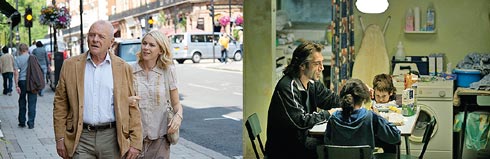
“You will meet a tall dark -haired stranger,” dir. Woody Allen
Biutiful, dir. Alejandro Gonzalez Injarita
Good competitive film Korean to them sangsa "Maid." Some colleagues scolded the film, because he turned upside down the idea of a first-oriented film shot in 1960. That's what critics advanced: they not only know that this is a remake, but also saw the original. The author of these lines did not see him, because he was satisfied with the new picture. Almost the only picture of the Cannes program of this year, reminiscent of the loud program of the year of the past, when absolutely all the ribbons were built on shock and provocations. In addition to the plot bells and whistles, this is such a Korean almodovar. A new young maid in a super -bog house - is it necessary to continue? Her conflict with a mother -in -law, which quickly cut through that the son -in -law from the maid was already sleeping. The worst ending.
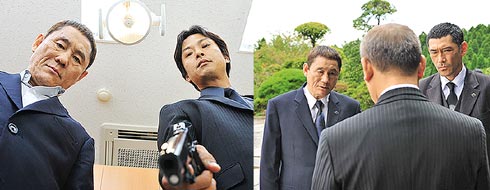
"Arbitrariness", dir. Takesi Kitano
The competitive film, in the assessment of which your humble servant dispersed with all domestic colleagues-Biutiful (distorted English Beautiful-beautiful) the famous Mexican Alehandro Gonzalez injarita, the author of Suki-Lyubvi, 21 grams and Bavilona. After Babylon, the director was disliked by many critics, accusing his ribbons only pretended to be high cinema, but in fact - glamor. The new film is also insanely beautifully built - Sound, Flint, Pokrodovo; But go someone else like that! The film is concentrated, multi -layer. Injarrita continues to be interested in the new world situation, when the races and nations that lived before on their own collided on a common patch (the action in this case takes place in Barcelona). The protagonist of Havier Bardem lives on this patch, who, knowing the imminent death of cancer, does not cease to act as an intermediary between immigrants (Chinese, Senegans) and the police. And it is tormented by the realization that there is no one to leave on the death of two young children. The finale is simultaneously melodramatic, mystical and shocking.

- "Copy is true", dir. Abbas kiarasts 2. "Another year", dir. Mike Lee
Interesting, but with reservations
The unconditional leader of the competitive program, according to the world press, was the film of the Cannes favorite, the representative of the "Social Realism" direction of British Mike Lee "Another year". In it, the characters, mostly weak age, talk about life and continue to cultivate their garden. And in the literal sense (the main characters really have a garden, the works on which allow the audience to understand the change of seasons - the film is divided into four chapters from “spring” to “winter”). And in the figurative: it is clear that people have no new newly new in the future - the same work before retirement, the same garden to death. Another year. Year after year. A garden behind the garden. Circle in a circle. But people continue to live and find joy in life. Is T -shirt interested: what gives them the will to life? Infants in the film predestination, making viewing boring.
The unconditional outsider, according to the world press, turned out to be - do not be surprised! - The competitive film Takeesi Kitano "arbitrariness". It is clear that in the film it can annoy. Having made a marginal autobiographical trilogy about the fate of the artist, Kitano finally decided to create his branded bloody picture about the confrontation of Yakuza clans. Every thirty seconds, someone is beaten, killed, cruelly tortured. Sadism is fantastic, although at the same time funny, full, as usual with Kitano, black humor. The moron is a milion. But at the same time, a feeling of repetition arises. Even thematic: Kitano has already made films that the new times of complete lawmakers destroy the godfathers who adhere to the old mafia morality.
Disappointed
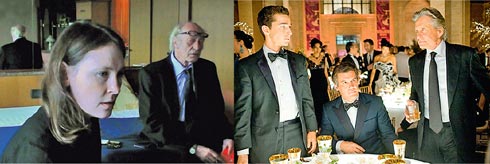
First - about two out -of -competition films. “Wall Street: Money is not sleeping” Oliver Stone is not just a remake of his famous 1987 film, but the first experience of understanding the world economic crisis in the feature cinema. The main conclusion of Stone: the greed of frauders-businessmen ruined. And at the same time we got it. Capitalism and money are, of course, good, but we need capitalism with a human face. Everything would be nothing, but watching a film consisting of continuous trepe about economics and finance is unbearable.
"Socialism", dir. Jean-Luk Godar
“Wall Street: money is not sleeping”, dir. Oliver Stone
Otar Ioseliani's "Counterpa" is an even more strange phenomenon. Joseliani, who was 76, until recently, did not make a single failed film. Its trilogy of the 1990–2000s is also remarkable: In Vino Veritas! - “Mond of Monday” - “Gardens in the fall”, the idea of which - “A man must live free!” But the “chantrape”, the meaning of which you can’t call the great (the artist is bad everywhere - both under socialism in the USSR and under capitalism in the West), is unfinished and incomplete. The finale is completely sucked out of the finger. At the same time, it is strange that Joseliani himself calls a picture of an autobiographical picture-he already made a wonderful film in the West, having managed to build producers, not to shoot custom-made commercial cinema and completely remain faithful to himself.
The most anticipated film of the competitive program was certainly "Uncle Bunmi, who knows how to remember his past lives." Just because he was removed by a director from Thailand Apichatpong Virasetakul, who recently during a survey of festival selectors around the world was recognized as the most promising director of the 21st century. Well, I briefly describe how the film begins. The dying uncle Bunmi decides to spend the rest of his life in nature - in the company with his nephew, assistant and sister of the late wife. Even in the picture there is a buffalo, in vain breaking with a leash - it is quickly found in the forest and dragged back. On the very first evening, their company (buffalo behind the scenes) joins the ghost of the deceased wife of uncle and a sort of hairy Chebucca from Star Wars, who claims that he is his long -lost son. None of the living who came is especially surprised. Family conversations come in: “Are you warm in the next world? There are enough clothes, did you get the clothes that we handed over to you through the temple? ”
They are mysterious - these directors of the 21st century.
Results of the 63rd Cannes Film Festival:
The main prize of the 63rd Cannes Film Festival was awarded to Thai director Apichatpong Virasetakul for the film "Uncle Bunmi, who could remember his past lives."
Director Mathieu Amalric, who shot the film "Travel", received a reward for directing.
The "Grand Prix" of the Cannes Film Festival went to Xavier Bovois for the film "About people and gods."
The acting award in the male category was divided by Javier Bartem and Elio Ermano.
Among the women, Juliet Binosh, who played in the film Iranian director Abbas, Kirosti, "A certified copy" was recognized as the best.
The film by Nikita Mikhalkov "Tired by the Sun-2: Present" was left without awards.