
Translated material
"Plank" became the coldest
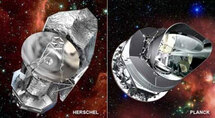
"Herschel" and "plank". Image ESA from the site http://infuture.ru/
The Detectors of the ESA Space Telescope Planck , launched into space along with Herschel more than a month and a half ago ( May 14, 2009 ), in early July reached the necessary operating temperature, which was a record -273.05 ° C. This makes them the coldest of all cosmic objects we know. Meanwhile, the spacecraft itself is brought to its final orbit near the second point of Lagrange in the Sun-Earth system (L2).
It is reported that the "plank" is equipped with a passive cooling system, which allowed to reduce the temperature to -230 ° C by radiation of heat into the surrounding space, as well as three active cooler coolers, which allowed to reach a temperature of only 0.1 ° C with the absolute zero on the Kelvin scale (-273.15 ° C) -that is For minus temperatures (it should be noted that on Earth in some experiments even lower temperatures are achieved). Three different institutions of the United States and Europe were responsible for different stages of cooling.
Super -low temperatures were required so that the “bar” detectors could capture the necessary temperature nuances of a relict study (i.e., permeating the entire universe of the cosmic microwave background). This is a kind of "cast" of the first light of an extremely young and just cooling universe. Such light was radiated about 380 thousand years after the Big Bang. Therefore, he reaches us after many billions of years in such a miserable low -energy form.
The above detectors will track the smallest fluctuations in the temperature of the microwave, and the scale of this task is already compared by the press releases with the detection of the thermal radiation of the rabbit sitting on the moon. To register the "rabbit" detectors and it was necessary to cool to temperatures so close to absolute zero (0k).
Until July 2, the plank was located 1.43 million kilometers from the ground. During the final maneuver, it is planned to change the speed of the device from 211.6 km/h to 1010 km/h in relation to the Earth. At the same time, together with the Earth and Point L2, "Planck" will move around the orbit around the Sun at a speed of 106,254 km/h (29.5 km/s). All operational measures were held strictly on schedule, and this stage of the mission is almost completed. Over the next few weeks, optimization and the necessary calibration will be carried out. The very experiment on the scanning of heaven will begin in mid -August.
Source:
Coolest Spacecraft Ever in Orbit Around L2 - ESA News