
Translated material
How not to work ...
Why is labor productivity so low in Russia
The labor productivity of a Russian worker is 4 times lower than that of his American colleague. This is the main conclusion from the report “Scudge Russia: Economic growth is possible by increasing labor productivity”, prepared by employees of the McKinsey International Consulting Company 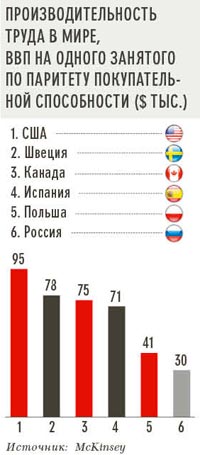
McKinsey analysts released the first similar report exactly 10 years ago - in 1999. Then the productivity of labor in ten sectors of the Russian economy amounted to 19% of the US level. The most “prosperous” then the sector for the production of computer software (38%), the most backward - the production of dairy products (8%) and cement (7%). Reasons? The lack of normal competition, competent managers, an independent judicial system, the distrust of market agents for domestic financial institutions, a low level of corporate culture, and finally, backward equipment.
Achievements from the past “10 years ago, McKinsey consultants were the first to stated that the annual growth rates of our economy could be 7-8%, and by 2009 the country could double the GDP,” says he says
Director of the Institute for Analysis of Enterprises and Markets GU-SHE Professor Andrei Yakovlev , recalling that report. The doubling of GDP is still included in the strategic plans of the Russian government. But in order to bring the current GDP from $ 14 thousand to $ 30 thousand per person by 2020, an annual increase in labor productivity is required by 6%. Not a single country managed to double its GDP in less than 20 years, the new, 2009 report McKinsey. So, Russia's happiness does not threaten at least 2029? No, researchers answer: Russia can achieve the desired result faster if it is able to extract experience from the economic growth of the previous 9 years, including error experience, and will use the achievements made in developed countries of the world.
One of the factors that allowed the country to quickly rise after the crisis of 1998 is a more complete loading of the production capacities that were obtained by the country from the USSR. However, this growth potential has already been exhausted - in 2007 the maximum load of existing capacities was achieved. “The successes of the 2000s are due to the previous production decline,” confirms
Scientific adviser to the Higher School of Economics Professor Evgeny Yasin . Another factor that contributed to economic growth in previous years is an increase in the number of labor, caused by a favorable demographic situation in the country. But this factor will no longer be able to help the Russian economy: by 2020, the able -bodied population of Russia will decrease by 10 million people, analysts from McKinsey counted. “Therefore,” says Yasin, “the only source of increasing the well -being of citizens is an increase in labor productivity.”
26% of the US level of the 2009 report is built on the analysis of labor productivity in five sectors: steel industry, retail trade, retail services in the banking sector, housing construction sector and in electrogeneration. These sectors of the economy are responsible for almost half the volume of Russian GDP and half of the employed Russians, so the data obtained completely describe the overall situation in the economy, says
Senior partner McKinsey Irina Shvakman .
The results are as follows: labor productivity in the Russian economy today is 26% of the US level. The most productive industry is steel (33%). In second place is retail trade (31%), in third - retail banking (23%) and housing construction (21%). Closes - the sector of electrogenation (15%). On average, the worker in Russia works more than his American colleague, but his productivity is almost 4 times less. Why?
The reasons for the failure of McKinsey called six reasons. The first is ill -conceived and ineffective logistics, that is, the organization of the workflow in companies and enterprises. For example, the key to the effectiveness of banks focused on working with citizens lies in the presence of a centralized backing office engaged in the collection, processing and analysis of customer information. A few Russian banks can boast of similar offices. The correct and planned distribution of responsibilities between employees increases the performance of their labor. For comparison: the average employee of the Russian bank performs about 9 thousand operations per year, his colleague in the USA is 60 thousand, and in Finland - 81 thousand.
The second reason is high administrative barriers and ineffective mechanisms for regulating the work of industries. For example, in order to agree on a construction project in all instances in Russia, it takes 704 days, while in Sweden - 116 days, and in the USA - only 40, the World Bank calculated.
The third is outdated methods and methods of production. The report of a decade ago noted that the main production capacities, outdated for 20 years, did not contribute to the growth of labor productivity. The same reason is relevant today. For example, 40% of Russian TPPs over 40 years old. For comparison: the number of such “long -livers” in China is 3%, in the USA - 28%.
The fourth is the lack of a clear plan for the development of land in the cities and around them. Only a third of the Russian cities have detailed development schemes, although by law they should be in every village. Result: Foreign investors are in no hurry to invest money, since the lack of understandable development plans increases their risks and costs.
The fifth is the low quality of the formation of managers. Despite the high literacy of the population and the level of technical education in Russia, the enterprises lack competent managers. This problem is as relevant as ten years ago, McKinsey analysts emphasize.
The sixth is an undeveloped financial system. Direct foreign investments, for example, are still reluctant to Russia: from 1998 to 2007, we received annually an average of 6% of the total world volume of direct investments (mostly speculative investors who immediately fled as soon as the crisis began), and the same China grew with two-digit indicators.
The crisis time base is good because it allows you to create a base for the future growth of the Russian economy, McKinsey experts say. They offer Russian authorities and business a number of recipes for increasing labor productivity. They are generally obvious. Increasing competition: the most effective industries - steel and retail - consist of the most competitive companies. Further - a decrease in the same administrative barriers, the adoption of measures aimed at great mobility of the labor force, improve the quality of medical services, etc. Actually, in many ways, the same was said in the famous Gref program of 2000, when Vladimir Putin just became president.
How applicable are the recipes of Western analysts for Russian reality? The opinions of experts were divided into this. “McKinsey report is unlikely to extend their conclusions to the entire Russian economy,” said The New Times
The main researcher at the Interdepartmental Analytical Center Boris Kuznetsov . “I do not question the very fact that in Russia labor productivity is much lower than in the United States, but the released figures need to be redeveloped by all sectors.”
“The main advantage of this report is that it contains specific recommendations - how to increase labor productivity in our economy. If we want to become a highly developed state, we need to deal with this problem in the first place, despite the crisis, ”says Evgeny Yasin.
1 The ratio of the volume of the released product, measured in monetary terms or in physical units, is among the workers engaged in its production.
2 The mortality rate of men in Russia exceeds a similar indicator of a number of countries of the African continent.