
Translated material
Drama lessons
New performance Dmitry Krymov
The devil knows how to determine what Dmitry Krymov does in his “laboratory” ... But the fact remains - each of his performances causes an incredible storm of emotions. You can furtively look at the auditorium and be surprised at that genuine childhood surprise, which froze on adults. So, opening his mouth, holding his breath, wiping off the tears - either from laughter, then from compassion - the audience will watch his new performance “Hills 10”.
Without retouching
On the eve of the premiere, the author laughed at us: “I want to put such a performance that it was not clear for a long time, but very interesting. For a very long time nothing is clear. But interesting. And then, without ceasing to be interesting, everything would be clear. Just not immediately, but pretty quickly ... and so that there was an interrah and a curtain. And sandwiches with sausage in the intermission. And tulle with glued trees. And a large dining table with cups. To have peace and peace. And there is a lot of shooting from different weapons and blood. ” Now it turned out that it all happened: intriguingly incomprehensible, terribly interesting, joyfully recognizable, cheerful and sad, not at all aggressive, although with shooting and blood.
The play has a subtitle “Lessons of Russian literature”. It was in these lessons that the nails of Soviet morality and morality were driven into us on the examples of the image of Lenin in Soviet literature, the mass heroism of the Soviet people during the years of the Second World War and the labor feat of ordinary Soviet people, directed into a peaceful future. The cheerful, optimistic, irreconcilable, uncompromising people-placas, inhabiting the artistic world of Soviet man, returned from oblivion by the power of our ongoing nostalgia. Under the ironic and hooligan gaze of Dmitry Krymov, the heroes gained a new look and new features and told themselves about themselves the whole truth, freeing themselves from ideological cliches and a temporary framework.
Let's part, laughing
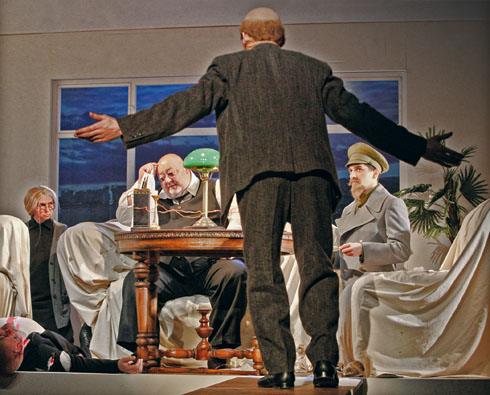
The scene from Pogodinsky “Kremlin chimes” play in three versions, all three are anecdotal, in Harms are absurd and absolutely merciless. The Moscow Panorama Outside the wide window of the Kremlin cabinet, the Moscow panorama refers to the Soviet “parquet” painting, the brain tenaches tenaciously holds the scraps of socialist realism from school reproductions: furniture in white covers, a polished table, a green lamp, a newspaper “Pravda” in the hands of a leader, a long shirt of Dzerzhinsky, a bookcase A glass door, the card of the homeland is huge, like a blanket, Krupskaya in round glasses and with a gray bundle. And, of course, the alarming rumbling "Apassionates".
The characters that have revived in these classical interiors arrange a real aesthetic riot and turn into the fruit of our collective consciousness. First, Lenin is a small crook with manners and shrill intonations of a criminal, then a German spy, singing with Dzerzhinsky and engineer Zabelin “Ah, Main Liber Augustine, Augustine, Augustine!” In pure German and looking over the heads with a bright Aryan look. In the latter version, Lenin is a lonely sick child, huddled in a corner of a huge chair and frightened to death by what he did (“the country is large and I am small,” he squeats sadly, bursting with small handles). The unperturbed Dzerzhinsky in the image of a centaur slowly passes the hooves to the forefront, waves his tail and drop a couple of weighty cakes on the floor. And then a suddenly darkened room, devoid of ceiling and walls, will be filled with gloomy silent people and, ominously singing under the nose the melody of the Apassionates, they will pick up the blessed Lenin along with the whole situation and slowly put it back into space, into the fog of non -being, into the blackness of the abyss. Only a confused squeak will be heard from the darkness of eternity: "Nadia ... Nadia! .. Nadenka ..."
Goodbye, little dried Ilyich, goodbye, pale tantrums with Hitler's manners, goodbye, capricious maniac ...
Puppet house
The military theme in our history is no less mythologized than Leninian. It is difficult to separate the truth from shamanic chants, to pull it out of under the protective grid of many years of lies. The Great Patriotic War Indeed, the “Stalingrad” of the Non -Bolshevik power, its “sacred cow”. It will not be possible to demolish this pile of state lies soon.
Taking the plot of the story of Boris Vasiliev “And the Dawns here are quiet” and setting her heroines in the space of the puppet theater, Krymov very carefully and very terribly talks about how the puppet consciousness distorts the face of the whole people, how it changes the cultural code of the nation, how it affects every subsequent generation.
Dolls-girls in chintz dresses and with ribbons in the hair under the gloomy murmur of Vaskov with the face of the sad Gurvinek obediently part with their sexual and personal signs: men's hands of actors remove colorful dresses from them, exposing the same iron hinges on the wooden limbs, cut off the shocks on the floor, they are shut footcloths, tighten the belts. And here is the five identical creatures of an incomprehensible sex with round non -extinguishing eyes. Their death will be meaningless, ugly and devoid of any halo of heroism. Only orphaned dresses will shoot into the sky, like departed souls, and birds in a peaceful juicy-green forest creak even more desperate. "
Strong aunts, unlike the heroines of the Rozov play, simply will not give up, they will arrange themselves with Mausers and machine guns and start a real war - they will shoot everything that distorts their picture of the world, which gives it volume, color, feelings
In the plot from the 60s-from Victor Rozov’s play “In Search of Joy”-the phrase of Vaskov “There are no women here, but there are fighters and there are commanders” will receive comic development, turning several actors into large unshaven women in bright crimson and red lipsticks. These strong “Aunts”, unlike the heroines of the Rozov play, will simply not be staggered: instead of reassuring it: instead of reassuring. The rebellious Oleg, they will arm themselves with Mausers and a machine gun and start a real war.
Sirens of popular anger will shoot everything that distorts, changes their picture of the world, everything that gives it volume, color, feelings: Oleg and its fish, us, who are sitting in the hall, fluffy hares jumping in the snow, Carlson, Cheburashka, Mickey Mouse, Winnie the Pooh. And with special hatred - Simpson, a roller and a pervert, inhabited by enemies. 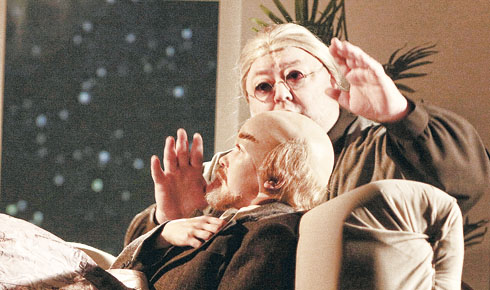
The desperate battle of the living with the dead was once led by the father of Dmitry Krymov, Anatoly Efros. It is no accident that the name of Victor Rozov appeared in the Golok canvas, it was his play then, in the late 50s, that became a saving circle abandoned to him for the legendary director. "They are alive!" - shouted Efros and fearlessly put his father’s saber in the hands of his hero. In order to destroy, destroy these primitive polished brains of "ordinary Soviet people."
The stellar hour of the triumphant people in the performance of Krymov will be the phenomenon of a half -drunk aunt with smeared mascara, which the director removed from the finale of the "optimistic tragedy." In the play of Vishnevsky, the old man of God dandelion rose to the deck of the cruiser and complained that she, they say, was stolen a wallet. Looking around the team that lined up in front of her, the granny points to one of the soldiers, who is immediately put in a bag, tied with a rope and thrown overboard. A minute later, a dumbfounded grandmother finds his wallet, but then the sailors are thrown overboard and her. In fairness. In the final, Krymova will also triumph. There she goes, staggering into the depths of the scene, singing the winner in the vile depraved voice of the winner: “Life-and-spray cannot be pierced by Naza-ad!” Only smoking corpses around.