
Translated material
Portrait on the wall
Turning away from the West, Russia in the "trolleybus that goes to the east" is moving towards China and Japan. “Three Chukchi sages” in the same song with “Aluminum cucumbers” seem to predict the appearance of the oligarch Roman Abramovich. “April”, if desired, can be interpreted as a story about the second coming of Jesus Christ: “And April will die, and will be born again, and will come forever.”
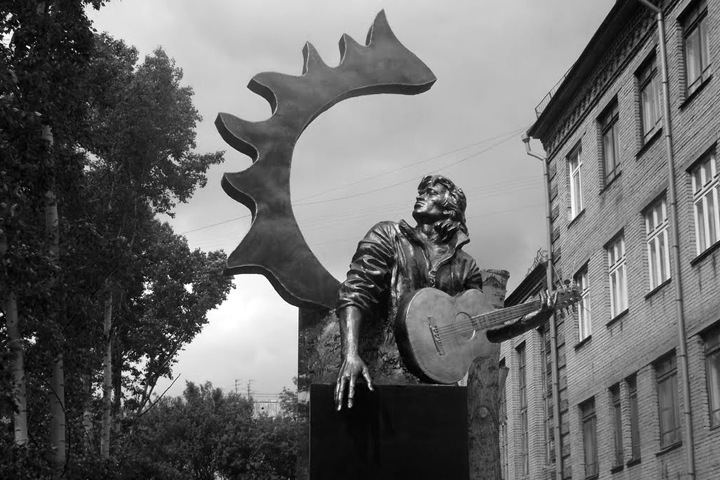
Near the monument to Tsoi on socialist avenue in Barnaul, you can almost always meet young people. Someone sits on a bench by the fence, someone plays a guitar or violin in front of an open case, where pedestrians reluctantly throw a trifle.
“We have already become cramped clothes that you sewn for us, and now we came to tell you what next!” - a lanky guy in a black leather jacket sings awkwardly. His girlfriend holds a hat in her hands. Smiling, she with a look offers to passers -by to support the young performer. The couple smells of alcohol.
27 years after the death of Tsoi, his songs can be heard on the streets, on radio and television, on social networks. Simple melodies are easy to arrange, this allows them to adapt them for projects of modern show business like “Voice”. In Barnaul, for example, the music of the “Kino” group will play the orchestra of Russian folk instruments “Siberia”. It is unlikely that Tsoi assumed that the rhythms born in communal services would someday be heard on balalaikas and domra.
But the reason for the popularity of Viktor Robertovich lies, of course, not only in music. For the perestroika tribe, the rock musician was a herald of the era. The hearts and eyes of millions of people demanded changes - and Tsoi sang about it. He proclaimed the change of eras, but he did not see the “largest geopolitical catastrophe of the XX century”. For the “blood group”, “in our eyes” and “star named the Sun” - part of life history that have grown up in those days. The same as an accident at the Chernobyl nuclear power plant and the signing of an agreement in the Belovezhskaya Pushcha. Soviet time ended in the kitchens under the Tsoevsky guitar battle, and the music was inseparable from history.
The Soviet Renaissance received a residence permit on the screens under the approving crunch of popcorn
But why are the songs of a rock musician from Leningrad important for people who are no longer born in the USSR? Today, three large artists are trying to answer this question - almost simultaneously, shooting of three films about Victor Tsoi began. One of them makes director Kirill Serebrennikov. The plot of the film “Summer” is built on the little-known facts of the biography of Tsoi and covers the period of the late 70s-early 80s. At the end of the protracted Brezhnev rule and the Kino group was created. Its founder is a musician, writer and screenwriter Alexei Rybin. It was he who played the guitar in the very first composition of the musical team. He will make the film “Tsoi” - the second in our list. Cinema will be based on personal memories. Rybin is a newcomer in the film industry, but his debut tape “will end soon” was warmly met by critics on the last “Kinotavra”.
90 million rubles for the third film will receive the studio of Alexei Teacher. Money was allocated by the structure of the Ministry of Culture of the Russian Federation - Film Foundation. The director of Matilda decided to make a film about Tso without an actor who will play Tsoi. Instead, the frames of documentary chronicle are used. “The potential of the film about TSOE is no less than the film“ Vysotsky ”. This is the story of Road-Muy, the main character is the driver who shot down Victor, ”Interfax quoted the teacher.
We live in time in which there are no modern heroes. The political and social situations are such that the basis for the scenarios of the “most important art” are the myths and legends of the USSR. Bayopics of Soviet athletes, actors and astronauts gather the cashier and force people to say: “Well, finally ours also learned to make a movie!”
In this situation, the ideological vector coincides with the commercial. In the film "Vysotsky. Thank you for living, ”they show us“ a good person at a bad job ” - a noble colonel of the KGB, who makes a heavy moral choice and, as a result of saving people from the prison. In the “time of the first”, the success of the space operation is completely dependent on the simple helicopter pilot, which finds Leonov and Belyaev in the ice taiga. "Thank you, Volodya!" - The great designer Korolev tells him, and this, no doubt, is not by chance. The state, allocating funds, broadcasts the desired image, people pay for viewing money - it seems that everyone is happy. The Soviet Renaissance received a residence permit on the screens under the approving crunch of popcorn.
All this resembles a computer game a little-it seems that someone specially constructs our reality
It is all the more amazing that today's system gives money for a film about a person who predicted the collapse of the previous system. And it is quite unbelievable that the desire to see a movie about “Kino” that appeared in the depths of the Ministry of Culture coincided with the aspirations of Kirill Serebrennikov - a man who is difficult to suspect in following the political conjuncture.
If Tsoi did not exist, he should have invented. Now this is the perfect hero. His songs are plasticine, from which everyone can fashion the image of the world convenient for themselves. Korean Tsoi forces to recall the Blok lines “Yes, Scythians - we! Yes, Asians - we, with slanting and greedy eyes! " And turning away from the West, Russia in the “trolleybus that goes east” is moving towards China and Japan. “Three Chukchi sages” in the same song with “Aluminum cucumbers” seem to predict the appearance of the oligarch Roman Abramovich. “April”, if desired, can be interpreted as a story about the second coming of Jesus Christ: “And April will die, and will be born again, and will come forever.” And the phrase “We were born in close apartments of new areas” well describes the modern policy of the point development of provincial cities. There are also those who want to speculate about children whose hearts and eyes require immediate change.
In the next one and a half years, we will see three heroes. And everyone can choose their favorite. All this resembles a computer game a little-it seems that someone specially constructs our reality. The sensation of the illusoryness of what is happening is enhanced near the monument. Barnaul Tsoi is cast from reinforced concrete and painted under bronze. The shadow in two shares the chin stretching to the sky.
"Look at the clock, look at the portrait on the wall!" - sings a lanky guy.
Is it about the 80s or about today?
Mikhail Bednarzhevsky, especially for Taiga.info