
Translated material
And behind the bow
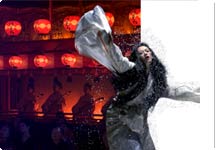 On January 19, one of the most anticipated films of recent years is “Heisha memoirs”. Spielberg intended to shoot him, but in the end he was pleased with the role of the producer, inviting the director of Rob Marshall - this is the first Marshall film after the Oscarovsky triumph of Chicago. To the emergence of the film, the book -sales - in our root, which was rooted from the West, was put on its original source to the regiments of hits: the novel Arthur Golden, who had a great success in Europe and America, the same name. Roman, if anyone does not know, is written on behalf of the famous Geisha Sayuri. The film itself, in which in the main roles, Chinese and Japanese actors, a few years ago, would have been released only in limited rental. Now it is produced by a circulation of 200 copies - all three times less than that of the "day patrol". Cinemas owners are making a large bet on him. And they can be understood.
By analogy with the famous phrase that when choosing housing, one must be guided by three main criteria: a place, a place and a place again-it is possible to say that the film “Heisha memoirs” has three main advantages: he is beautiful, beautiful, just madly beautiful.
This can also be seen in the drawback: pre -war Japan of tea ceremonies, lanterns, kimono and dancing with fans (and two -thirds of action since 1929 has been taking place in Kyoto) looks a little too expected on the screen. But what about that? Do you often see a film in which absolutely every frame is a deceased painting?
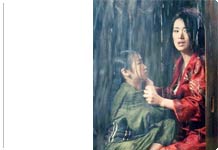 For those who read the novel, it will also be pleasant that “Geisha memoirs” - the most important film that is almost no distorting the source. True, in the end, in post -war scenes, there are too many Americans, but the Yankees with their jeeps, planes, loud Gulbo and jazz needed director Marshall to show how quickly the former Japanese life broke. Moreover, the city district, in which the geishas live, for some reason is not called Jion, but the khans-cho, although in that area, according to the novel, not geisha lived, but quite the opposite-prostitutes.
How do you not see the difference? The difference is that Geisha ties a belt on a kimono with a complex bow in the back, which you will not tie without outside help, and the prostitute is visible in front. Because geisha serves men in a completely different way - she is trained in art and is given only to the constant lover who contains it and with whom she has an official contract. And the belt in the front is in front, in order to quickly and many times tie it in the course of the evening, then again untie it.
This is a detail from the novel. The novel in general in separate chapters seems to be a popular science guidance “How to be a game”. The film, despite the abundance of exotic, seems to be a much more traditional work. It follows the three -eternal themes for classical Hollywood: this is the story of Cinderella, the story of rivalry and a love story.
The story of Cinderella is that a girl from a fishing village becomes a famous geisha named Suri. Director Marshall again proved that he knows how to make impressive climaxes, and he loves - not in vain he took off Chicago - so that the heroine at this great moment was on stage. The culmination of the success of Sayuri is a dance during the main annual performance, which is gathering a Japanese bomond. Not being a big specialist in Gayish dance, I still suspect that Marshall added gag. The dance and make -up of Sayuri look so avant -garde, spectacular and (well, in our case, you will not get away from this word) beautiful, which I guarantee: the entire auditorium will open their mouths from amazement.
The love story is the story of the relationship between Sayuri with a person called the chairman in the novel and the film. The first Gaysh law is that you have no right to desire and feelings. Already because under the working conditions you do not belong to yourself. Geisha works for men - all at once. She can’t love someone alone. Sayuri, however, fell in love. I won’t disclose the intrigue with the chairman, but I note that in this case, director Marshall did not offend the writer Golden.
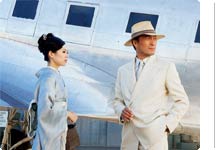 The history of rivalry is the Hate of Hate to Sayuri from the famous Geyshi Hatsumomo, who has recognized the competitor in a 9-year-old girl, while the maid, who has recognized the maid. The girl would be bad, if she (also partly because of rivalry-because of the dislike of already to Hatsumomo) did not take under the guardianship another famous geisha, mother. Hollywood cynicism is that the Japanese women are depicted in the film by Chinese women - for the clear commercial reason that there are no famous Japanese actresses after the mosquito of the Kurihar in the world, and the Chinese - the success of the successful Tiger, the Hero, the House of Flying Daggers - Full. Sayuri plays Zhang Dzia (we are transcribed by us as “Ziyi”), Hatsumomo-Lee, Momhu-EX-EX-girl Bond Michele Yeo. Rob Marshall came up with a cool scene in the book of the Suri fight with Hatsumomo, probably not assuming that for filmmakers it can have a symbolic meaning. The former, now aged geisha No. 1 from rage and despair fights with the new Geosh No. 1, in addition to the young, psychologically losing in advance. But it is not possible that this is the fight of the former main actress and first beauty of Chinese cinema Gun Lee from the current main and first (and still really young), just that the Zhang Dzia spent her on the cinema, And both opened the Guru of Chinese cinema - director Zhang Imou. Isn't it funny?
It may seem strange, but the eternal stories of love and rivalry lurk a serious topic and a curious ideology. And the very fact of the appearance of such a Hollywood film on world screens makes us make an obvious and important geopolitical conclusion.
First about ideology. Here the film is inferior to Roman. The “geisha memoirs” are implicitly explore the topic of a woman’s fate in a society where men are infinitely dominated by. The book comes to that paradoxical for many, but for a long time to me the conclusion that it is in such societies that women, seemingly always bowing, psychologically stronger than men and have huge backstage influence (Iranian cinema festivities brought to this conclusion). The author of the novel Arthur Golden goes further, coming to the idea of making a geisha career in such a society - for a woman, an almost the best fate. Yes, geisha does not belong to himself, etc., but she is in abundance, she is influential, and it is still unknown who is worse: she or the wife of a rich man who, according to the traditions of this society, scores on his wife and spending time with geishas.
The film interprets the situation traditionally in feminist. Ultimately, he is nevertheless about a serious female share in a non-democratic society. Geishas in it are slightly akin to serfs. More precisely, serf actresses. Therefore, Hatsumomo in the book is a village, which you rarely find, an evil monster, and Sayuri has only two feelings towards her: fear and hatred. And in the film, finally Khatsumomo’s won, Sayuri pronounces the words that in fact they are similar to her, they have a common fate of etc.
As for geopolitics, the appearance of the first expensive Hollywood film, shot exclusively with Chinese and Japanese stars (the Japanese still entrusted male roles), once again suggests that Southeast Asia wins the world. The turn of the geopolitical plot is that it now becomes an important audience - China, adding money to its population to entertainment, will bring Hollywood more than native America. The western and even the Russian public, in its turn, was a spore learned to distinguish between Chinese and Japanese acting faces. Go, ten years later, the main roles will play the main roles of Zhang Dzia, Zhang Li, Chan Gong and Zhang Dzedun.
Made in China
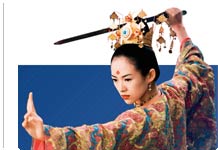 A certificate of changes in world film policy and audience is the appearance of the first Chinese actress, who gradually goes into a series of megazoves. It is about the 26-year-old Zhang Dzia (aka Ziyi), who last year was already entrusted to present one of the Oscars. Lee is also a star. But although she is the “face of L'Oreal”, as an actress she always remained famous only among the so -called. festival audience. The take -off of Zhang Dzia is rapid, three years ago, your humble servant, having interviewed her, did not even decipher the record by thinking, because to whom is this actress known? These are the stages of a short big way:
1999 - "Road Home" Zhang Imou; The debut in the cinema, in the black and white festival film as a village girl. At that moment, it seemed that Zhang Imou, in every sense, parting with the previously beloved Gun Lee, almost spite her quickly found a new loud face, and the girl’s career would end.
2000 - “Cracking tiger, invisible dragon” Engl Lee; The first film in Chinese exclusively with Chinese actors, which raised a grandmaster in America in a hundred hundred million dollars and took four Oscars (at the same time he set a record for foreign paintings in the number of “Oscar” nominations - 10). There, Zhang Dzia fought in swords with Mamaha - Michele Yeo.
2002 - "Hero" Zhang Imou; The first Chinese film, good (at that time) with us.
2004 - “House of Flying Daggers” by Zhang Imou; The first film, after which we were clearly remembered.
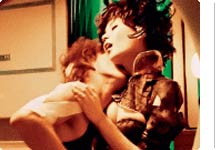 2004 - “2046” Wong Karu; The cult film of a cult director, in which Zhang Dzia first starred with Gun Lee.