
Translated material
Ozone layer
 One of the out -of -competition hits of the MMKF - “Angel” by Francois Ozon goes into our rental right during the festival, on Thursday June 28. This is not a sin of distributors: a similar practice has been adopted in Cannes and Berlin festivals. Francois Ozon is already remarkable in that not a single full -length film is like the previous ones, while all without exception - even if someone does not like subjectively - are certainly famous. If we talk about modern directors, then a dozen worthy of such a compliment will hardly be typed. Here - so that there was no doubt - a list of full -length ozone tapes: “Sitkom”, he is “rat -legged”, “criminal lovers”, “rain drops on hot rocks”, “under the sand”, “8 women”, “pool”, “5´2”, “farewell time”, finally, “angel”. In addition, only Ozone and Kim Kiduk (maybe even Chkhan of the Criminal Code of Pak) can be considered formed by the former masters of the latest generation, who has been in a movie world after von Trier, Tarantino, Sokurov, Kusturitsa. However, the 39-year-old ozone is still quite young by age.
Whoever says about the crisis of modern cinema, but the situation in it changes quickly and makes it equally quickly change its own assessments about it. Less than six months ago, looking at the Angel Berlinal (which, at mine, and not only, the taste, was the most interesting film of the contest program there, but did not receive a single “bear”, because Berlin finally reoriented to politics), I concluded that Ozone was a relative of the antipolis of Tarantino. A relative - because both love postmodernist to interact with mass genres. A relative - because the heroes of Ozone, too, sometimes, in Sitkom, “8 women”, now “Angel”, look, like Tarantino, typical characters of the mass poult. The antid is because the favorite source of interaction -inspiration -experiment for Tarantino is male genres, primarily an action movie. And Ozon has women's genres.
 Was it possible to predict that the “proof of death” by Tarantino and the “angel” of the ozone, which were published almost simultaneously, would turn out to be ideological twinpix - two equivalent peaks of one kinnoye? That both films will perform for the glory of the woman, unless they approach the praise from different sides? And at the same time, they will justify the woman as the heroine of the Mass Poll-again, everyone in her own way, having challenged different lines of pop culture?
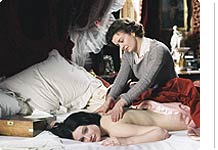
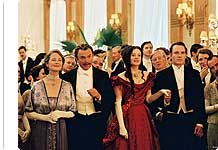
The Angel, the first, by the way, is Ozon’s English -language film, shot from the 1957 novel, the writer Elizabeth Taylor unknown to me (has nothing to do with the actress), is this: a ladies' novel, and not easy, but in Cuba. The heroine is a young impudent provincial writer of such novels (she will not be sharply called her Khabalka), who, in 1905, idyllic for the UK, a year, suddenly in the blink of an eye becomes famous and rich. Despite the fact that, the tastes of the author of these lines, composes - without even ruling or rewriting, on the move, neat handwriting - the terrible Babsky banal region. Someone is not lucky, someone on the contrary: she instantly acquires a publisher, money, fame, beloved husband, estate under the ladies' name “paradise”, dresses, interiors (can you imagine more beautiful dresses and interiors if we are talking about the modernist beginning of the XXV?) The heroine looks simultaneously beautiful and vulgar, talented and aggressively mediocre, and aggressively mediocrity, and an aggressive revolutionary. A petty -bourgeois fool, fixated on her talents and diligently posing for fans. It causes either sympathy or irritation.
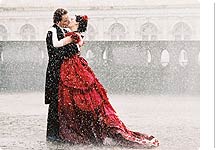 Half -films It seems that you are looking at a parody of ladies' novels. One music is worth it - exaggeratedly romantic and beautiful. But the second half is in the Ozonovsky tragic. The film makes us recall the “Foam of the Days”: in accordance with the deterioration of the mood and material state of the heroes, their divine dwelling is also becoming more and more poor and sad. But what is most entertaining, the film makes it clear that the ladies' tuften that the heroine composed in her novels was not the fruit of her infantile imagination, but a reflection of real life, which the heroine seemed to be a graphomaniac, in her own way, in her own way, in her own way, very correctly-by the way, the turmoil begins that she does not support the patriotic line of British literature at the time of the beginning of the Second World War, Considering wars by male abomination.
It is already clear here that ozone is still different from Tarantino. He is truly serious about life, and in particular - to the topic of death (in relation to which Taranthically obviously not serious).
It is amazing not even that all ozone films are conceptual. All of them - which is a rarity for a director with modern game thinking - are also tragic.
 Ozon is a director, most addicted to all existing analyzing conflict, which actually remains fundamental since the day of the creation of the world: male and female. He is customary to attribute a homosexual orientation. I sincerely spit on who is what orientation, and I really don’t know what kind of orientation of ozone, but he made the toughest (although it is formally comedy) from modern a film about how the masculine principle is aggressively and selfishly crushed by the female - “rain drops on hot rocks”. He made the best films of our time - what we already started talking about - for the glory of the woman, having discovered the unique ability to show on the screen the unique actresses of French cinema that they all agreed to act with him - and not one was in the claim. From legendary to fashionable and young. From Daniel Darieo (who played in “8 women”) to Katrin Denev, Fanny Ardan and Isabelle Jupper, who played there. From Jeanne Moro, who came to him in “Farewell Time”, to Emmanuel Bear, Valeria Bruni Tedeski, Virzhini Ledwinin Sannie. The Great Charlotte Remling - she generally played three times, which in itself is the recognition of directorial abilities: in "under the sand", "pool" and now in the "angel".
Exploring how they are now expressed, the “masculine opposition”, Ozon composed the most gloomy cinema -ups about the prospects of marriage - “5´2”, the essence of which boils down to the fact that a good business will not be called marriage. The form of the film is innovative, except that the hooligan Gaspar Noe used the like in “irreversibility”. The film develops from the final to the beginning. From the final of marital ties - to the first love date, fixing the moments of crises, which inevitably lead to a break.
 As for death, Ozon made a dilogy “under the sand” and “farewell time”. The film "Under the Sand" is also interesting for the fact that he develops the main female theme for the ozone. There was a wife with her husband, she lived to the advanced age, and her husband once, while she took a nap on the beach, went swimming - and disappeared meet. And the woman adjusted her life to him all her life. And it is not clear what is psychologically better for her: to find out that he drowned or that he escaped. The first situation will lead her into despair, the second - even more in despair, because if he led a double life, it turns out that her whole life was spent in vain. That she was essentially not at all - as if she was not in the world, as if he had not disappeared, but she herself suddenly evaporated, only the physical shell reflected in the mirror remained.
Another focus of ozone films: some of them are the statements seriously (“under the sand”, “5´2”, “farewell time”), and some seem to be like candy: a genre game. “Sitcom” is a game with the genre of situational comedy. "8 women" - with cinema and style of the 1950s. "Angel" is also a candy. It is all the more surprising that this candy, despite the ladies' primary, is not only not clumsy, but is able to come to the taste of the most cruel male moviegoers.