
Translated material
2008: The successor to himself
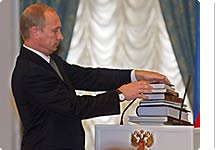
 Ours forever The weaver of the fifth category of the Nordtex plant, the register of the Ivanovo region, Elena Lapshin, was the first to ask the delegates of the United Russia Congress to “come up with something” so that Vladimir Putin remained president after 2008. “Before going to the rostrum, my knees tremble,” said NEWSweek, but after Vladimir Vladimirovich said literally me literally It broke through, and I told about everything that was sore. " Plier, did not hide Lapshin, was agreed in advance with the Ivanovo governor and party members.
Five months before the presidential election, but many, including Putin himself, had already been for the party ride: the main conflict of all his reign is that the Constitution forbids him to stay at the helm after 2008. Putin finally reassured it: he will not go anywhere.
It turned out that he was not cunning when he repeated again, more and more annoyed that there would be no successors, but there would be candidates for the president. The “problem-2008” was resolved in the most banal way: Putin almost directly announced that in May 2008, when his presidential term will end, he will become the Prime Minister and at the same time the leader of the parliamentary majority. It would be easier to cancel the provision on two presidential terms in the Constitution, but Putin promised not to do this many times; For the first time - even in the fall of 2004 during a visit to Kyiv. “We thought the design would be more complicated. But maybe it’s easier - it is more reliable, ”the Kremlin official shrugs.
However, this is not a solution to the problem, and, saying “a”, Putin will be forced to say “b”. The prime minister itself is not enough for him. In order to hold power with a guarantee in his hands, Putin will either have to change the constitution (so that the head of government becomes actually the first person in the country), or force the next president to resign after some time so that he, after new elections, return to the Kremlin.
Both of these options are associated with well-known difficulties: to fully reform the system of power for themselves and suddenly, from scratch, building a parliamentary republic is quite risky, and a quick return to the Kremlin after a simple, sewn white threads, the combination will not look very decent, even despite the observance of all formalities. The first script is bulky, laborious and dangerous; The second is still very ugly. Both will strike a decisive blow to Putin’s reputation in the West and nullify the qualitative difference between the state system in Russia and authoritarian repressive regimes among neighbors in Belarus and in Central Asia.
Congress of winners 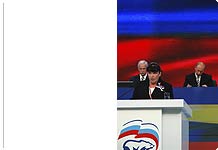
First, the weaver of Lapshin cheered the delegates with simplicity and sincerity. Following her, the champion of the Paralympic Games Mikhail Terentyev rolled out onto her. He, together with Putin, was at the IOC session in Guatemala and rejoiced at the victory of Sochi in a dispute for the Olympics. Terentyev called Putin the talisman of Russia. The head of the organization of small and medium -sized businesses “Rossiya Russia” Sergey Borisov campaigned Putin to join the party. Finally, the representative of the intelligentsia, the rector of the Samara Medical University, Gennady Kotelnikov, asked the congress to ask Putin to head the party "in order to head the government in the spring of 2008."
Putin did not object. Refusing to formally join the party, he headed the pre -election party list, and about the government said that this is a “realistic proposal”. It is only necessary that the party won the Duma elections, and in the presidential election defeat "a decent, capable, effective, modern person with whom you could work in pairs."
There was a scream similar to the one that the Russian delegation in Guatemala was emitted when they won the right to hold the Olympics.
"Well done! Well done!" - Under the roar of applause, one of the delegates praised Putin. “Great, great,” another said. “I even went to church in the morning to happen in the morning. The Lord probably heard. This is a great trust in our party, ”Vice Speaker Lyubov Sliska shared impressions. Chechnya President Ramzan Kadyrov rushed to hug with President of Ingushetia Murat Zyazikov. Zyazikov, too, could not recover: “This man stopped the country that stood over the abyss. And now he needs to give the opportunity to do this even more, ”he said.
Kemerovo governor Aman Tuleyev was amazed. Even the mayor of Moscow did not know anything in advance. “It was absolutely unexpected, but very pleasant this decision. It will help our party in the elections and the state, ”Yuri Luzhkov said on the sidelines of the congress. “I am proud of his step. This is a risky step, but justified, because it is right: well, we need stability, ”Tuleyev explained. “That's it, now only forward,” Sergey Shoigu smiled gloomily. Previously, before the sensational events of the last week, Shoigu was supposed to be second in the first three list. But Putin led the party spokes in proud loneliness, and Shoigu was moved to one of the regional groups, and even in the Stavropol Territory dysfunctional for United Russia.
Rokirovka
After the little-known Viktor Zubkov, and not the semi-official successors Sergey Ivanov or Dmitry Medvedev, was appointed Prime Minister, Putin’s decision to become prime minister already looks quite logical. Since September 2005, when Ivanov and Medvedev became deputy prime ministers, and until recently it seemed that Putin was seriously picking up a replacement. But by the time of the nomination of Zubkov - and, probably, even a little ahead of time - he has already planned how the party’s congress should go and how he will announce what remains.
Putin announced his plans as always ambiguous. “The chef still holds all the doors open,” says the Kremlin official. Many observers even believe that the sensation of the past week is only the next “cover operation” so that Putin will still leave the president to the president of the president. Everyone is used to being driven by the nose, and they are waiting for a trick in advance. But it is unlikely that Putin is now deceiving everyone. “There is a feeling that Putin has emotionally made a decision,” says another interlocutor of Newsweek in the Kremlin.
Firstly, the full successor on the stage did not appear: after the new prime minister began a powerful populist campaign from a place in the career (see Newsweek No. 40), he suddenly almost completely disappeared from the television. The too sharp first steps of Zubkov caused tension, the source close to the Kremlin says. Even from the way Putin is holding, it is imperceptible that he leaves - on the contrary, he fills the whole space. But this does not mean that he completely wrote off Zubkov.
Since Putin remains, then there is no need to somehow spin the presidential candidate, it will be enough to point to him at the right time: here he is, my sparring partner. And the role of presidential elections will be played by elections to the Duma. “Putin, together with the party, should receive more in the elections than the future president [in his elections],” comments Mikhail Vinogradov from the Center for Political Conjuncture. “And everything else is guesses.” And the party will also nominate a presidential candidate - so that this candidate is more closely connected with the party and Putin, the political scientist Dmitry Badovsky suggests.
Secondly, the new government Putin clearly selected directly for himself, observers note: it is stronger than the previous one, and almost all the key figures from Putin’s entourage are already in it: Dmitry Medvedev, Sergey Ivanov, Dmitry Kozak, Alexey Kudrin. From the Presidential Administration, the envoy to the Government has already moved to the government in the Far East, Kamil Ishakov - Deputy Kozak, the new Minister of Regional Development. A source close to the government offers to wait for new appointments to the vacant posts of envoy, freed by Kozak and Iskhakov, then it will be clear how Putin thinks. “The vacancies will hang until March, or some retirees will be stuck,” the interlocutor of Newsweek believes in one of the envoy.
Of the closest associates of the president in the Kremlin, only Igor Sechin, his permanent secretary, remained in the Kremlin. In December, after the elections, officials are waiting for the second series of permutations - probably, outsider people, such as the Minister of Transport Igor Levitin, Minister of Culture Alexander Sokolov, maybe someone else will leave the government. And already in May, on the eve of the inauguration of the new president, Putin and Sechin will move to the White House, suggests a source of Newsweek in United Russia. And Sechin will then change the head of the government of the government Sergei Naryshkin. The permutations in the office show that Putin plans to settle in the White House for a long time.
Prime Minister with mission
But why did he stay if he wanted to leave? “It’s just that you can’t be the father of the nation without a structure. After all, everything changes, everything flows, - the permanent head of Kalmykia Kirsan Ilyumzhinov shared with Buddhist calm on the sidelines of the congress. “On the one hand, he is the leader of the whole people, and on the other, he does not let go of organizational levers.”
And the source close to the Kremlin recalls that in February Putin began to read the memoirs of American President Franklin Delaino Roosevelt, who in 1940 violated the rooted tradition of two terms in order to lead America from the Great Depression, to conduct it through the Second World War. Even earlier, Putin quoted Roosevelt in his message. Putin, obviously, draws a parallel to each other and Roosevelt, the source claims.
Roosevelt violated the tradition. Putin revives her: Russian leaders - all except Boris Yeltsin - went either forward, or as a result of the coup. But many observers are sure: Putin believes that he has a mission. A mission, under which a worthy successor cannot be found and which compels him to stay in order to control Russia manually.
As a result, Putin came to the conclusion that there was no more effective form than combining the positions of the Prime Minister and the head of the party. The only problem is that the President of Russia at any time can dismiss the Prime Minister without explanation. And dissolve the Duma if she rejects the prime minister’s candidacy three times. To reduce these powers of the president, you need to change the constitution.
At a meeting with the Valdai Political Science Club, Putin opposed the formation of a parliamentary republic in Sochi immediately after the appointment of Zubkov: they say, it is dangerous and that there can be no other form of democratic government in Russia ... except for a strong presidential government, ”there can be.” Sources in the Kremlin in chorus assure: Putin will not touch the Constitution.
But still, Putin -Prime Minister paired with a certain, even a weak and non -ambitious president - such as Zubkov - a dangerous and conflict scheme, a source close to the Kremlin says. Still, the constitution is such that it is the president of the country - the initiator and conductor of all foreign and domestic policy, emphasizes one of the authors of the Constitution Mikhail Krasnov. And Putin clearly does not intend to let the levers out of his hands.
Putin’s agenda is a foreign policy; He is immersed in a global game, says political scientist Badovsky. For Putin, probably there is even a question who he is or the future president will go to the next summit of the big eight. Under him, the president must be a decorative figure and perform exclusively representative functions. What if he suddenly refuses? How does this fit with his own, Putin, by the assertion that the country needs a strong presidential authority? And what about the fact that they can remove it? The position of Roosevelt was strong.
Of course, there is always a way out: Putin Prime Minister can shift the “technical” president to return to the Kremlin. At the beginning of the next presidential period, he definitely has enough levers and influence for this, experts believe. Probably, Putin today does not plan to immediately return to the Kremlin, but intends to be the prime minister, believing that he can control the situation. Maybe even he today sees his task in order to rule through his authority without resorting to extreme measures. Otherwise, what is he better than the self-team neighbors Lukashenko and Nazarbayev?
But the vulnerability of his new position will quickly become Putin obvious. The national leader, who is aware of his high mission, should not have such problems. In addition, Putin’s rating may begin to fall: the White House is not the Kremlin. The phenomenon of Putin’s immense popularity rests on the fact that he is the president, a symbolic figure, and, changing the status, he risks - the magic of his image can gradually stop acting, says sociologist Alexei Levinson from Levada Center.
And in this regard, Putin’s knowledgeable interlocutors do not exclude that somewhere in a year - in the fall of 2008 - Putin will either begin the reform of the Constitution, or push the President to resign as a health reasons.
Having made his announcement at the congress, Putin disappeared. On the sidelines in the spotlight was Ramzan Kadyrov with a delegation from Chechnya. The delegation celebrated the victory and radiated optimism. The head of Chechnya opposed Putin to head the government.
The second person I do not see the president. Vladimir Vladimirovich should always be in the foreground. I see him as a lifelong president, ”Kadyrov said.
But the president just said that he did not want to go for a third term.
I think the president should be reckoned with the opinion of the people. Now, in the election, people will say their own. If it is needed for the people, it should work.
Pavel Sedakov took part in the preparation of the material
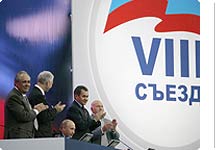 Leading and guide
"United Russia" as a result of the elections will become a ruling party with an almost Kazakhstan result
Having headed the list of United Russia, Putin struck a crushing blow to the rest of the batches. The Kremlin in a hurry rewrites the election script to the Duma. Now the minimum task facing Putin’s party is the constitutional majority in the Duma of the next convocation. The bar for governors and staff rises by an average of 15%, explains the source in the party - from 47-50 to 62–65%. Now the election to the Duma is a referendum on trust in the president; But it will be very difficult to recruit more than Putin in the presidential election in 2004 (70%).
But in all parties, except for the only opposition brand - the Communist Party, is just a disaster. Four parties were firmly planned to go to the Duma: “United Russia”, the Communist Party, “Fair Russia” and the LDPR. And for one of them in the Duma there is no longer enough space, her chances become purely theoretical. And the only question is who will fly out. The party of Sergei Mironov was immediately enrolled in the candidates for the flight: the Socialist -Revolutionaries built tactics on the fact that they were “on the new”: for Putin and against United Russia. This tactic has lost all meaning. The pre -election platform of the Socialist Revolutionaries collapsed.
A panic began in the "SR", says a source close to the party. There was talk about the urgent shake Party, including even the federal three, so that the remaining passage places - if they are at all, put the most in need. And the position of Mironov himself in the Federation Council becomes very shaky. The party saw the only way out: Mironov should talk to Putin.
After a conversation with President, Mironov was better holding a blow. It turned out, from his words that Putin simply saves United Russia from defeat, “and at the same time puts a“ deuce ”to the leadership of this party in terms of its readiness for ... struggle.” Well, in the Duma, the majority in the person of EP and the allies in the person of SR will serve as a guarantee of the continuation of the Putin course after 2008. That is, Putin allegedly turned the green light again. “The field is narrowing for us, but it persists,” says the activist of the Socialist Revolutionaries, deputy of the Moscow Region Alexander Romanovich. “Our topics are still close to people.” Now “Fair Russia” will more actively fight the Communist Party and defend the left idea. The LDPR will not pass in the next Duma, Romanovich believes.
The LDPR risks staying with nothing, the political scientist Mikhail Vinogradov agrees. The main thing is that in the Kremlin they do not “clean” the Communist Party in order to replace it with “fair Russia”; After all, there were once such plans, a source at the headquarters of the United Russia is experiencing: it will not be possible to get rid of the Communist Party, both will pass both. Other observers do not exclude that the LDPR in this situation will simply be removed from the elections. To decide who to be in the Duma, and to whom to disappear, Vladimir Putin will personally.
So it would be so 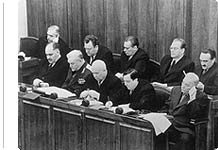
Vladimir Putin can rely on the political tradition of the Soviet government: the leader is always and in everything the most important, regardless of what his position is called today
Already immediately after the revolution, Vladimir Lenin, the head of the Soviet government (his leadership in the Bolshevik party was not at first formalized) - there were more power than Nicholas II. The emperor could get along and not get along with the Duma, and Lenin himself made decisions for the advice of all levels, directly pointed out the courts what sentences to pass, and did the sleepless reprisals entrusted to the Cheka or the executive committees in the field - under the king, the independence of Russian law was still at a completely average European level. The nominal head of state Yakov Sverdlov was still among the real leaders of the country and even replaced the Prime Minister Lenin as the first person after the assassination attempt on the leader, but this was not explained by his position, but a longtime belonging to the Bolshevik elite (that is, the leader is not at position, but the position of leader) and the recognized leader of the Minister of Military Lev Trotsky was in the army. But already starting with Mikhail Kalinin (since 1919) to Mikhail Gorbachev (elected by the President of the USSR in 1990), the head of the Soviet state was a purely decorative figure - it is unlikely that anyone considers Vladimir Putin the heir to Nikolai Shvernik (chairman of the Presidium of the Supreme Soviet of the USSR in 1946-1953, almost two presidential terms).
Joseph Stalin was elected by the party Secretary General in 1922 and until 1929 he ruled the country, forming different two- and triumvirates, which never included either the President Kalinin or Prime Minister Alexei Rykov. In the 1930s, Prime Minister Vyacheslav Molotov was an obvious subordinate of Stalin, who himself became the head of government only in May 1941 in the war, he was also the People's Commissar of Defense, the Supreme Commander-in-Chief and Chairman of the State Committee of Defense, but, according to G. K. Zhukov, “formalities were not observed”: the functions of the organs were not very different-“Stalin worked as a team,“ a comrade Stalin. "
After the death of Stalin in 1953, his premier position, which seemed the main one, went to George Malenkov, and Nikita Khrushchev was content with the first secretary of the CPSU Central Committee. But six months later, Khrushchev pulled the authorities of the first person on himself, and in 1955 he shifted Malenkov, appointing Nikolai Bulganin as his “technical prime minister” - he did not have real power, like the then nominal head of state Klim Voroshilov. In the West of the Soviet arbitrary interpretation of posts and the status of the first secretary of the Central Committee, they did not understand, therefore, Khrushchev was forced to make visits to Germany and England (1955-1956) with Bulganin. There, they were comical to always stay together and not to be a single step out of each other. Khrushchev became the prime minister in 1958, finally combining real power with the official one.
After the overthrow of Khrushchev for a long time, the triad Brezhnev -Kosygin - Buddy (party -government -councils) developed for a long time. The Secretary General of Brezhnev was the first among equals from the very beginning: he could directly lead the economy (stopped the Kosygin reform to transfer enterprises to the self -leveling) and made visits as a head of state, not being such. In protocol difficulties in the Brezhnev title, they additionally indicated: a member of the Presidium of the Supreme Soviet of the USSR. Like, our president is collective - the Presidium, and Leonid Ilyich is one of its manifestations. Then Brezhnev headed the Supreme Council (1978), but this only changed the status - his authority did not increase, they were all so. Andropov and Chernenko, becoming the Secretary Generals, immediately formalized their election by the chairmen of the Presidium of the Supreme Council, but Gorbachev, without entering the autocracy, first for three years (1985–1988) put Andrei Gromyko in this chair.
Is it necessary to remind that under any of the Soviet leaders the Constitution of the USSR was not violated and it never had to be changed, adjusting to a new power configuration?