
Translated material
Boin Day
Wodete, auto -zaks and a thousand detainees - this is how the Saturday day in Minsk passed
It feels like the winter of 2010-2011 was smoothly replaced in the spring of 2017, and there was no previous six years - in terms of the scale of repression, in any case. Oh yes, over the years that there were no, the political prisoners managed to be released, and the European Union abolished sanctions against the Belarusian regime, including visa restrictions for the fans and security forces who participated in repressions. Now, it seems, the sanctions will return. That's just the fear of Belarusians, who constrained the country after December 19, 2010, is unlikely to return.
True, if then the rally and the procession still took place and were brutally dispersed with the subsequent hundreds of arrests, then on March 25, the security forces used other tactics: not to allow people to collect at the agreed place-near the Academy of Sciences. It was planned that a rally will take place there, and then a procession on Independence Avenue will be held. The city authorities were notified, but within the deadline established by law, they did not answer the applicants of the action. But in the evening, the day before, it was reported that the rally and the procession were refused, and those who wish could gather on the Bangalor Square - in the bear corner of the city.
A few days before the action, all applicants were arrested and sentenced to administrative arrests. Two remained at large: presidential candidates in the 2010 election Vladimir Neklyaev and Nikolai Statkevich. Neklyaev was removed from the Warsaw-Minsk train at night-he was driving specially at the rally after performing in the Polish Sejm. On Saturday morning, it turned out that he was in the Brest isolator. And Nikolai Statkevich simply disappeared - on the eve of the action, all his accounts were hacked, the phone was disconnected, and he did not appear in the city on Saturday.
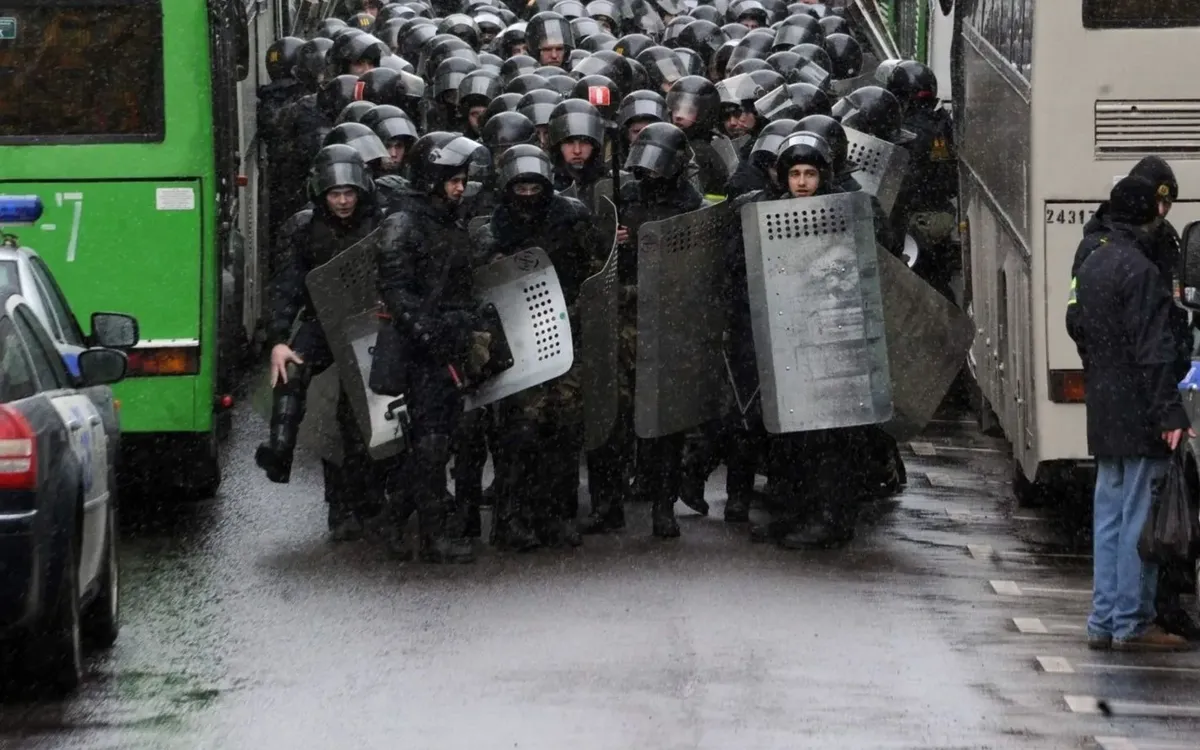
In the morning, Minsk looked as usual. But from noon, the center was cordoned off by the police, in the lanes adjacent to Independence Avenue, the columns stood auto -zaks. From hours in the afternoon, entering the city center was blocked. Metro and buses went without stops. Police cordons appeared on the outskirts of the gathering place, and mass arrests began.
At first they stopped people walking along the avenue with backpacks (I think the percentage of arrested random passers -by has yet to be calculated). Then they began to grab on the central streets located near the Academy of Sciences - on the streets of Kozlov, Yakub Kolos, Surganov, Kalinin, on Masherov Avenues and Independence. Of course, they beat. They dragged them to autozaki and transported to various police officers and isolators (by the way, on the eve of all the detainees, they prevented the Minsk insulators to prison in Zhodino - they cleared places for political). The journalists of the Belsat, Komsomolskaya Pravda, Radio Svaboda, the newspapers of our NIVA (it was the correspondents of this newspaper were able to inform from the factory police department that there were more than a hundred detainees). The elderly was beaten and pushed into auto -zaks.
An hour before the scheduled beginning of the action, riot police hacked the door to the office of the human rights center Vasna. There were 58 people inside - except for Belarusian human rights activists, there were journalists, as well as citizens of France and Russia. Everyone was taken out of the office and pushed into the bus. They took him to Pervomaisky police department and said that they were accused of hooliganism and banditry. True, a few hours later released. Obviously, the goal was to prevent the presence of human rights defenders during mass cleaning. But two out of 58 had to be taken to the hospital: they were greatly beaten during the detention.
People did not resist the arrests, but resisted attempts to prevent the action: they gathered in groups and walked along the avenue. So they took them in groups. And they all did not leave, emerged from somewhere in the courtyards. Again they formed in small columns and walked. And they were grabbed again. But Minsk was able to hold out for several hours.
According to human rights activists, about a thousand people were detained on this day. The traditional name of the action on February 25 “Volya Day” Belarusian journalists remade on the “Basil Day”. But it is precisely the "Volya Day" that is a traditional action. It was on this day in 1918 that the Belarusian People’s Republic was proclaimed in Minsk-so the Belarusians wanted to leave the power of the Bolsheviks. And every year Belarusians gather on this day. This action is more a holiday than a protest. They come there with children and flowers. Even in 2011 and 2012, at the peak of repression, their will did not disperse. And how can anyone object that the regime was finally shaken?
I can say for sure: Belarusians are now angry now. The fact that they did not disperse, but still tried to go through the right route, already knowing well that they would last a couple of minutes, after which-beating, arrest and an uncertain future (students can be excluded from universities working-and this is in the best case, if they did not bring under the “criminal”), the most reliable proof.
The shares will continue, now it is clear. Spring ahead is still long, there will be enough dates to everyone, like anger. But Lukashenko’s nerves and excerpts were not enough. It is to blame.