
Translated material
Turtle Reform Reform
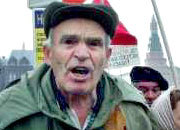
The fate of Russian pensions has developed paradoxically. On the one hand, in this area it was somehow not up to reforms, since the situation throughout the ten years of the existence of Russia remained extraordinary, on the other hand, the understanding arose quite quickly that the system, which forms spontaneously on the basis of the Soviet inheritance, can provide a guaranteed collapse in 20 years. The demography helped, so to speak, more precisely - the inevitable aging of the population.
Pension systems are, if we simplify the impossibility, joint (distribution) and accumulative. Solidarity is when all the money goes to the common boiler, and then they share "in fairness", that is, regardless of the initial contribution. The accumulative principle implies that a person puts off his own retirement, but not in a cube, but in a special (state or not) pension institution. In a perfectly pure form, these systems are not represented in life, but they can be combined, naturally, differently. When each pensioner has a bunch of workers, you can afford a “fold”, in which several “grandchildren” contain one grandfather, hoping that their own old age, in turn, will provide the next generation. When the number of pensioners is approaching the number of active workers, as is happening over the past 50 years in all urbanized countries, including Russia, the joint system is malfunctioning.
In Europe, they became worried when 40-45 pensioners became per 100 workers. We have the same hundred employees feed 60 pensioners .
The forecast is as follows: in 2015 there will be 70 pensioners for 100 workers, in 2023 - 80, in 2033 - 90. And after 50 years, pensioners will generally become more than workers , and there will be no one to support them. Theoretically, of course, it can be imagined that enterprises will transfer another one and a half more to the pension fund (now - 28 kopecks, and this is a lot), but this is a lot), but with difficulty it is with difficulty.
Therefore, attempts to introduce a funded system began quite early. Already in 1995, the concept of pension provision reform was adopted, which provided for a three -level pension system with a significant accumulative element. Its essence was that any person who has not even worked out for a day is supposed to be the so -called social pension, every person who works all his life pays contributions to accumulate a compulsory retirement pension, and besides this, there is an additional funded pension. Then a specific project was proposed to the new system, and the remaining project.
In 1997, an even more radical concept of pension provision was actively discussed, which involved reforms on the Chilean model. In Chile, pension provision was completely transferred to the funded principle and transferred to non -state pension funds. This idea did not go through us, and in 1998 a government program of pension reform was adopted, which provides for very cautious and gradual introduction of elements of the funded system. So far, the reform is at the stage of introducing individual personified accounting . This means that people are given plastic pension certificates with a number, which later should become the number of their personal pension account. By the end of this year, the epic should end, and then ...
And then what? The program of priority actions by the Government, prepared by the Center for Strategic Reforms of Herman Gref, mainly states that in the next two years the government will patch up the existing system, and in the second place to think about the future - to gradually consider the issue of gradual increase in the retirement age and prepare bills that "ensure a gradual transition to the accumulative financing of pensions." In terms of the work of the Duma for the next six months - also mainly patches, and from the news - only the Law "On the Basics of the Pension System". It is clear that increasing the retirement age is unpleasant, and introducing a funded system that hurts the interests of such a powerful institution as the Pension Fund is completely scary. But to be late with the reform is even worse.
Mikhail Dmitriev: What pensions we receive in 2001 - publications about the CSR. Center for Strategic Development, 07.27.2000
The President in January may sign a decree on raising pensions to working pensioners - country.ru, 12/29/2000
Photo AP