
Translated material
"Transval" could destroy the disco
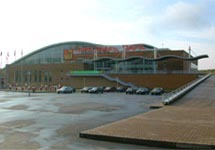
The participants in the investigation of the disaster in the Transvaal have a fundamentally new version of its causes, Kommersant reports. Experts suspect that the support of the dome broke, unable to withstand the lateral dynamic blow. It could produce it both an explosive wave and a sound pressure from a disco passing in the water park. On Wednesday, a special examination was scheduled on this occasion. In Transvaal, it will be held by specialists of the English company Martin Weli.
In the first days after the tragedy, the version was put forward that the collapse occurred due to water-saturated bulk soil, on which the foundation of the building rested. Some of the specialists even accused the Turkish construction company of saving on the foundation. “When there are even the slightest problems with geology, Russian designers always prescribe a pile foundation,” one of the experts told the newspaper. “The fact is that long piles, breaking through a movable bulk or flooded soil, are based on a solid base. The low -vagus or even monolithic foundation“ floats ”with the ground, dragging along with the upper structure. InSAAT (the company that carried out the “Transvaal”. - Ed.) They knew about this, but they are unprofitable to score piles, because for this it is necessary to hire Russian specialists - the Turks have no their pile mechanisms.
The foundation version, according to which the eleventh support broke due to a shift in the base, remained dominant in the investigation for several days, but in the end they abandoned it. Geodetic survey showed that the foundation sank only 15-23 mm with a design assumption of 50 mm. “Underground structures are my main specialty,” explained the leader and owner of Kocak Insaat Ismail Konchak. “On this topic, I even defended his thesis. In the water park, we really refused the piles, but made an even more powerful foundation: a monolithic reinforced concrete slab of half a meter, which took about 5 thousand cubic meters of solution. The building at an eight -meter depth could withstand a multi -storey building, and not like a light water park. "
Now the investigation participants believe that the eleventh column could be broken for another reason. The dome of the water park, which was a segment of the sphere with an angle of 108 degrees at the base, was supported by an administrative building in the center and 22 columns in the arc. Each of the columns is a round hollow metal structure with a height of about 8 m and a diameter of 450 mm, plastered with cement mortar. The columns were not rigidly related to the rest of the design. Below they simply stood in the cups of the handicrafts, and at the top they focused and connected with the roof with a small hinge that compensates the temperature extensions of the dome.
The “pencils”, as the designers called the columns, had such a margin of safety that they could withstand 15 more water parks set from above, but only if the load was on static compression. The horizontal load could break the "pencil". As experts now believe, it was such a load attached to the eleventh column, and caused the disaster. However, where did she come from, is not entirely clear. There are only assumptions on this subject: the effect of an explosive or sound wave.
The version of the terrorist attack, according to a member of the State Commission, co-owner of LLC Sergey Kiselev and Partners (General Projector of the construction of the water park.-Ed.) Igor Schwartzman, "for some reason they stubbornly do not want to consider." “Rescuers stole all the columns in a heap and buried all the columns,” says Mr. Schwartzman. “Now it’s hard to say the Eleventh, the Eleeenth to explore it.“ In any case, they did not contact us. Moreover, we offered the Chekists to pay attention to the wreckage of the drain pipe, which went just along the eleven column. A specialist in terrorism, but it cannot be ruled out that it was in this pipe that the rescuers also cut the pipe and took the dump.
Another assumption about the nature of the horizontal hit on the column is due to the fact that the “Transvaal Park” was used by owners not only for its intended purpose, but also as an entertainment complex. So it was last Saturday - a disco dedicated to Valentine's Day was held in the water park. To organize the holiday between the pool and the outer wall of the building, just opposite the 11th column, a dozen powerful audio collars were installed, which since 18.00 gave up to 25 kilowatts of sound. The pressure of the sound wave acted on the column on the side, but it was too weak to “squeeze” it until the column of the column fell into the beat of the music. This phenomenon - resonance - is well known not only to musicians, but also to designers. It arises when two types of vibrations coincide in frequency, and their "peaks" seem to be applied to each other. In this case, the fluctuations are increasing many times. In music, resonance is widely used to enhance sound, and in the operation of construction facilities it leads to catastrophic consequences. Everyone knows the story of the bridge that fell upon when it was marched on it, minting a step, a column of soldiers. It is possible that something similar happened in the Transval Park.
According to the teacher of the department of reinforced concrete building materials of the State Construction University of Vladimir Danel, to which the newspaper turned for comments, such a version cannot be excluded. “Although her probability is extremely small, everything can be,” he said. According to Mr. Dunel, "in this case, the spectrum of the frequency of exposure should coincide with the spectrum of the frequency of the own vibrations of the building." But in his opinion, it is possible to affirm anything only after special research and experiments.
Meanwhile, the designer of the Transval A water park Nodar Kancheli, which the prosecutor’s office was already preparing accusations, said that a “release” had occurred before the collapse of the water park roof. According to Kancheli, this is evident from the video of the last minutes before the disaster.
“I can’t say what it is - smoke, dust, explosive gases. But this“ something ”was thrown outward, aside the building. An approximate cross section near the place where it“ flew out ”, about 20 cm, about five meters long, and at the end there was already a diameter of a meter or more,” Kancheli said in an interview with the Country and Peace program NTV. In the video, normal frames were at first, “then the exhaust is so,” Kancheli said. “Immediately everything went out. That is, he collapsed, so I understand,” the architect said.
This emission occurred in the area seventh from the corner of the rack building, which support the water park dome.
When asked if the whole roof could collapse due to the fall of one supporting pillar, the architect answered in the affirmative. “In general, what was currently designed and designed to terrorist attacks always suggested that almost any column, any core in the design, being broken or blown up, the structure should fall. For example, a visor over the bends. If it has a supporting contour, then the entire visor will collapse, under which 80 thousand people,” Kancheli said, noting that there are a lot of examples.
The architect said that he has been working for more than 30 years and among his Moscow works - a guest courtyard, Manezhnaya Square, the dome of the Cathedral of Christ the Savior. There are projects outside Moscow. “This object collapsed the first. We tried to analyze among ourselves - where could be such a miscalculation. So far we could not find anything,” Kancheli said.
In the entertainment complex "Transval-Park" on February 14, a roof fell. As a result, 26 people were killed, including seven children.