
Translated material
Pluto is unclenched into ordinary

In Russia, unprecedented cold reign in Russia, and later American operators doused from the Cosmodrome at Cape Kanveral in hot florida sent a spaceship to the coldest place of the solar system - to its periphery. We also decided to console readers in a peculiar way: there is a place in our universe where Moscow, which is exhausted from frost, will seem to be a paradise of a paradise! As you can see, almost all the approved names of the planetoids of the distant Kuiper belt are associated with deities who personify either cold, or water, or both at once, since darkness and ice reign there.
More recently, Pluto (to which on Thursday successfully started the automatic interplanetary station "New Horizons") was considered the greatest exotic throughout the solar system - and not only because of its eccentric orbit, but also because it can boast of unprecedentedly large satellite - Haron. It is believed that Haron appeared as a result of a cataclysm, in many respects that led to the formation of our earthly moon ... However, now Pluto suddenly ended up in a "warm" (or rather, on the contrary, phenomenally frozen ...) the company in many respects comparable in its parameters of transneptun objects that have "acquired" their own moons. Of the four largest famous bodies of the Kuper belt (KBOS), three have one or a large number of satellites.
“We are now beginning to understand that Pluto should be attributed to a small family of objects like him, almost every of which has a moon or moon,” says Antonin Bouchez, from the California Institute of Technology - Caltechy - Caltech ). The corresponding report was read out at the recently ended winter 207th meeting of the American Astronomical Society (American Astronomical Society - AAS ) in Washington (County of Colombia).
Object 2003 UB313, which is 25 percent exceeding the diameter of Pluto and also possessing a large eccentricity of the orbit (Afelia - 97 A.E., Perigelia - 36 A.E.), was opened by American astronomers Mikeel E. Brown), Chedvik Trujilo (Chard Trujillo) David L. Rabinowitz during the review conducted using the Samuel automatic telescope, Palomar Observatory. Earlier, with the help of the same telescope, Sedna (2003) and Quaoir (2002) were opened with the same group. The official number and name for 2003 UB313 and its alleged satellite (S/2005) are approved by the International Astronomical Union, and most likely they will become I'Mir (YMIR) and A'Dumla, proposed by the discipliers. In Scandinavian mythology, Imir was called the first giant, from the body of which the world was created. The cow Audum, which arose from the melted hoarfrost, filling the world abyss, fed the Imir with her milk (she herself ate that licked salty stones covered with hoarfrost). However, with the light hand of journalists, completely different names for this planetoid and his satellite - Zen (or Xena - Xena) and Gabrielle - are much more popular - by the names of the heroes of the famous television series "The Queen of the Warriors", or the name of the daughter of Michael Brown Lyla (Lila), whose name was named after the file with information About the new planet on the website of the astronomer himself.
Simultaneously with 2003 UB313, the opening of 2003 EL61 was announced. The planetoid 2003 EL61 rotates extremely quickly - it makes one revolution in four hours and has a cigar -shaped form - it is pulled 2 thousand kilometers in length, which is comparable to the diameter of Pluto (however, its more correct form would be compared with handball). It turned out that 2003 EL61 has as many as two satellites, the diameter of the majority of them can be 300 kilometers. And if the planetoid itself was supposed to be called Santa, then his moon, of course, decided to name in honor of the deer Santa Claus Rudolph. The second satellite of Santa turned out to be about half as much, but as it is supposed to be called, has not yet been reported. Researchers believe that these moons formed from the fragments of another large inhabitant of the Kuiper belt, which broke out about 2003 EL61 during the formation of the solar system - more than 4 billion years ago. According to this scenario, that long -standing disaster warmed up 2003 EL61 so much that the planetoid lost most of its ice, and mainly rocky breeds remained. The blow to the tangent forced the heated stone to rotate so quickly that its shape stretched out in the form of a cigar, and frozen after cooling (the stones there are “cemented” with ice remains).
But at the brightest after the pluton of the inhabitant of the Kuiper belt - 2005 FY9 - it is not yet possible to find modern satellites with modern means of satellites. 2005 FY9 wears a strange (for the planet) nickname Easter rabbit (Istebanni - Easterbunny), its diameter (according to preliminary estimates) is about one and a half thousand kilometers (that is, in size it is most likely to be 2003 UB313 and Pluto, but surpasses the Sedna).
Busha believes that the planetologists are now faced with the task of solving a new riddle: why the vast majority of “small” celestial bodies among hundreds of objects known to us that inhabit the Kuiper belt have only an approximately 11 percent chance of owning their own satellites, despite the fact that three of the four largest objects (which are clearly more than 11%) are equipped with the moon. Perhaps this means that for large and small bodies located outside the orbit of Neptune, the fundamentally different mechanisms for gaining satellites are characteristic.
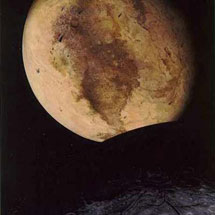
Over the past decades, experts fell on the opinion that Pluto's companion Haron was formed as a result of a catastrophic collection. According to computer models, Pluto was struck by an object, the dimensions of which were about twice inferior to its own diameter, and as a result of this conflict, part of the planet’s substance simply evaporated, but most of this material still remained almost intact, giving rise to Haron. The earthly moon, as it is now believed, was also created in a similar way (as a result of a collision of the Earth with a heavenly body the size of Mars), with the only difference that it was formed from a hot disk formed by a material thrown into orbit after a powerful clash. Only last year, the astronomers discovered two new small plutonium moonlines, but they also fit into the usual scheme: the huge Kharon was formed due to the sliding blow of Pluto with another body, and the remaining pair of famous satellites (as well as some additional, not yet identified from the ground) was created from its fragments.
As for the other inhabitants of the Kuiper belt, they probably could acquire their moon only due to the more rare cases of gravitational capture with the participation of three bodies - which is why the aforementioned 11 percent barrier is characteristic.
The discovery of three giant planetoids pushed the previous achievements and, in particular, the discovery (in November 2003) by a group of the same Michael Brown using the Spitzer space telescope, which rotates around the Sun through an unusual elongated and remote orbit. This planetoid of an unusual reddish shade is now officially called the Sedna (SEDNA, the former designation of 2003 VB12) named the Eskimo goddess of the sea.
According to preliminary data, Sedna's diameter is from 1600 to 2000 kilometers, but it is still not excluded that it will be more than the same Pluto, the diameter of which is 2390 kilometers. This is the most distant and coldest planetoid of all ever found in the solar system. Sedna systematically becomes a little brighter, then a little more dull, possibly because its surface is covered with light and dark spots. Initially, it was believed that the period of rotation of Sedna is 20-40 days. Then she should have a large satellite, which gradually due to gravitational interaction "inhibited" rotation. Thus, the rotation of Mercury and Venus slowed down under the influence of a hedge of the sun, and the rotation of Pluto has a relatively “leisurely” character (period - 6 days), due to the fact that the rolled -abusive forces of the satellite - Karona, which is rotating around him, also act on Pluto.
Sedna could not find a satellite, but new dimensions allowed to remove this problem itself. Thorough measurements of the smallest pulsations of brightness (probably missed during previous studies), reflecting the movement of darker and lighter parts of its surface (in detail not distinguishable, of course, from such a distance even in the best telescopes) allowed to “abandon the services of” the hypothetical moon. The most suitable period of rotation for Sedna is now considered 10 hours or so that it is typical of asteroids in our solar system (the Earth turns in 24 hours, Jupiter and Saturn in 10 hours), and it does not need to be assumed to be assumed to the presence of any external influences.
About 12 thousand years, Sedna is required to close his extremely elongated orbit, which at the point closest to the Sun is removed from our luminary by 74 A.E., and in the far - at 600-900 A.E. (For comparison: Pluto on average was removed from the Sun by 39 A.E., and Neptune - by 30 A.E.) Some scientists attribute Sedna to the number of the most external members of the Kuiper belt, while others consider the planetoid the first representative of the so -called Oort cloud - hypothetical education on the very outskirts of the planetary system, from where comets are only “visible”. More precisely, in the case of Sedna, we talk about the so -called "internal" cloud of Oort.
The Sedna was thrown into such an exotic orbit, probably as a result of a long interstellar cataclysm. This is evidenced by the first detailed studies of this object. Most likely, some wandering star passed next to the Sun over four billion years ago and became the culprit of a number of upheavals that changed our planetary system. As a result of computer modeling, the support of Sedna received support, however, the question of the possibility of implementing other, more outlandish scenarios, for example, interaction with a hypothetical planet, which is at a distance of approximately 75 A.E. From the sun. And the discovery of such a planet is still possible, although until now the search has turned out to be unsuccessful.
Another bizarre scenario, which is also able to explain the current orbit of Sedna, suggests that Sedna could be born next to the brown (brown) dwarf with a mass of about 20 times smaller than the mass of our sun, and then was captured by the solar system during a catastrophic rapprochement with this very brown dwarf. Thus, the "atrocities" are no longer accused of a stranger, a stray star, but our own sun-sewer, while Sedna itself may turn out to be the "piece" of a completely alien planetary system closest to us.
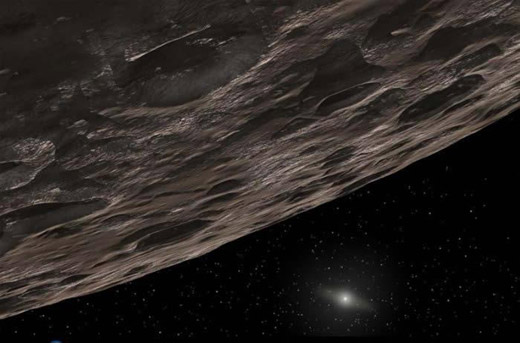
Another hero who unreasonably quickly receded into the background is the planetoid quaoir (or kvarvar, QUAOAR, its former designation is 2002 LM60, and the current official number - 50,000), opened with the same 1.2 -meter California telescope named after Samuel Stroko in June 2002. The diameter of the kvaoara is 1250 kilometers. The name is given in honor of the Indian deity of the rain.
This transneeptun object follows in a circular orbit of approximately 6.3 billion kilometers from the Sun (42 A.E.) and 1.8 billion kilometers from the Neptune orbit. This is a classic object of the Kuiper belt - his orbit is much “more correct” by that elliptical that is observed in Pluto. At times, Kwaoir is closer to the sun than Pluto, but most of the time is still further.
Observations in the infrared part of the spectrum made it possible to find out that kwaoir reflects only 10 percent of sunlight, so it was quite difficult to detect. On the contrary, Pluto reflects 60 percent of the falling light. Its orbits are mostly located closer to the sun, the ice evaporate and condenses re -condenses, adding white to it.
However, Kwaoir - this dead frozen world - cannot be considered only as an "eternal cemetery." Even in the edges extremely remote from our luminary, sometimes there is enough “warmth” so that we can talk about the support of some planetary processes like cryovulcanism.
Observations carried out using the 8-meter Japanese Subaru telescope, installed on the Hawaiian Islands, allowed to be found in spectra (that is, in the sunlight reflected from kvaoar) the "signature" of crystalline water ice, as well as, possibly, ammonia.
The detection of crystalline ice means that kwaoir is heated by something besides sunlight. The idea of the presence of an alternative heat source arose because in the area where kvaoir lives, the sun can only heat up to minus 223 degrees Celsius, and water molecules organize a crystalline lattice at temperatures above minus 163 degrees, at ultra -low temperatures they freeze in disorder (so that the molecules can be lined up in Christial. lattices, additional energy is required).
The source of additional thermal energy can be directly the kwaoir itself. So, objects whose diameter exceeds 400 kilometers can generate heat due to the radioactive decay of minerals containing Uranus. This warmth melted the ice in the depths of Kwaoara, in its inner core. The molten liquid then appeared on the surface and again froze in the form of crystalline ice, thus imitating earthly volcanic processes, as a result of which the molten rock - magma - flows to the surface, and then cools and hardens. The detection of ammonia on kwaoara could also "pave the path" to such volcanism. After all, ammonia is the most effective antifreeze in the universe, it makes the ice melt already at minus 100 degrees Celsius. Another possible explanation for the presence of crystalline ice on the kwaoar is collision with micrometeorites that “exhibited” the ice that formed on the planetoid in ancient times - four billion years ago. Coordinations could also ensure the production of enough heat to crystallize "random" amorphous ice on the surface of the planet. Observations, however, until they allow you to answer the question whether the kwaoir is covered with dirty ice completely, or the blocks of ice rest among the areas filled with soil.
In addition to 2003 UB313, 2005 FY9, 2003 EL61, Sedons and Kwaoara mention are worthy of several more relatively “fresh” and rather large objects that at one time became a sensation, but in the light of the latest discoveries, which had departed not even to the second, but to the third plan. This is primarily an asteroid number 90482 Orkus (Orcus, its previous designation 2004 DW), "retroactively" detected even on 1951 photographs, the likely diameter of this object is comparable with the size of 2005 FY9 and is about 1,500 kilometers. Then there are Varuna (Varuna, stress on the first syllable, Sansk. वरुण - In Vedic mythology, this is a deity of space waters, as well as the keeper of truth and justice and a judge, its official number 20,000, and the previous designation is 2000 WR106, diameter - 900 ± 140 km), Ixion (Ixion, number 28978, former designation 2001 KX76, ~ 1065 km), an nameless asteroid, which received the official number 55565 (previously it was designated as 2002 AW197, 890 ± 120 km) and, finally, chaos (Chaos, number 19521, former 1998 WH24, 500-600 km). And the last sensation should be recognized as the detection of a relatively large object of the Kuiper belt with a very exotic orbit (which is a circle located outside the plane of the ecliptic). There is still no intelligible explanation of how such an orbit could form ...
Link:
Kuiper Belt Moons Might Be More Common - University Today (NASA ASTROBIOLOGY)