
Translated material
Daughter for her father
The most famous Burma woman was released
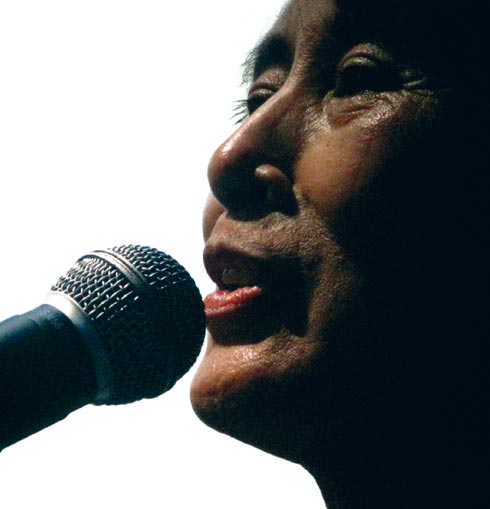
Daughter for her father. This fragile, with aristocratic facial features, a 65-year-old woman is the leader of the democratic opposition of Burma (Myanmar), where the military junta is in power. In politics, she has been more than twenty years old, of which almost fifteen were under house arrest. On November 13, under the pressure of the politicians of the world - from the US President to the UN Secretary General - the generals were forced to release it. How Su Ji became a nightmare for a military junta - found the New Times 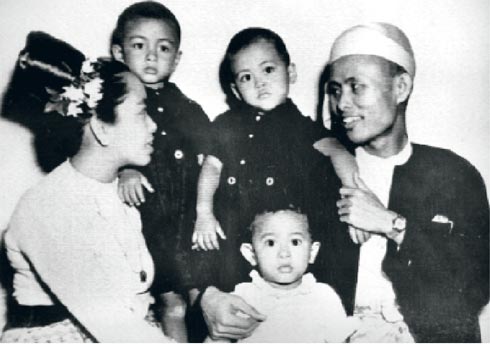
Freedom - for a long time? Then, in the late 1980s, it seemed that the military junta of Myanmar (as the generals renamed the country, known since time immemorial as Burma) was about to collapse. In May 1990, the government was forced to hold free elections, the first in 30 years, and was defeated. Most of the places in parliament received the National League for Democracy, led by Aun San Su Zhi. However, the junta did not recognize the results of the vote, and Su Ji at the time of the victory of her party in the elections was already under house arrest. This is an absurd situation, when the leader of the winning party simply does not release from home, turned into a system -forming element of the country's policy: to kill Su Zhi, whose name by that time acquired world fame, or to send it to the junta prison, but it could not allow her to move around the country.
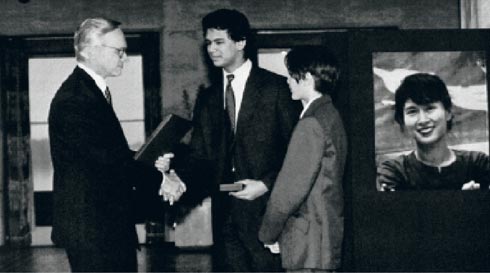
The Nobel Prize of the World (1991) Su Ji accepted “on behalf of the whole people of Burma” by her son Alexander Aris (in the center), however, without a prison, the struggle for democracy in one of the few dictatorships who survived the end of the 1980s is a difficult matter. Su Zhi has not seen her two children who live in neighboring Thailand for more than ten years and does not know if he would see. The junta controls the country, which means its boundaries. The husband died of cancer ten years ago, and the older brother lives in the USA.
The authorities offered her a deal according to a familiar scenario: the right to go abroad without the opportunity to return and rejection of political activity. She refused.
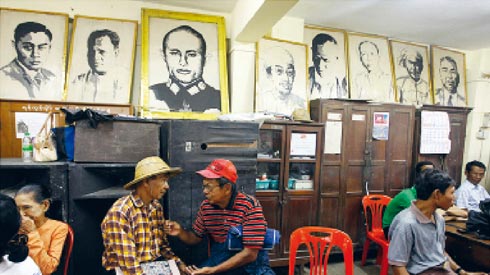
Activists of the National League for Democracy are found under the portraits of the dead like -minded people. The third left is a portrait of General Aun San and paid - with life within the boundaries of her own villa. Its first term under house arrest - since July 1989 - lasted six years. Again, she was forbidden to leave the house in September 2000. The arrest was lifted in May 2002, it was released for a year, in 2003 they locked the arrest again and several times. And on November 13 this year, they again allowed to go outside. But no one knows how long she will stay free this time.
The transformation to understand why politics became part of the fate of Su Zhi, it is enough to recall her father, General Aun San, a national hero who fought for the independence of Burma against the British and Japanese, the creator of the country's army. The general was killed by political opponents in 1947, the mother was engaged in the upbringing of her daughter, the nurse of the Central Hospital in Rangun, which herself became a noticeable figure of Burmese politics and was appointed ambassador of Burma in India and Nepal in 1960. Su Zhi graduated from a secondary school in Delhi, and here she entered the university, studied political science. In 1964, she entered the famous University of Oxford in the UK, received a bachelor's degree in political science, philosophy and economics. In 1969 she moved to New York and received his position in the UN Secretariat. She voluntarily worked in a hospital where she looked after poor patients. In 1972, she married a Tibeta specialist Michael Arisa and left with him in Butane. In 1988, Su Ji returned to Rangun to care for her mother, who survived the heart attack. In the country, there were mass demonstrations, the democratic movement was gaining momentum. In August 1988, Su Ji called on the government to start preparing for the elections. About 500 thousand people then listened to her speech near the Buddhist Temple ...
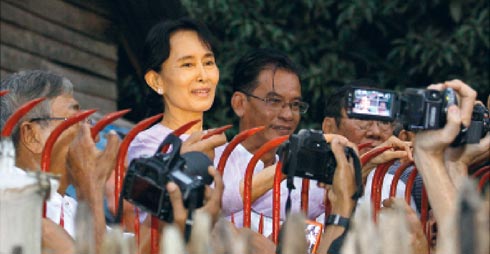
November 13, 2010. The comrades-in-arms meet Su Ji, who was released from the house arrest from the house arrest, analyzing the political fate of this courageous woman, Professor Georgetown University, in the past a high-ranking American diplomat David Steinberg believes that he was more likely to engage in Su Chi's policy. In other words, politics came for her. When her country was seething with protest demonstrations, Su Zhi simply could not stay away - the story of the family did not allow. Although neither experience nor ideas about how, in fact, this policy must be engaged in, Professor Steinberg said in an interview with The New Times, she did not have then. However, there was the experience of a diplomat and broad international relations.
The shadow of the father and yet, why, barely joining the struggle, it was Su Ji who became the leader of the protest? Professor of the University of Kanberra Monika Dischantor, the author of several books on the history and policy of Burma, in an interview with The New Times emphasized that in the 1980s there were many authoritative people with liberal views. But for Su Ji, in addition to views, education, experience, there was also the name of the father. This is generally characteristic of Southeast Asia: here the families of those who are recognized by the national hero become part of the elite-followed by a priori the right to leadership, a specialist in the region, professor of the University of North Illinois, the work of Jacobsen told The New Times. A similar example is Megavati Sukarnopyry, the daughter of the first president of Indonesia, who has achieved victory in the presidential election. One can recall Koruson Akino, the first woman-president in Asia, the leader of the revolution, which overthrew the authoritarian regime in the Philippines,-she also comes from the family of politicians. The fourteenth President of the Philippines was also a woman - Gloria Arroio, daughter of the ninth president. Traditionally, the daughters and widows of national heroes are endowed in the countries of the region with all the advantages of their men, but at the same time, they think there, they are deprived of the shortcomings inherent in strong sex: power spoil women than men, believe in Asia, because women do not have a tendency to destroy, says Professor Jacobsen.
Donation of traditions is the necessary component of political behavior in Southeast Asia. And Su Zhi strictly follows this rule: for example, it wears traditional Burmese outfits, visits saints for Buddhists, despite the fact that she lived in the West for many years, and its political program involves the integration of Burma into a modern Western political and economic context. In other words, she says to the fellow citizens: yes, I speak English without an accent, but my roots, my life is Burma.
New Mandela? Even the time of liberation of Su Zhi shows how much it has in its country. The generals released her from house arrest 6 days after the parliamentary elections (they took place on November 7)-the first over the past 20 years. In other words, the junta did everything to deprive her of any chance of participating in these elections: the experience of 1990, when her party won the elections, the generals did not forget and could not forget.
True, the generals stated that they were ready to release her on May 27, 2009. A strange case prevented this. Two weeks before the announced date, the American citizen John William Yettou penetrated the house of Su Zhi. The territory around the house standing on the shore of the lake was under strict protection. Yetto managed to cross the lake, he overcame about three kilometers in home -made flippers. The American remained to spend the night in the house of Su Zhi and tried to leave swim at dawn. He was discovered by a police patrol. For the fact that Su Zhi violated the arrest regime, having adopted a guest in her, the term of its detention was extended. Yettou was sentenced to seven years in prison, but his liberation was achieved by the American senator Jim Webb, who specially flew to Burma for negotiations. The country's authorities considered that behind a strange visit to Yettow are opposition. The opposite opinions were also expressed: it could be a provocation of the authorities in order to get a reason not to free Su Zhi. Perhaps Yettow was just crazy. Be that as it may, Su Zhi remained under arrest for another year and a half.
Why was she released now? Professor of the Moscow Formation believes that the junta simply managed to minimize her risks and does not see in Su Zhi a serious threat to her regime: “They did everything they could to limit its political influence,” the expert notes. However, Professor Jacobsen believes that the case is different - the situation in the country begins to change: part of the new generation of officials of the country has received an education in the West and understands the benefits that they promise the country's great openness and the liberalization of the regime. The release of Su Ji to freedom, according to the expert, is a signal to the rest of the world that changes are taking place in Burma. Not only did Su Ji allowed the territory of her villas to leave the territory of her-the authorities allowed to gather at her house tens of thousands of supporters, among whom were young people who are unlikely to remember the events of the late 1980s. Given the long term that she had under arrest, let the home (Su Zhi, speaking about this, is almost shy about the fact that she was so “easily” and recalls that in prisons of the country - hundreds of political prisoners), she began to compare her with Nelson Mandelia. However, there is a well -known stretch: it is not at all obvious that Su Ji will be able to resurrect his party, as well as the fact that the generals will allow her to participate in the elections. And whether the elections will be - it is also unclear. However, the years of captivity did their job. Su Ji became the national hero of his country, a symbol of its resistance to military junta. Will the happy ending will follow - time will tell.