
Translated material
Reflex of freedom
Director Ivan Solidovsky and producer Natalya Mokritskaya violated the conspiracy of silence around the topic of the disabled
Director Ivan Solidovsky and producer Natalya Mokritskaya violated the conspiracy of silence around the topic of the disabled
On a battered cool wall, portraits of Botkin, Pavlova, Burdenko, Pirogov. A commission is seated by cloves embellished with carnations. Inspector for minors, a doctor and a nurse, teachers, aunt from Rono, aunt from a minimum. The harsh court is headed by the director of the school Teresa Pavlovna. And the whole bossal brother is a chubby boy in sports pants with a children's face. I disrespectfully tells the ministerial lady to remove the beads, and she unquestioningly fulfills the order. Teresa Pavlovna gives an installation how to behave on an “exam” ...
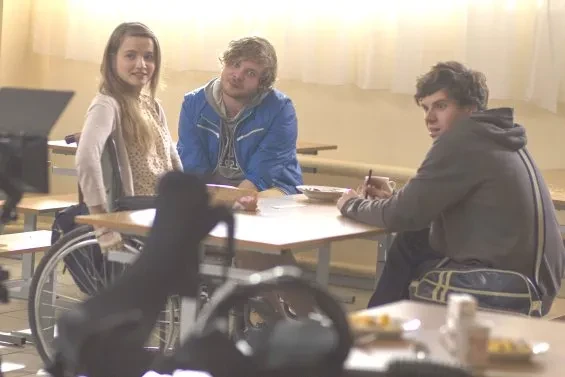
In the Krasnopresnensk art school is the shooting of the Class Class, the film based on the book of Ekaterina Murashova. The action takes place in the “special” class of the Moscow school, which combined children with disabilities, socially dysfunctional, “mentally inferior”. This same “11-kk” comes to the brand new, Lena Chekhova, whose behavior soon turns her into a white crow and threatens the whole unfriendly team with great problems.
Now she froze before the commission - a fragile girl in a wheelchair, a mother stuck near a chair nearby. The Terrible Court is about to issue a verdict: is Lena Chekhova worthy to continue studying at school? Or will the stroller return to "home schooling"?
The assistant quickly rinses the floor. The shooting begins. The boy in sports pants is the 23-year-old director Ivan Tverdovsky, a bullet flies out of the class to the corridor and already from the monitor gives instructions to the operator: whom we “take”, at whom we are holding the look at what pace we are “moving”.
Our players actually do not see the topic of disabled people point blank. Needless to say: in the current race for a box office-a “unprofitable” topic. The conspiracy of silence was violated by Ivan Solidovsky and producer Natalya Mokritskaya. According to Vani, they went far from the book, but approached reality.
Ivan Tverdovsky :
-In the early 1990s, specialized schools began to cover, where teachers who have a medical education taught, collective individual training programs were developed. We decided to save, and at a regular school to form special classes for children with “deviations”, where ordinary teachers who read brochures about the training of disabled people taught. With a “contingent” collected in a heap in the 11th grade, they were engaged in folding numbers! What is the correction, individual approach! They made sumps where they drove everyone who have some kind of violations: glue boxes, collect switches ... In general, they deliberately turned off any abilities of the teenager. We are making a movie about such an artificially created ghetto, about the first love in such an ugly “interior”.
- The plot partly resembles the "scarecrow", did Bykov’s picture affect you?
- Undoubtedly. When Masha Pozhayeva, playing Lena Chekhov, was moving in character, they said about Lena Bessoltseva from the "stuffed". This is the eternal problem of conflict of general thought and different thought.
-In our cinema, the themes of people with disabilities are traditionally afraid due to a complex balance between social order and conjuncture.
- For me, disabled people are officials who arranged this “reform”, having driven living, often capable of people into a camera with a grille, invisible, but crippling. Which cannot be overcome. In Moscow, the situation is not as nightmare as in the province.
- So, this is not only a film, but also an attempt to influence the existing practice of isolation of disabled people from society. It is monstrous when children are deprived of hope for prospects, for the future. By the way, Pavlov, the portrait of which hangs at school, spoke about the second signaling system as the possibility of orientation in the world around him. And his book was called the Reflex of Freedom.
- When we reflect on the problems of people with disabilities, we try to arouse tolerance in ourselves. Due to many circumstances, our brain is not very ready normally and not to perceive not like us people. The main thing is not to say that you need to be tolerant. It is important - not to feel the inner gap, superiority. We just have to protect them. And for this you need to know: who and why do you protect? Understand their internal problems.
- That is, with the help of cinema, to leave the outer name row to the inner, sensual space ...
- Undoubtedly. Our story is about people who were literally twisted into a canning bank. Everything is done to turn off the outside world, turn off all feelings.
- How can you turn off feelings?
- Since you are disabled, you are forbidden to suffer, love, hate, feel. Why is it normal in the graduation class of a regular school, when the boy kisses the girl, and in the correction class for medical reasons, is this prohibited? “Love is badly affects the psyche ...” and other crap of the dog.
- Did this topic arise in your life not by chance?
- In elementary school, I almost ended up in such a class. I had health problems. My parents saved me. Any of us could be there, they could cut the wings to anyone.
- Your short films have become known, thanks to the experimental form. In the "dog buzz" you mixed documentary style and playing almost without a seam. Will this film also shoot?
- No, there is a playful movie here, a lot is tied to the actors. I would like to get a strong emotional charge out of them.
- Does the debutant experience professional fear in full meter?
- But it doesn’t matter to me at all, a short or full meter, advertising, documentary cinema, playing ... just different methods - the return is still maximum.
During a short break, I get acquainted with the actors of the Gogol Center-Philip Andreev and Nikita Kukushkin, playing adolescents in love with Lena Chekhov.
Philip: In the theater, I already had the experience of reincarnation into special people. In the “Hero of our time” he played a blind boy, in “idiots” activists pretend to be demented.
Nikita: And everywhere I have the roles of people with deviations from the norm, with a shift. When I came to the samples, the cruelty of my stage character from the play “Brothers” still lived in me, the director saw this.
Philip: Here Vanya says: "Do not justify the hero." But I am still instinctively looking for internal logic, I must feel, understand the nature of betrayal ...
Nikita: Unlike my hero, I would overcome my egoism, fear, I would talk to Lena. I did something. And he, having felt the pain, was frightened, pretended that there was no betrayal at all. So, he will drag his whole life this burden.
- You work on the set not only with professional partners, but also with not very healthy people.
Philip: In the work, in the relationship we did not have any barrier.
Nikita: Yes, they are the most real, compared to me ... with us. There are few real people in the world. Here's a problem!
- It seems that the Optina Elders belong to the wisdom of the disease that captures a person to awaken a falling out soul. What is the authenticity of these people?
Nikita: They do not know how to lie, do not fake.
Philip: This is a natural existence beyond the boundaries of the system of “approximate moral coordinates”, in which we are dissolved so much that we do not notice the “approximately”. They are honest in front of them ...
Nikita: They do not manipulate anyone and nothing. Their defect-painful is the most important problem of life. Unlike us, it seems to be healthy, who have all the problems in their heads. We are overlapping with mustard complexes, launched far -fetched difficulties.
- Is it possible to say that for you this work and this communication has become a kind of correction?
Nikita: Of course. I wanted to equal them. It is important for me that there are such people. Real. Night -hearted. When you just see the soul.
Classmates of Lena Chekhova are played by young people who have passed the "Correction class" themselves. We get acquainted.
Alexander Stronichev: My character Sasha is from the breed of people who never interfere.
Irina: My heroine, with all her might, wants to get out of this “special class”. He tries to study well at the limit in order to get a norm in life normally. Naturally, she condemns Lena Chekhov, because because of her everyone may not go through the commission.
Boris: I play Boris Levitan. Imagine what name they came up with me. Although I do not draw and my voice is not set. My Levitan is seemingly unsociable, loner. But the herd feeling captures when everyone is united against a classmate: “She got alone, and answer everyone!” Why? We were never told what self -sacrifice, mutual understanding, sympathy are. Lena Chekhova shouts that they treat us like animals ... But how to understand this if I have not seen another? This is normal for us. And when we throw her alone in the class, we rejoice for ourselves: we were released.
- You speak in the first person. What is the distance between your heroes and you?
Boris: Of course, there is a distance. To be different unusual.
Irina: I also studied at home - I studied in a special school for the disabled under the home program. She could only communicate with the teacher. I also do not want someone to interfere with break out ... I understand my heroine. And to me ... it's difficult with her. I would really like my Irina to apologize. I am so sorry for Lena Chekhov, I understand that we are acting with her. Although for adolescents is it not familiar to hand over each other?
- You have experienced a “feature” of correctional classes. What is the problem of such school "Harlems"?
Boris: They are too closed.
Sasha: You gradually get used to it, dissolve in this detached world.
Boris: I do not agree. When you leave the closed -type school, a similar class, you get into a completely different environment, you feel awkward. You just don’t know how to behave with people. How to react when you are examined ... When they laugh at you? The problem of vacuum, gap, certainly exists. And we do not know how to overcome her ...
Perhaps the "Class Class" will reduce this distance?