
Translated material
Bronze Western
The unique role of a cowboy myth is not associated with history, but with the psychology of America, which Remington was able to portray. His best work became an American icon and was awarded a place in the oval office
That America, where the Chekhovsky Chechevitsyn dreamed of escaping, was a country where they “drink instead of tea jin”, where “the earth is trembling when a herd of bison runs through the pampas”, where “Mustangs kick and laugh.” All this was discovered by Mine Reed, American adults - Western. Long before they appeared not only in the cinema, but even in books, artists took up the image of the Wild West, or rather sculptors. The bronze age of Westerna, preceding the paper and celluloid, and became the object of the exhibition in the Museum of Metropolitan.
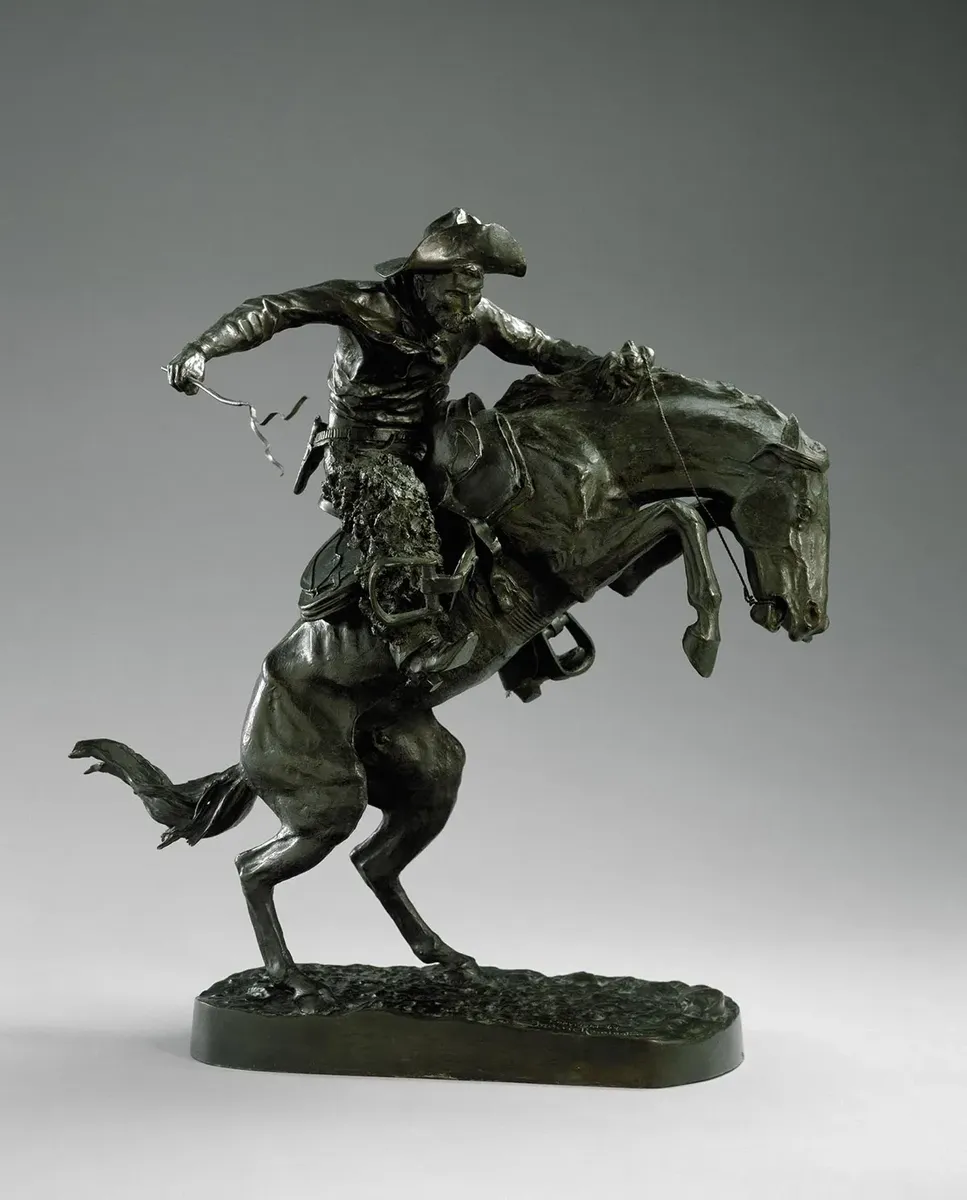
Sculpture Frederick Remington
That America, where the Chekhovsky Chechevitsyn dreamed of escaping, was a country where they “drink instead of tea jin”, where “the earth is trembling when a herd of bison runs through the pampas”, where “Mustangs kick and laugh.” All this was discovered by Mine Reed, American adults - Western. Long before they appeared not only in the cinema, but even in books, artists took up the image of the Wild West, or rather sculptors. The bronze age of Westerna, preceding the paper and celluloid, and became the object of the exhibition in the Museum of Metropolitan.
Unlike a monumental sculpture that decorates (or frightening) areas and squares, bronze figurines were chamber. Allowing relatively inexpensive replication of the original, they turned out to be an indispensable part of a decent situation in American apartments of the 19th century. Like birds in a cage, such sculptures did not live outside, but inside, representing the domesticated part of the virgin nature. Each composition served as a desktop memorial to the West with its Indians, bison, cowboys and freedom to the horizon.
This myth was distinguished by the fact that more or less corresponded to reality from America. That is why it was so difficult to capture him from the Old World. Those who have passed the European (usually Italian) school did not know the language who was suitable for describing the fresh, not yet exhausted by the art of the reality of another, as if that seemed to fall off the heaven of the continent. Faced with a new challenge, the artists were forced to retreat into the distant past and change the wild west into an ancient outfit.
“Opening America,” art announced, “we went back on our own history. The distant West is a tunnel into the past. Through it we can fall to the origins of our world. Indians are the Achaeans of the Iliad. Mighty, fearless and sad, like all epic heroes, they again leave the arena of history.
The task of the American artist is the same as Homer: to capture the appearance of the disappearing world into edification to future generations. I must admit that the sculpture could not cope with this task. Its Indians are more likely to recall museums than prairies. Perfectly, like ancient gods, they are combed in Renaissance fashion, shoot from onions like Apollo, hunt like Artemis, fight like Achilles, and die like a hector.
The animals of the New World were better than the natives to European sculptors, especially the bison. And it’s clear - why: they amazed fantasy. Once, when I was driving along the northern outskirts of the state of New York, I happened to see the steep snowy hills, wandering along the fence of a farm, trying to breed them into meat. Near and at the openier, the bison seemed prehistoric creatures. Like dinosaurs in the barn, they did not fit into agriculture. It was such that they were depicted by a sculpture. Having discarded smooth antique models, the artist created an expressionist portrait of the Native American West, to which the furry mountains of bison served as a temple and an idol.
Only having destroyed the indigenous America, the country discovered new heroes - cowboys. The most famous of them was Theodor Roosevelt, although few less than him approached this role. A native of an old Dutch family, the future president was born in New York, on the 14th Street. In this museum of the house, everything is given out by a well -established, respectable, quite bourgeoishair: crystal, piano, bust of Plato. Roosevelt, however, potting his political ambitions, went west and started a ranch. A stranger in this environment, he suffered from ridicule: because of his glasses, he was called a "four-eyed cowboy." Defending dignity, Roosevelt participated in cowboy duels. But having achieved recognition in the West, he carefully protected the secret of a 20-kilogram chest, where he kept his favorite books. It is unlikely that real cowboys would approve the habit of reading the same Iliad for the night.
Carefully choosing a mask for himself, Roosevelt loved her. One of the first to create literary westerns, he announced that it was in the cowboys that the ideal character of the American is embodied: the independence of behavior, independence in judgments, stubborn persistence in achieving the goal, the ability to survive, relying only on himself.
The first cowboys appeared in Texas at the beginning of the 19th century, when there, as, however, now, there were a lot of free pastures for cattle. To distill huge herds hired experienced riders, usually Mexicans, mulattos or blacks. For each herd of 2500 goals there was a dozen cowboys, who led a difficult nomadic life, which seemed romantic only to the townspeople from the eastern coast.
At first, there was nothing specifically American in the figure of a cowboy. The same character in similar conditions arose in South America, in the endless pampas of Argentina and Uruguay. This is the shepherd shepherd with their colorful folklore and a kind of outfit (poncho, soft boots, a bright belt with a mate tea spaced to it). Moreover, the cowboys were in the old world. I saw them on the southern outskirts of France, in Kamarg. In this still the shellless area of the salty swamps of the mouth of the Rona, wild white horses, direct descendants of a prehistoric horse have been preserved. These European Mustangs go around the Provencal riders, calling themselves "Gardiens." They consider themselves the first cowboys to export this image to the New World along with all its attributes, including the famous blue jeans.
In other words, the unique role of the cowboy myth is not associated with history, but with the psychology of America, which the most famous artist Frederick Remington managed to portray in textbook sculptures. His best work became an American icon and was awarded a place in the oval office of the White House.
Most of all, Ronald Reagan liked this half -meter composition. An excellent rider, he knew how to evaluate the bronze dance of a man with a horse, which the artist himself called the "bypass of Bronko." On the semi -domestic slang of the cowboys “Bronko” - a word denoting a horse that has not yet known the reins. The same can be said about the cowboy, going around the stallion. Helped and cheeky, they are even like externally. Both are caught by the author at the time of dynamic balance, which may end in the fall of both.
A strut for sculpture, the posture reveals the hidden meaning of the masterpiece. The metaphor of the Wild West is on two legs, and both are horsepower. If the bronze Indians are elegian (sunset sunset), then cowboys live in a short present, in an intermediate state between the reckless will and the inevitable civilization. It is not surprising that the horse stood on its hind legs.
The horse is one of the most ancient symbols of the unconscious, spontaneous. Only by curbing this powerful and obstinate beginning, a person subjugates the destructive forces both in the external and in the inner world - in himself. Exceptional geographical circumstances - the youth of the American fate - overturned an archaic myth in modern history. In her context, the cowboy myth plays in the vastness of the Wild West the mystery of the birth of order from chaos. As every lover of westerns knows, the best sheriffs come out of lonely cowboys.
But in addition to the historiosophical interpretation, the plot of “man in the saddle” has a very specific, domestic meaning.
The sculpture of Remington, which studied the life of cowboys in Montana and Kansas, tells about riding everything that you wanted to know, but did not dare to experience.
I understood this, only having met Icelandic Mustangs. Brought 1000 years ago by the Vikings, they never left the islands. In the summer, Icelandic horses live unattended in the mountains, in winter they languish in the stables and are happy to get out for a walk - on their own, not our conditions. Without realizing all this, I first climbed into the saddle and immediately regretted it. From the side and on the screen it seems to you that the reins can be held by controlling the animal like a bicycle. In fact, a harness is needed in order to connect a person with the beast more like an electric or telepathic connection. It allows the horseman to transfer impulses, which in my case were exhausted by fear. I instantly realized this, the horse went with a gallop and to the river, not frozen only because of a frantic course. Enjoying freedom, both did not pay attention to me and did the right thing, because I still could not find out how to intervene in the process, not to mention stopping it. Left to myself, I tried to just sit in the saddle. It was as difficult as dancing in canoeing. Any movement caused an unforeseen reaction with equally dangerous consequences. Through the horror (and thanks to him!) It dawned on me that the horse riding is not violence, but a symbiosis of two will. A person’s parity with a horse is not harmony, but unifying a struggle, like poles in a magnet.
The moment of truth returned me alive to the stable and helped to deal with the bronze western.
A cowboy needs an unheard of horse to use the energy of freedom, and the sculptor is to capture the zenith of the West. Still wild, he attracted those who civilized and killed him. A short respite of progress gave us a chance to survive the excitement of a prehistoric fight with nature. Cowboy on a horse, like a Matador without spectators, fights with it alone on equal terms.
The excitement of this fight for the second century feeds the world with raw emotions. But if the myth of cowboys turned out to be durable, then they themselves were enough for a short while. The railway and barbed wire took their jobs, except, of course, the one that showed by show business.