
Translated material
Dream Exhibition
In the capital, IV Moscow International Biennale of Young Art is taking place - one of the most significant art events of the season.
In the capital, IV Moscow International Biennale of Young Art is taking place - one of the most significant art events of the season.
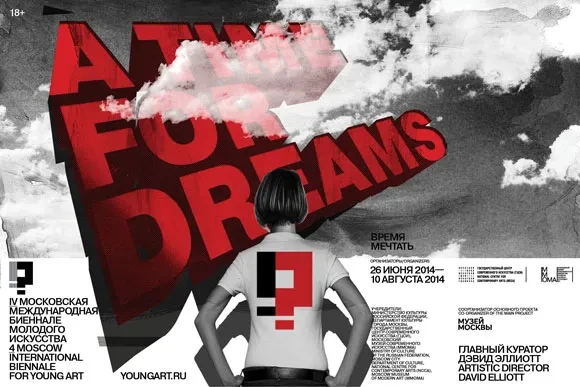
For a large -scale project, the chief curator of Biennale David Elliot chose the topic - “Time to Dream”. The young generation is characterized by dreaming of the perfect and beautiful, their views on life are not “stained” irreparable mistakes, and the infantile hopes for the perfect world still live in their hearts. To believe, hopes to dream - this truism is an unspoken manifesto of the Biennale of young art. About 3,000 thousand people throughout the year sent their work to curator David Elliot, of which he took 83 artists from different countries for the main project, whose work corresponds to the theme of Biennale and the age framework (people under 35 could participate in the project).
“Time to dream” is a topic that is closely intertwined with the most famous speech of a fighter with segregation in the USA Martin Luther King “I have a dream”. King’s epoch -making performance is a step towards freedom, justified by idealism and invincible power of the spirit. “I dream” - words that push new achievements in those days when conflicts and cataclysms play the main role on the stage of life. Martin Luther King said: “I dream today!”, And modern young artists dream today.
In the two huge halls of the Moscow Museum (a platform for the main project of the IV Biennale), work is represented, where each of the artists in his own way presented his own world of dreams: someone has a utopian and infallible, and for some it is an arena where anti-utopia is confused by monstrous reality. Passing the halls of the exhibition, you first get lost in a series of exhibited works, the meaning of which has to be guessed by yourself (no explication is provided). But as the proverb “the farther to the forest, the more firewood”, and at the exhibition, each subsequent work finishes the visitor's performance about the topic of Biennale.
The word "dream" causes associations with something beautiful, but on the Biennale, dreams are refracted by reality, under the oppression of which even the most rainbow dreams turn into crazy obsession. Video "end of the industrial era" by Vladimir Logutov is one of the first exhibits at the exhibition. The name of the work speaks for itself: ruins, in the place of which panel houses will be built in the future. But while the video sequence is a protracted present, the staticity of which scares and repels. The continuation of the concept of Logutov is the installation of Vladimir Chernyshev and Artem Filatov “Empty House”. Their work is a distorted house, the boards for which artists gathered in villages near Nizhny Novgorod, where they lived in childhood. “Empty House” is an apotheosis of the decline of the traditional culture of Russia. In the same hall there is the work of the Thai artist Praotype Suthathogthai “Product: Medallion” from the series “Holy Production”. Medallions with the faces of the saints were located on a huge board: the talismans, who used to be a sacred attribute, today play the role of commercial products set on the conveyor.
The exhibition exposes the problems that have named in society: "Look and dream of preventing this horror." Time to dream of making our world better - so you can clarify the motto of the David Elliot project. In addition to the thematic component of Biennale, the curator set the task of opening new names and creating a space to generate new ideas and strategies.
In addition to the main project in the Moscow Museum, the exhibition includes a strategic project and three programs: special, parallel and educational. The expositions can be viewed at almost all exhibition venues of the capital: GCSI, MMOM, IPSI, the Center for Contemporary Art Winzavod, the Institute of Media, Architecture and Design "Strelka" and so on.
As part of a special program, the Winzavod hosts the exhibition “One place near another”, the curators are Anastasia Shavlokhova and Lucas Topfer. Four components of modern reality are huddled in the gloomy space of a large winery, in the halls of which there are expositions. The exhibition halls drawn dashed lines that connect the ideological parallels of the exposition: nature, technology, power and anarchy. In the basement of the Center for Contemporary Art, the Vinzavod series of graphic works “Herbarium” Ilya Dolgova (a symbol of admiration for unbridled nature) met with sixteen soldiers of riot police - the installation of Julius von Bismarck (metaphor of unlimited power and strength). And the art group “ZIP” with its work “The Third Lagoon” (materialized anarchy) mimicated at the visualized speed of the sound of Karsten Nikolai “334 m/s”. Vinzavod halls focus on the relationship of ideas in the space of reality.
Each of the programs of Biennale has their own topic, which either complements the main one, or is its continuation. So “Time to Dream” - all summer.
Ksenia Kulyasova