
Translated material
If the breasts are in "Crosses"
The famous prison is changing a residence permit. There should be a museum in the buildings left
The famous prison is changing a residence permit. There should be a museum in the buildings left
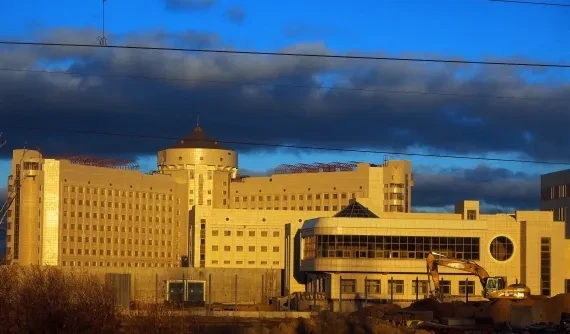
Photo: TASS
The institution of-47/1 main management of the penalties of the Ministry of Justice of Russia in St. Petersburg and the Leningrad Region-the “Crosses” noted throughout the country-received a new building and will soon leave the historical center of the city.
The criminals and deputies of the First State Duma, dissolved by Emperor Nicholas II, artist Kazimir Malevich, historian Lev Gumilev and aircraft designer Andrei Tupolev, poet Nikolai Zabolotsky and future Marshal Konstantin Rokossovsky, actor George Zhzhenov and writer Daniil Kharms, were sitting within the walls of this prison. Lev Bronstein, after the imprisonment in the Crosses, took a pseudonym, under which the whole world knows him - Trotsky, as his beloved prison overseer was called. Fantastic shoots were made from the “Crosses”, horror stories told about them, but the real situation in them, especially in the Soviet period, was worse than the most terrible fairy tale.
Now the “Crosses” begin a new period of their history - in a new place, in a new building. And again they will become the largest prison of Russia, and possibly Europe.
The first five buildings of the future prison complex have already been handed over, the rest are still being completed, but now the hostel for household services, designed for 280 people, laundry, production workshops and kitchen are handed over, and employees of the pre -trial detention center begin work. Prisoners will begin to be transferred to the new isolator only in 2016.
In total, a whole prison town is located in a 35 hectare with a six -meter fence - with multi -storey regime buildings, where there are cameras for 4 thousand prisoners, with a hostel for staff, administrative and economic buildings, an investigative department, a nurse, a dining room and a sports complex for employees. All regime buildings are combined into a single system, which can be moved by without going outside, in addition, elevators are installed in the multi -storey buildings of the new “crosses”. And this is the first pre -trial detention center in Europe with current elevators in which prisoners will be transported. According to Gennady Kornienko, the head of the Federal Penitentiary Service of the Russian Federation, the new investigative insulator "will be the largest not only in Europe, but also in the world, and even American prisons will not be compared to the new insulator in Kolpino." At the same time, as promise in the service of the penalties, each prisoner will account for at least 7 square meters. meters excluding the area of the bathroom - such norms of detention are adopted in Europe.
Two main buildings with cameras are built, as well as historical, in the form of crosses. The internal layout will be similar to the previous one: four corridors, which are visible from the center of the building deep and up, from the first to the last floor. Each building is designed for 1792 people. There is another prison building in which there are 146 single cameras. According to the new concept, not only the under investigation will be in the “Crosses-2”: convicts who filed appeals against court decisions will serve the term.
Historical “Crosses” were built at the end of the 19th century by the architect Tomishko on an analogue of American prisons. At that time, it was the largest and most comfortable prison in Russia: 960 cameras were designed for 1150 people. The prisoners were allowed to take books and some comfort objects with them: the story is known as Vladimir Nabokov, the father of the famous writer, who found himself in the “Crosses” in 1904 after the dissolution of the First State Duma, brought his bath there. It was possible to order lunch from a neighboring restaurant in the camera if the prisoner had money. The doors of the cameras (if they were not criminals) during the day were open and prisoners could communicate with each other.
With the coming to the power of the Bolsheviks, the life of prisoners in the “Crosses” very quickly turned into a nightmare, which lasted all the next decades: crowded cameras, disgusting food, lack of serious medical care, normal ventilation in the cells. During the period of large terror, from crowded cameras of the “Crosses”, thousands of the NKVD arrested according to the ordering were taken out for execution. During the years of the blockade, the “Crosses” turned into a mass grave: the prisoners practically did not feed, many of them went crazy or, falling from hunger into hopeless despair, finished their lives of suicide, and the employees themselves, mostly old people and women who were in a barracks, were dying of exhaustion. In February 1942, Daniil Harms, arrested six months before, died in a psychiatric hospital “Crosses”.
After the war, communications were changed in prison buildings, but, in fact, the living conditions in the “Crosses” practically did not change. During the years of perestroika in the cells of the pre -trial detention center, for a maximum of two prisoners, 15–20 people sat at the same time.
“In the“ Crosses ”in the mid-70s I began to come as an operative, an investigator,” says Alexander Kozlik, a lawyer, an honored lawyer of Russia. - The insulator was then crowded in the same way as later, during the years of perestroika. Some of the premises were generally closed due to complete unsuitability, people slept in turn in the cells, they did not make repairs there. Then he experienced all this on himself: three years ago I was arrested, spent many months in the "sailor silence", in the "Crosses". Here we sat four in the cell for seven and a half meters, you go to the toilet, you hang the curtain, there is nothing to breathe, the walking courtyards are like cages. We fed terribly, we prepared soup ourselves, tea with a conventional heater. Walks - an hour a day, washed down once a week. The situation acted oppressively - it was actually psychological pressure on the under investigation. The insulator is the same place where you need to place those who are really dangerous for society, and we have a little that they are immediately hidden in the insulator. Now law enforcement agencies use an opinion in a pre -trial detention center to break a person, to obtain consent from him to the option that the investigator offers. And many broke, admitted what the investigators were waiting for.
Alexander Abramovich managed to prove the illegality of his arrest, he even achieved the payment of compensation for moral damage and published the book “Diary of the Head of the investigation from Sailor Silence”, in which he described the life and customs of Russian pre -trial detention centers.
“Recently, once again I was on excursions in the Peter and Paul Fortress,” Alexander Kozlik told Novy Novaya. -I looked at the royal casemates-in 200 years in Russian prisons, nothing has changed, the twins-brothers of the “crosses”.
The fact that the “crosses” have not been responding not only to modern standards of detention of prisoners, but elementary ideas about humanism, a lot was said, but only in 2006 it was decided to build a new pre -trial detention center in Kolpino, a suburbs of St. Petersburg. And now the most urgent question that arose before the city in connection with the crossing of the “crosses”: what will happen to historical buildings and the entire territory located in the very center of St. Petersburg? They talked about hotels, business centers, that the buildings that are an architectural monument will most likely put up for auction that the Museum of Crosses will move to Moscow, to Butyrka. At the presentation of the new “Crosses” Oleg Korshunov, Deputy Director of the Federal Penitentiary Service of Russia, said that the old building could be given the Federal Penitentiary Service of the Russian Federation for St. Petersburg and the Leningrad region to accommodate the administration. Now the divisions of the penalty service are occupied by 9 buildings in the center of St. Petersburg, and it would be worth uniting them in one place. But, according to many Petersburgers, this place must be preserved as a museum.
“This is a monument of history, one of the most powerful, the most St. Petersburg,” says director Alexander Sokurov. - This place should become a memorial, here it is necessary to make a monument to imprisonment in Russia. I'm afraid that if the FSIN takes this building, they will begin to rebuild it and destroy the monument. Because it is impossible to live and work in these walls - this is the place of suffering of millions of people! There is nothing to touch, from there people should just leave and leave the buildings - as in hospitals - for ventilation. Historical ventilation for long-long years. The souls of the people destroyed there will still be hung over this place for a long time.
According to Anatoly Razumov, an employee of the Russian National Library, the head of the Center “Returned Names”, “Crosses” can become part of a large museum complex.
“I have been offering this idea for a long time,” says Anatoly Razumov. - Nearby Trinity Square with Solovetsky Stone, the Peter and Paul Fortress with its places of the first Soviet executions. In fact, this is a whole museum complex in which some buildings of the “Crosses” should be included in an integral part.