
Translated material
The price of the transaction
The price of the transaction. So far, the Kremlin and on the old square analyze the results of the elections to regional parliaments, determining which of the party “legs”, “United Russia” or “Fair Russia” will be the main one, while in the same offices they decide whether or not to be democrats - the Union of Right Forces or the newly -minted “civilian force” - among deputies of the next State Duma, the democratic flank is prepared to take one of the last way one of the way The oldest parties are the Party "Apple". In the latest elections to regional parliaments, the aximal result of Yablochikov is 3.8% of the vote, almost twice as lower than those 7% that are necessary for passing the 2007 Duma.
Ilya Barabanov
(based on the "Faust" Goethe)
Analyzing the pre -election layouts on the eve of the regional elections, political analyst Dmitry Badovsky said that for Yabloko this is the last chance to catch on a train of deputy mandates that was leaving in December 2007. Removing the “Yabloko” list in St. Petersburg actually crossed out these chances. The failure that happened on the day of voting finished the party completely. In the Murmansk region, the Democrats could not even recapture the election pledge without crossing the three percent barrier. In the Moscow region, the presence of the famous State Duma deputy Galina Khovanskaya did not help at the head of the list of the famous deputy of the State Duma. The result is 3.8% of votes 1 .
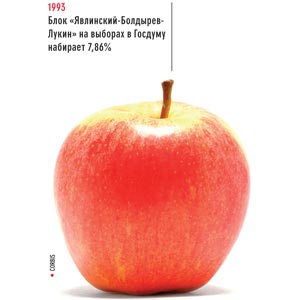
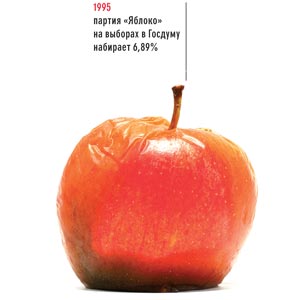
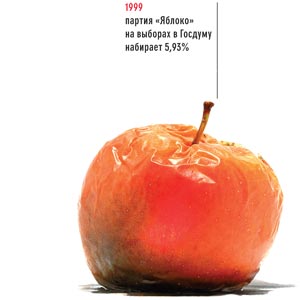
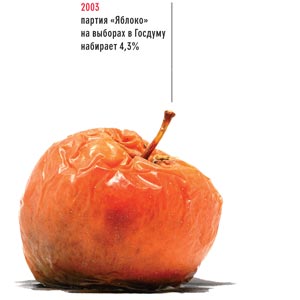
Having good chances at one time, the “Yabloko” could not become a party in power. The party fell into the State Duma twice: in 1995 and 1999. In 1993, in the first convocation of the Russian parliament, the Yavlinsky -Boldyrev -Lukin block was held, on the basis of which the party was founded in 1995, which gained almost 7% of the vote in the very first elections (6.89). Four years later, the five percent barrier was already overcome with great difficulty. About 4 million voters cast their votes for the Democrats, which amounted to 5.93%. In 2003, it was not possible to get into the apple parliament, like their colleagues in the democratic flank from the ATP.
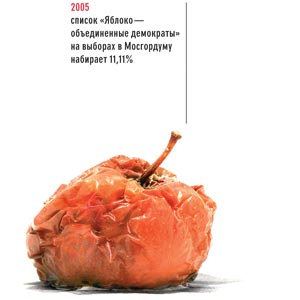
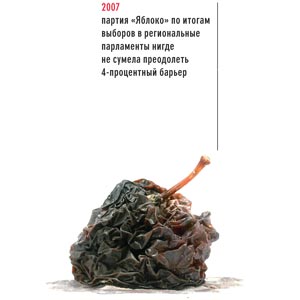
“Everything was bought on credit,
- And there are a lot of creditors " -
After the main sponsor of Yabloko, the head of Yukos, Mikhail Khodorkovsky, was sent to the colony of the city of Krasnokamensk, the Chita region for eight years, Yabloko became bad not only with the support of the population, but also with financial resources. A series of failed elections to regional parliaments only confirmed information about the lack of access to serious sources of financing. A positive shift seemed to have happened when the “Yabloko” with the ATP agreed on a joint campaign in the elections to the Moscow City Duma. Having created a single list on the basis of Yabloko and overcoming a nine percent barrier, the democrats began negotiations on the unification of the two parties. Throughout 2006, Grigory Yavlinsky and Nikita Belykh managed to breed his parties in the regional elections, supporting each other, and financial support went from ATP to Yabloko. At the same time, according to the sources in the leadership of the party, the democrats began to help the metallurgical group "Evraz" and the financial and industrial consortium "Alfa-Group". The financing of the opposition party with these associations went with the approval of the Kremlin and the presidential administration. Salaries increased among employees of the party apparatus, and the leadership of Yabloko, they say, managed to agree with the old area on the conditions under which democrats will continue their existence.
“The devil puts you
- Golden trap " -
The leadership of Yabloko has always refuted rumors about negotiations in the presidential administration. However, the sources of The New Times at the top of the party talk about three completely clear conditions that the deputy head of the presidential administration, Vladislav Surkov, set before the Democrats. Yabloko financing could continue if the party:
- refuse to create a single democratic coalition with ATP;
- It will not support the idea of a boycott of the elections, on the contrary, not questioning the legitimacy of the procedure, will participate in all elections (although the Kremlin reserved the right, under certain circumstances, the “Yabloko” is removed from the elections);
- denies the possibility of a party to enter the opposition coalition “Another Russia”.
"High spirit,
- My priceless bail " -
The deal, however, turned out to be by no means equal: despite the fact that the party’s leadership tried to comply with the conditions proposed by it, the funding allocated to the Kremlin was enough and only enough for the symbolic content of the apparatus, but by no means for large -scale political activities.
One way or another, having received financial resources and an approving nod from the presidential administration, Yabloko still abandoned the unification with the ATP. Nikita Belykh, the voices of others, truth, tried to say something that the leaders would return to negotiations on the possible combination of the two parties of the democratic flank after the elections to regional parliaments, but last week Grigory Yavlinsky, the leader of Yabloko, on the air of Radio “Freedom” quite peremptorly declared a new party strategy and the refusal of further negotiations with the right.
In an interview with The New Times, this position was confirmed by the first deputy chairman of Yabloko Sergey Ivanenko. “The elections do not comply with democratic standards,” he said, adding that the federal government does not affect the election results in the regions and all troubles - from local authorities.
In December, when the new composition of the State Duma will be elected, regional authorities will not decide anything. “We will continue to participate in the elections,” Ivanenko promised, disagreing that the party had already lost all prospects. Along the way, the deputy chairman of Yabloko denied information about negotiations with the presidential administration and the party financing by the Evraz and Alfa Group group. “Basically, money comes to us from the budget, plus private donations, plus businessmen,” Ivanenko explained. “But I can’t call these businessmen the names of these businessmen and I don’t comment on these rumors.”
“I will show
- A bloody receipt ... " -
The leader of the ATP Nikita Belykh, unlike his colleagues from Yabloko, is ready for further negotiations. “It’s more convenient for me not the death of the“ apple ”, but our association,” Belykh said. The leader of the right confirmed that the ATP provided “Valoko” “impressive financial assistance” in those regions where the right ones during the 2006 campaigns shot their lists in favor of the lists of the Yavlinsky party. True, in any of the regions, Yabloko was unable to go to the parliament on his own. At the same time, the whites are sure that, having achieved a certain success in the March elections, the Union of Right Forces managed to “run up the new face”. In the meantime, opponents of the ATP, meanwhile, argue that the right -wing conditions were set as the “Yabloko”, and at least two of the three points of the “abstract named after Vladislav Surkov” completed the ATP. Namely: he categorically did not support the idea of a boycott of the elections, although the heads of the party with the lips of Nikita Belykh and admitted that “eliminating the threshold of the minimum turnout, a ban on criticism during the election campaign - all this actually means the abolition of the elected process”, and publicly condemned the practice of street policy “Another Russia”.
Whether the right fate of Yabloko will repeat, it will become known as a last resort in December. However, some conclusions can be drawn after the April elections to the Parliament of the Krasnoyarsk Territory, which is considered an indicative region: statistics indicate that the results of elections in the region are then largely repeated in the elections to the State Duma.
Meanwhile, in Yabloko itself they recognize: the party has almost finally turned into a puler party that could only take away the voices from others (as happened in the elections to the Legislative Assembly of St. Petersburg in March), while having no own prospects.
Life years
It was not for nothing; clear before me
The final conclusion of the wisdom of the earth:
Only that is worthy of life and freedom ...
The ending, however, is known even to schoolchildren.
____________________________
1 similar indicator, 3.64% of the vote, the Democrats received in the Republic of Komi.