
Translated material
Queue to Europe
Schengen opens the boundaries. Will the Russians are among the first?

Whether Russia will be among the countries with which the European Union will restore a normal message from July 1 is not yet clear. Apparently, it will take some time before the Russian owners of Schengen visas will be able to freely come to the EU, and Europeans - to Russia. But it is likely that Russia will not be the last.
After an epidemic of coronavirus, the European Union opens the boundaries even with a guide of the original schedule. Passport control at the internal borders is removed from Monday, June 15, and from July 1, the European Commission proposed to gradually cancel the ban on optional trips through external lines of the EU since March 17.
First, only with elected countries based on more or less defined criteria. They were designated on Thursday by the European Commissioner of the Interior Ilva Johansson.
Let me remind you - this is only a recommendation. Only government government, not Brussels, have the right to make such a decision. But everyone perfectly understands the imperative, dictated by the Schengen space: a foreigner who arrived in it can move between the Narva and Canars, without showing the passport. And the governments of the EU countries will make a decision all together for each individual foreign country. They must coordinate the general list of countries whose citizens are ready to let in Schengen.
So far, certainty only in the Western Balkans. Although these countries are not EU members, they are actually considered their own.
This is not “abroad”, but countries with a “European perspective”: Albania, Bosnia and Herzegovina, Kosovo, Northern Macedonia, Serbia, Montenegro. Serbia and Kosovo are listed separately. Doesn't matter. Once they will be in the same union.
Also, Norway, Denmark, Iceland and Finland have already announced that from June 15, citizens will be allowed to freely move between the countries of the region. Restrictions are still preserved only for Sweden.
The European Commission recommended when taking restrictions on external borders to take into account three criteria for each foreign country. This is the epidemiological situation and measures taken against the epidemic of coronavirus; the ability to provide an EU citizen on a trip, holding the spread of the virus; Reciprocity, that is, the abolition of this country of its restrictions on traveling EU citizens.
In Brussels, it is believed that restrictions should first be removed from countries whose epidemiological situation is similar to the EU average and where there is sufficient potential to combat the virus. Restrictions should remain in force for countries, which are worse than in the EU.
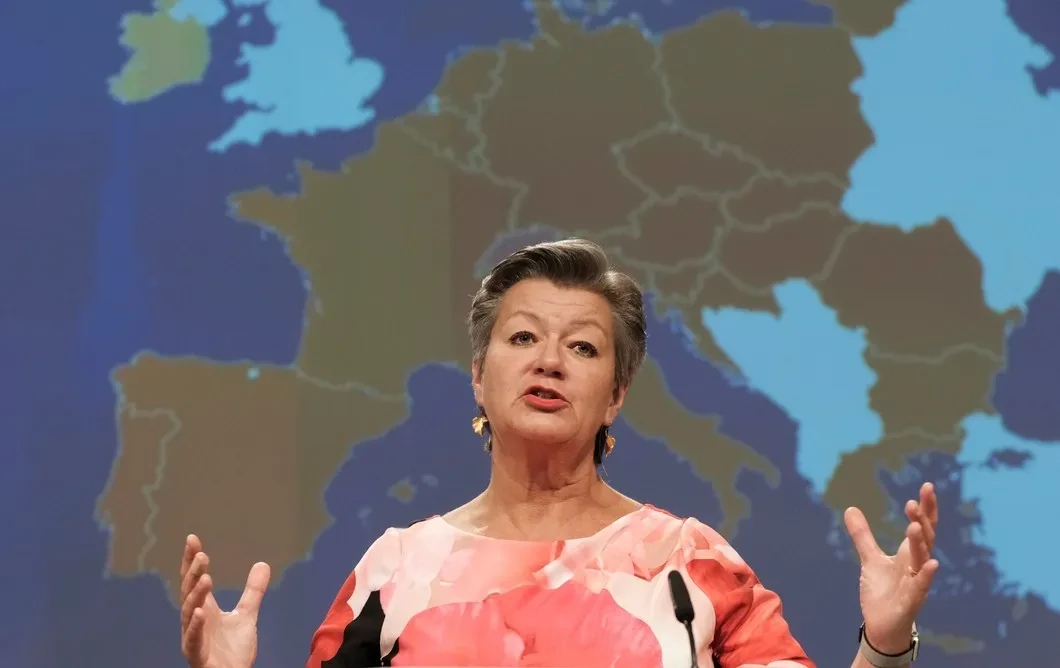
Since they will evaluate according to the European Center for Prevention and Control of Diseases (ECDC) and WHO, the chances of Russians may be higher than, say, Americans. Although if a distrust of Russian statistics has recently prevailed, then the shooter of sympathy can swing the other way.
Neither Ilva Johansson itself, nor its representatives on the press relations with the press began to evaluate Russia's chances to include in one of the first groups of countries opening to the EU.
For third countries, in relation to which restrictions are still in force, the European Commission proposes to expand the categories of those who are allowed by trips, including, for example, students, qualified workers, the personal presence of which is necessary on the spot.
Here Brussels recommendations, in principle, do not differ from the approach of Moscow, which allowed traveling abroad for a “good reason”,
Including study, work and treatment.
Those who do not have a Schengen visa or it ended can send an application to the embassy or visa center. The European Commission recommended EU members to synchronize the renewal of visa operations with the abolition of travel restrictions.
The recommendations of the European Commission include all members of the Schengen Convention (including Bulgaria, Croatia, Cyprus and Romania, which are not really included in the Schengen space) and associated members of Schengen (Liechtenstein and Switzerland). Only 30 countries. Visas for entry into the EU are required by citizens of 105 countries of the world. At normal, they are issued 15 million a year.